Taking command of your finances is the cornerstone of a secure and prosperous future. 🏡 Budgeting isn’t just about tracking numbers; it’s a proactive strategy that empowers you to understand where your money goes, minimize wasteful spending, and pave the way towards achieving your most ambitious financial dreams. 🌟 Whether you’re dreaming of homeownership 🏠, planning for a comfortable retirement 🏖️, building a robust emergency fund 🛡️, or simply seeking to increase your savings rate, the right budgeting approach can be a game-changer. In this comprehensive guide, we’ll explore 10 distinct and effective budgeting methodologies, helping you find the perfect fit for your unique lifestyle and financial aspirations. Let’s dive in! 👇
Choosing the right budgeting strategy is like selecting the best tool for a job. 🛠️ Just as different tasks require different implements, varying financial objectives necessitate tailored approaches to money management. For instance, someone meticulously planning for retirement might benefit from a strategy that emphasizes long-term growth and consistent contributions, whereas a freelance artist with fluctuating income might thrive under a more flexible and adaptive system. There isn’t a one-size-fits-all solution; the most effective budget is one that aligns seamlessly with your personal circumstances and goals. 🌱
The Undeniable Power of a Well-Crafted Budget 💡
At its core, a budget acts as your financial compass, guiding every dollar earned towards its intended destination. Instead of the dreaded end-of-month mystery of ‘where did my money go?’, a budget allows for intentional allocation. This deliberate planning unlocks a cascade of benefits:
-
- Enhanced Spending Control: Gain crystal-clear insight into your spending habits, enabling you to make conscious choices about where your money goes. 🧐
-
- Accelerated Savings: Systematically set aside funds for your goals, whether it’s a down payment, a dream vacation, or your rainy-day fund. ☔
-
- Fortified Financial Security: Build a robust safety net to weather unexpected storms, such as job loss or medical emergencies. 🏥
-
- Swift Progress Towards Goals: Achieve your financial milestones, from paying off debt 💳 to saving for a major purchase, with greater speed and efficiency. 🚀
-
- Reduced Unnecessary Debt: Make informed decisions that prevent the accumulation of high-interest debt. 📉
-
- Accelerated Wealth Accumulation: Lay a solid foundation for long-term financial prosperity and build lasting wealth. 📈
The journey to financial well-being starts with finding a budgeting method that resonates with you and that you can consistently implement. Let’s explore the options! 👇
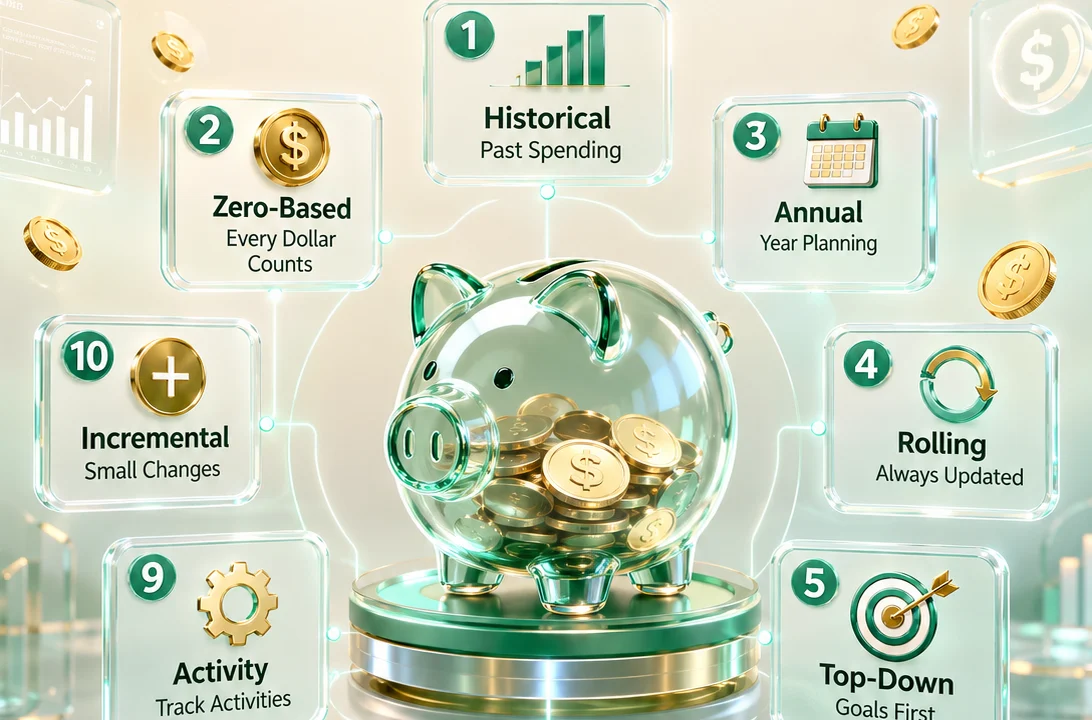
1. Historical Budgeting: Learning from Your Past 🕰️
What is it? Historical budgeting leverages your financial records from previous periods to forecast and plan for the future. It’s about understanding your established spending patterns to make informed decisions moving forward.
How it works: Instead of creating a budget from scratch, you’ll review past income, expenses, and savings data. You then adjust these figures based on anticipated changes, such as inflation ⬆️, potential salary increases 💰, or upcoming new expenses. It’s a retrospective approach to forward-thinking.
Ideal for:
-
- Individuals with a consistent and predictable monthly income. 💼
-
- Families whose expenses tend to remain relatively stable month-to-month. 👨👩👧👦
-
- Businesses with well-established and predictable operating costs. 🏢
Advantages:
-
- Ease of Preparation: It’s often the simplest method to get started, especially if you have good financial records. ✅
-
- Data-Driven Insights: Relies on actual financial data, making it grounded and realistic. 📊
-
- Time Efficiency: Significantly reduces the time needed for initial budget creation compared to starting from zero. ⏱️
Potential Drawback: If past budgets included inefficient or unnecessary spending, historical budgeting might inadvertently perpetuate those habits unless actively reviewed and corrected. 🧐
2. Zero-Based Budgeting: Every Dollar Has a Job 💯
What is it? Zero-based budgeting (ZBB) is a rigorous method where every single dollar of your income is assigned a specific purpose. The goal is for your total income minus all allocated expenses, savings, and investments to equal zero. 💰➡️ 🎯
How it works: At the start of each budgeting period (typically monthly), you meticulously allocate every incoming dollar. This means assigning funds to categories like savings goals, housing 🏠, food 🍎, transportation 🚗, education 🎓, entertainment 🎉, and investments 📈. Nothing is left unassigned.
Ideal for:
-
- Individuals aiming to save aggressively and maximize their savings rate. 🏆
-
- Those undertaking detailed debt repayment plans. 💳
-
- Newcomers to budgeting seeking a structured and disciplined approach. 🤓
Advantages:
-
- Eliminates Waste: Forces you to justify every expense, significantly reducing or eliminating wasteful spending. ✂️
-
- Intentionality: Cultivates a mindset of conscious financial decision-making for every dollar. 🤔
-
- Maximizes Savings: Helps identify and funnel more money directly into savings and investment accounts. 🌟
Consideration: This method requires diligent tracking and regular monthly adjustments to remain effective. It’s a hands-on approach! 💪
3. Annual Budgeting: Planning for the Long Haul 🗓️
What is it? Annual budgeting extends your financial planning horizon to a full year, rather than focusing solely on monthly cycles. This approach is invaluable for anticipating and managing larger, less frequent expenses.
Typical Annual Expenses to Consider:
-
- Educational tuition fees 📚
-
- Major home maintenance or repairs 🛠️
-
- Annual vehicle insurance premiums 🚗
-
- Planned vacations and travel ✈️
-
- Holiday gift shopping 🎁
-
- Significant business investments or capital expenditures 🏢
Ideal for:
-
- Individuals and families engaged in long-term financial planning. 🔮
-
- Businesses requiring a strategic overview of their finances for the year ahead. 📈
Advantages:
-
- Superior Forecasting: Allows for more accurate predictions of financial needs over an extended period. 🔮
-
- Improved Cash Flow Management: Better planning for periods of higher expenditure. 🌊
-
- Simplified Goal Setting: Makes it easier to set and track progress towards ambitious yearly objectives. 🎯
Challenges: Unexpected financial events or market shifts can necessitate mid-year adjustments. Flexibility is key! 🤸
4. Rolling Budgeting: Always Forward-Looking ➡️
What is it? Rolling budgeting is a dynamic system that continuously updates your financial plan. Instead of a static annual document, a new budgeting period (usually a month or quarter) is added as the current one concludes, ensuring your budget is always current and relevant.
Example: As January draws to a close, February becomes the focus, and a new month is added to the end of the planning horizon. This maintains a consistent 12-month forward view.
Ideal for:
-
- Freelancers and gig economy workers with variable income streams. 👨💻
-
- Growing businesses that experience frequent changes and opportunities. 🚀
-
- Individuals whose income or expenses fluctuate significantly. 🎢
Advantages:
-
- Up-to-Date Accuracy: Always reflects the most current financial conditions and projections. ⏰
-
- Enhanced Flexibility: Allows for agile adjustments as circumstances evolve. 💨
-
- More Realistic Forecasts: Provides a more accurate picture of future financial needs. 💯
Drawbacks: This method demands consistent oversight and frequent updates to maintain its effectiveness. It requires an ongoing commitment! ✍️
5. Top-Down Budgeting: Goals First, Details Second 🎯
What is it? Top-down budgeting starts with overarching financial goals and then strategically allocates resources to specific spending categories to meet those objectives. The philosophy is to define the destination before mapping the route.
The Core Question: Instead of asking, “How much can I afford to spend on X?”, the primary question becomes, “What is my ultimate financial goal?”
Example: If your primary objective is to save 20% of your annual income, you would first allocate that 20% to savings. The remaining 80% is then distributed across essential and discretionary spending categories.
Ideal for:
-
- Individuals who are highly goal-oriented and motivated by targets. ⭐
-
- Organizations and businesses that need to establish strategic budgets aligned with overarching objectives. 🏢
-
- Those seeking a quicker method for initial financial planning. ⚡
Advantages:
-
- Goal Alignment: Ensures that all spending decisions are in service of your most important financial objectives. ✅
-
- Simplified Decision-Making: Streamlines the process of prioritizing spending. 👍
-
- Disciplined Planning: Encourages a focused and intentional approach to financial management. 🧘
Limitations: If the initial goals are unrealistic, the resulting budget may become challenging or impossible to adhere to. Setting achievable targets is crucial. 🎯
6. Bottom-Up Budgeting: The Power of Detail 🔍
What is it? Bottom-up budgeting builds your financial plan from the ground up, starting with granular estimations of every single expense. All these detailed figures are then aggregated to form the complete budget. This method offers exceptional accuracy due to its foundation in real-world spending.
How it works: Rather than setting an overall budget figure first, you meticulously estimate the cost of each individual expense. This includes items such as:
-
- Utilities (electricity, water, gas) 💡
-
- Rent or mortgage payments 🏠
-
- Groceries and dining out 🍎
-
- Transportation costs (fuel, public transit, maintenance) 🚗
-
- Phone and internet services 📱
-
- Educational expenses 🎓
-
- Healthcare costs (premiums, co-pays) 🏥
-
- Insurance premiums 🛡️
The sum of all these individual estimates forms your total budget.
Ideal for:
-
- Individuals who want a highly detailed and accurate financial picture. 📊
-
- Businesses with numerous departments, each requiring precise budgeting. 🏢
-
- Families who need to track every expense meticulously. 👨👩👧👦
Advantages:
-
- Exceptional Accuracy: Provides a highly realistic and precise financial plan based on actual needs. 💯
-
- Enhanced Spending Visibility: Offers deep insight into where every dollar is being spent. 👀
-
- Easier Cost Identification: Facilitates the identification of areas where spending can be reduced. ✂️
Limitations: This method is inherently more time-consuming, as each expense category requires individual review and estimation. It demands thoroughness! ⏳
7. Stability Budgeting: Prioritizing Security 🛡️
What is it? Stability budgeting places paramount importance on safeguarding your financial future rather than maximizing current spending. It prioritizes building emergency funds, increasing savings, ensuring adequate insurance coverage, and covering essential living expenses before allocating funds to discretionary purchases.
The primary goal: To reduce financial risk and build a robust foundation of long-term financial security and resilience.
Core Priorities:
-
- Building and maintaining an emergency savings fund. 💰
-
- Consistent contributions to retirement accounts (401(k), IRA). 📈
-
- Covering essential living expenses (housing, food, utilities). 🏠
-
- Ensuring comprehensive insurance coverage (health, auto, home). 🏥
-
- Aggressively paying down debt. 💳
Ideal for:
-
- Families seeking a secure financial footing. 👨👩👧👦
-
- Conservative investors who prioritize capital preservation. 🏦
-
- Individuals bracing for economic uncertainty or significant life changes. 🌍
Advantages:
-
- Builds Financial Resilience: Creates a strong buffer against unexpected financial shocks. 💪
-
- Encourages Consistent Saving: Fosters a disciplined habit of regular savings. 💯
-
- Reduces Financial Stress: Provides peace of mind knowing you’re protected. 😌
Challenges: By emphasizing protection, stability budgeting might leave less room for luxury purchases or spontaneous entertainment. It’s about prioritizing the long game. 🎯
8. Growth Budgeting: Investing in Your Future 🚀
What is it? Growth budgeting is an investment-focused approach that allocates a significant portion of your resources towards opportunities that are likely to increase your future income or long-term value. Instead of solely focusing on cost reduction, this method emphasizes strategic investment in areas with high growth potential.
Key Investment Areas:
-
- Professional education and certifications 🎓
-
- Business expansion initiatives 🏢
-
- Marketing and advertising campaigns 📢
-
- Acquisition of new technology 💻
-
- Diversified investment portfolios 📈
-
- Skill development and training 🧠
Ideal for:
-
- Entrepreneurs and business owners aiming for expansion. 🌟
-
- Investors focused on capital appreciation. 💰
-
- Career-driven professionals looking to enhance their earning potential. 💼
Advantages:
-
- Fuels Long-Term Income Growth: Directly invests in avenues that can increase your earning capacity. ⬆️
-
- Promotes Strategic Investing: Encourages thoughtful allocation of resources for maximum return. 📊
-
- Accelerates Wealth Building: Focuses on creating assets and opportunities for future prosperity. 💎
Considerations: Growth investments often require patience and time before yielding significant or measurable financial returns. It’s a marathon, not a sprint! 🏁
9. Activity-Based Budgeting: Value-Driven Allocation ⚙️
What is it? Activity-based budgeting (ABB) links financial allocations directly to the specific activities that generate expenses. Instead of relying on historical spending data or broad categories, ABB assigns funds based on planned actions and their expected outcomes. This approach illuminates where money is truly being utilized and whether that usage creates tangible value.
Example: Instead of simply allocating a fixed marketing budget, ABB would determine spending based on specific, planned marketing campaigns, associated advertising activities, and their anticipated results. The budget is driven by action, not assumption.
Ideal for:
-
- Businesses seeking to optimize resource allocation and efficiency. 🏢
-
- Organizations managing complex projects with distinct phases and costs. 🏗️
-
- Companies focused on continuous improvement and waste reduction. ♻️
Advantages:
-
- Identifies Inefficiencies: Pinpoints unnecessary or low-value activities contributing to expenses. 🎯
-
- Improves Resource Allocation: Ensures resources are directed towards activities that generate the most value. ✅
-
- Supports Smarter Decisions: Provides data-driven insights for more strategic financial choices. 🧠
Challenges: This method demands meticulous planning and ongoing data analysis to accurately link activities to costs and outcomes. It requires diligence and attention to detail. 🧐
10. Incremental Budgeting: Small Adjustments, Big Picture ➕
What is it? Incremental budgeting is a straightforward approach where the previous budget serves as the baseline, and adjustments are made by adding or subtracting small increments for the upcoming period. It avoids the often-arduous task of rebuilding the budget from scratch each time.
Example: If your monthly grocery budget last year was $400, an incremental budget might adjust it to $425 this year to account for moderate inflation. The change is incremental, not revolutionary.
Ideal for:
-
- Households with relatively stable spending patterns. 🏠
-
- Government organizations with established budget cycles. 🏛️
-
- Mature businesses with predictable operations. 🏢
Advantages:
-
- Speed and Simplicity: It’s a quick and easy method to implement and maintain. ⏱️
-
- Ease of Maintenance: Requires less effort than creating a completely new budget. 👍
-
- Predictable Planning: Offers a degree of certainty in financial forecasting. 📊
Limitations: This method can sometimes overlook significant inefficiencies or failing to adapt to major shifts in financial priorities, as adjustments are often minor.
Choosing Your Perfect Budgeting Match 🤔
The selection of the ideal budgeting method hinges on a few key factors: your financial objectives 🎯, the stability of your income 🌊, and your preferred planning style 🧠. There’s no single correct answer, but understanding these core elements will guide you to the most effective strategy.
Ask yourself:
-
- Is my income consistent, or does it fluctuate unpredictably? 🎢
-
- Am I saving for a specific, tangible goal? 🏆
-
- Do I need to gain tighter control over my spending habits? 🧐
-
- Is my primary aim to grow my income or business? 🚀
-
- Is ensuring long-term financial security my top priority? 🛡️
Here’s a quick snapshot to help compare:
| Budgeting Method | Best Suited For |
|---|---|
| Historical Budgeting | Stable, predictable spending patterns. |
| Zero-Based Budgeting | Maximum control and aggressive saving. |
| Annual Budgeting | Long-term financial planning and goal setting. |
| Rolling Budgeting | Variable income and dynamic financial situations. |
| Top-Down Budgeting | Goal-oriented planning and strategic alignment. |
| Bottom-Up Budgeting | Detailed expense tracking and accuracy. |
| Stability Budgeting | Prioritizing financial security and risk reduction. |
| Growth Budgeting | Investing in future income and long-term value. |
| Activity-Based Budgeting | Identifying and eliminating wasteful spending. |
| Incremental Budgeting | Simple, quick annual updates for stable budgets. |
Navigating Common Budgeting Pitfalls ⚠️
Even the most sophisticated budgeting method can falter if common mistakes are made. Be mindful of these potential traps:
-
- Overlooking Small Expenses: Daily coffees or impulse buys add up significantly over time. ☕
-
- Forgetting Irregular Costs: Annual subscriptions, car maintenance, or holiday gifts need to be factored in. 🎁
-
- Setting Unrealistic Goals: Overly ambitious savings targets can lead to discouragement. 😔
-
- Infrequent Reviews: A budget is a living document; it needs regular check-ups. 🗓️
-
- Neglecting an Emergency Fund: Life is unpredictable; an emergency fund is non-negotiable. 🆘
-
- Post-Goal Overspending: Relaxing your budget too much after hitting a milestone can undo progress. 🎉
-
- Incomplete Tracking: Only monitoring income without tracking expenses leaves a significant gap. 📊
By consciously avoiding these common errors, you can build a budget that is both realistic and sustainable. 💯
Final Thoughts: Your Path to Financial Empowerment 🚀
A truly effective budget isn’t about restriction; it’s about making deliberate, informed choices that align with your deepest financial aspirations. Whether you resonate with the meticulous detail of Bottom-Up Budgeting, the disciplined structure of Zero-Based Budgeting, the adaptive nature of Rolling Budgeting, or the forward-thinking potential of Growth Budgeting, the most successful approach is the one you can consistently embrace and follow. ✨
Commit to regularly reviewing your budget, be prepared to adapt it as your life circumstances evolve, and keep your eyes firmly fixed on the prize: long-term financial health and freedom. The small, consistent efforts you make in managing your money today will undoubtedly blossom into greater financial confidence and security for years to come. 🌱💰🌟