
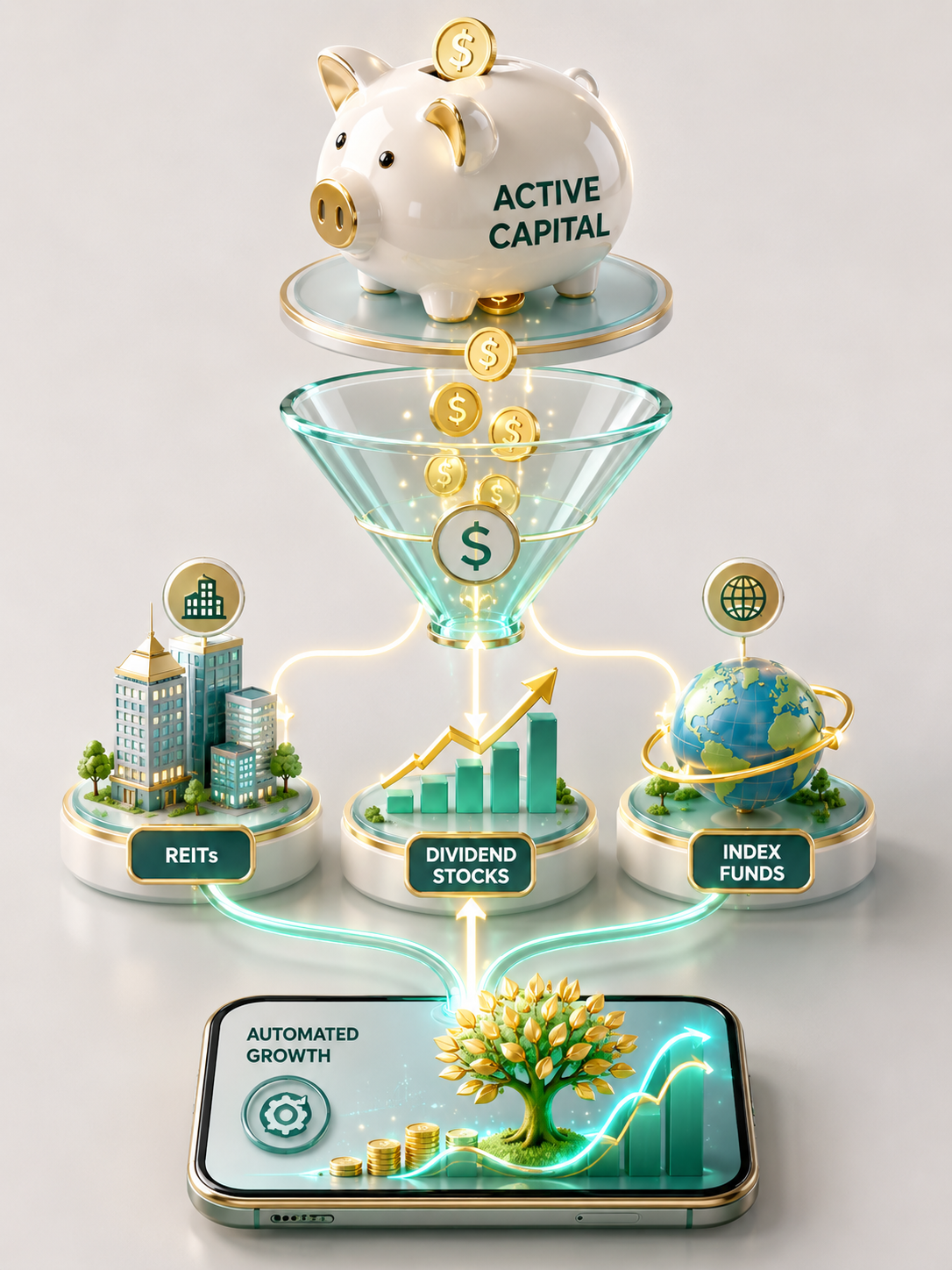
Have you ever wondered what it would be like to wake up, check your financial accounts, and see that you have earned money while you slept? The concept of passive income often feels like a distant dream or a marketing gimmick, but for those who understand the mechanics of wealth, it is a tangible, achievable reality. The secret to financial independence isn’t necessarily working harder or logging more hours at your desk; it is about transitioning from trading your precious time for money to building a system where your capital does the heavy lifting for you.
Many individuals operate under the assumption that the only way to get ahead is to climb the corporate ladder or start a high-stress business. While these paths can lead to wealth, they are constrained by the physical limits of the 24-hour day. To achieve true liberation, you must cultivate an engine that operates independently of your daily labor. In this guide, we will explore the professional frameworks and asset classes that allow you to transform savings into a self-sustaining stream of income.
The Architecture of Passive Income
Before deploying your capital into the markets, it is vital to understand the fundamental difference between speculative growth and cash-flow-oriented investing. Most amateur investors are lured by the idea of ‘buying low and selling high.’ While this can certainly build a net worth, it creates a ‘liquidity trap’—you only realize your gains when you sell the asset, which means your income stops the moment you stop owning the investment.
Passive income investing is entirely different. The core objective here is systematic capital allocation. You purchase assets—stocks, real estate, or funds—specifically designed to distribute profits to you on a consistent schedule. This creates a cycle where your initial labor produces capital, that capital produces assets, and those assets produce recurring revenue. Over time, this revenue can be reinvested, creating a compounding effect that accelerates your path to financial freedom.
Premier Asset Classes for Consistent Cash Flow
To construct a resilient income engine, you need to diversify across assets that are proven to generate reliable payouts. Relying on a single source of income is the fastest way to jeopardize your financial security. Here are the most effective vehicles for building your portfolio.
1. The Power of High-Yield Dividend Stocks
When you purchase shares of a dividend-paying corporation, you are effectively becoming a partner in a business that views you as an owner entitled to a portion of its profits. The most desirable stocks in this category are known as ‘Dividend Aristocrats’—companies that have not only paid dividends but have increased them consistently for 25 years or more. These companies represent stable, mature businesses that prioritize shareholder value, making them the cornerstone of a conservative income portfolio.
2. Leveraging Broad-Market Index Funds and ETFs
If you prefer to avoid the stress of picking individual stocks, Exchange-Traded Funds (ETFs) offer an excellent middle ground. By purchasing an index fund, you gain exposure to hundreds or thousands of companies at once. Many ETFs are specifically engineered to track high-yield sectors, providing you with a diversified stream of dividend payments. Because these funds are passively managed, they usually come with very low expense ratios, ensuring that your net returns remain as high as possible.
3. Real Estate Investment Trusts (REITs)
Real estate is a classic wealth-building tool, but managing physical property—dealing with leaky roofs, late-night tenant calls, and unexpected maintenance—is rarely ‘passive.’ REITs provide a solution by allowing you to invest in large-scale commercial and residential properties via the public stock market. Because of their unique legal structure, REITs are required to distribute at least 90% of their taxable income to shareholders as dividends. This makes them one of the most efficient ways to achieve high-yield real estate exposure without the logistical headaches of property ownership.
The Implementation Framework: A Step-by-Step Approach
Building a machine requires a blueprint. If you attempt to rush the process, you risk making emotional errors that could set you back by years. Follow this disciplined framework to ensure your portfolio remains on track.
- Step 1: The Safety Net. Never invest capital that you might need for essential living expenses. Establish a liquid emergency fund that covers at least three to six months of living costs. This ensures that you are never forced to sell your income-producing assets during a temporary market downturn.
- Step 2: Automate the Pipeline. Consistency is the silent killer of market volatility. By setting up automated monthly transfers from your paycheck into your brokerage account, you utilize ‘Dollar-Cost Averaging.’ This strategy removes the temptation to ‘time the market’ and lowers your average purchase price over time.
- Step 3: Diversify Across Sectors. Do not put all your capital into one industry. A balanced portfolio should include a mix of dividend-paying stocks, REITs, and fixed-income assets to protect against sector-specific downturns.
- Step 4: The DRIP Advantage. Use a Dividend Reinvestment Plan (DRIP). By automatically using your dividend payouts to purchase additional shares, you trigger the power of compounding. Early on, this growth may seem small, but given enough time, the number of shares you own will grow exponentially, leading to significantly higher passive payouts in the future.
Risk Management and Wealth Protection
Creating a passive income model is not just about choosing the right assets; it is about defending them against the inevitable fluctuations of the market. High yields are attractive, but they can also be warning signs. A company offering a 12% yield might be in financial distress, and the dividend could be cut or eliminated at any moment. Always check the ‘payout ratio’—a measure of how much of the company’s net income is being paid out as dividends. A sustainable payout ratio is generally between 30% and 60%.
Furthermore, consider the role of inflation. Fixed-income assets, such as bonds, can lose purchasing power if inflation rises rapidly. By maintaining a healthy allocation in equities and real estate, you align your wealth with assets that have historically tracked or outpaced inflation.
Growth vs. Cash Flow: The Philosophical Shift
To understand why passive income is the key to lifestyle design, we must compare it with traditional growth investing. Growth investors look for the next big thing, hoping to see a stock price jump 50% so they can sell and lock in the gain. This is an active process—once you sell, you no longer own the asset that generated the gain.
Conversely, cash flow investors treat their portfolios like a goose that lays golden eggs. They focus on the yield, not just the price fluctuations. This creates an environment where you don’t need to ‘quit’ your investment to access the wealth it generates. For those seeking early retirement or financial autonomy, this distinction is paramount. You aren’t building a pile of money to spend down; you are building a stream of cash that supports your lifestyle indefinitely.
Avoiding Common Traps
Even the best-intentioned investors can fall into predictable traps. Avoid ‘portfolio churning,’ which is the act of constantly buying and selling based on daily news cycles. Every time you trade, you likely incur taxes and transaction fees, which act as a massive drag on your long-term returns. Passive investing is a game of patience. Let your assets sit, compound, and mature.
Also, beware of high management fees. Always review the expense ratios of the funds you hold. Over 20 or 30 years, an extra 1% in fees can cost you tens of thousands of dollars in potential growth. Opt for low-cost, broad-market index funds whenever possible.
The Psychological Freedom of Passive Income
The ultimate goal of building a passive income engine is not necessarily to buy a yacht or a mansion; it is to buy your time back. When your investments generate enough to cover your basic living expenses, your entire relationship with the concept of ‘work’ changes. You are no longer tethered to a position out of financial necessity. You gain the freedom to pursue work that you find meaningful, to travel, or to dedicate time to the people who matter most.
This is the true measure of wealth. A person who earns $50,000 a year from their investments is arguably ‘wealthier’ than a person earning $200,000 who is completely dependent on their stressful, 80-hour-a-week job to maintain their lifestyle. True wealth is the ability to walk away from any situation that does not serve your life’s purpose.
Conclusion: Start Your Engine Today
The journey to financial independence is rarely a sprint; it is a marathon of consistency and smart decision-making. By starting today, even with modest amounts of capital, you set the wheels of compounding in motion. You don’t need a fortune to get started—you only need the discipline to start, the wisdom to choose cash-flowing assets, and the patience to watch your system grow.
Are you ready to stop working for every dollar you earn? Take the first step by mapping out your income portfolio, identifying the assets that align with your risk tolerance, and setting up your automated investment pipeline. Your future self will thank you for the decisions you make today.
Frequently Asked Questions
What exactly is passive income in an investing context?
Passive income refers to cash flow that you receive on a recurring basis without having to spend your own time managing the underlying asset. Once the initial investment and research are complete, the capital takes over the work.
Are dividend stocks risky?
All investing carries risk, but dividend-paying stocks are generally considered more stable than speculative growth stocks. By focusing on established companies with a long history of increasing payments, you can significantly mitigate risk.
Can I start with very little money?
Yes. Many modern brokerage platforms offer fractional shares and automated, low-cost investment plans that allow you to start with as little as a few dollars, making passive investing accessible to everyone regardless of their initial bankroll.
What is the best way to protect my income from taxes?
Consider using tax-advantaged accounts such as IRAs or 401(k)s. Depending on your jurisdiction, these can allow your dividends to grow tax-free or tax-deferred, significantly increasing your net returns over the long term.
How often should I check my portfolio?
Passive investing is meant to be hands-off. Checking your portfolio once every quarter or once a year for rebalancing is more than enough. Excessive checking usually leads to emotional decision-making, which can harm your returns.


