Embarking on the journey to build lasting wealth isn’t solely about boosting your income. It’s equally crucial to identify and sidestep those insidious financial habits and external forces that quietly diminish your long-term prosperity. From the relentless march of inflation and the crushing burden of credit card debt to the subtle creep of lifestyle inflation and the pervasive issue of chronic procrastination, each of these obstacles can significantly hinder your financial growth over time. 📈 By understanding precisely how these wealth killers operate, you empower yourself to make more astute financial decisions, safeguard your purchasing power, trim unnecessary expenditures, and cultivate sustainable wealth-building practices. This comprehensive guide delves into the four most significant threats to your personal finances, elucidates their far-reaching consequences, and offers actionable strategies to conquer each one. Whether you’re just beginning your financial adventure or looking to refine an existing plan, recognizing these common financial missteps is paramount to fortifying your financial security and accelerating progress toward your future aspirations. Remember, small, consistent improvements often yield far more substantial results than sporadic, drastic overhauls, making disciplined financial habits one of the most valuable assets you can cultivate. ✨
Which Financial Foe is Draining Your Coffers the Most? Let’s Unpack It.
Wealth doesn’t evaporate in an instant. More often than not, it’s gradually eroded through a series of seemingly minor financial decisions, prevailing economic trends, and ingrained habits that compound negatively over the years. While many individuals fixate on increasing their earnings, diligently protecting the wealth you already possess is of equal, if not greater, importance. 🤔
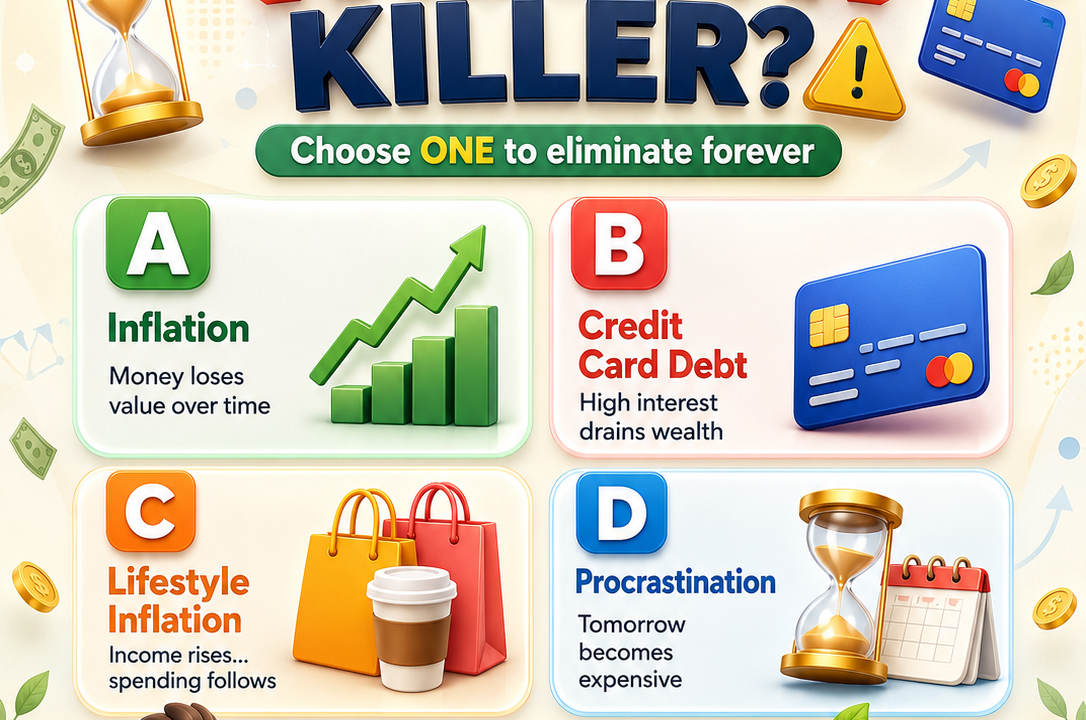
Consider this simple, yet profound, question: If you could banish one major financial obstacle from your life forever, which single change would have the most profound positive impact on your long-term wealth accumulation? The answer, perhaps surprisingly, isn’t as straightforward as it might initially appear, as a multitude of distinct factors silently chip away at financial success. This insightful guide meticulously examines four of the most significant wealth killers and explains why gaining a deep understanding of each one is the key to unlocking smarter, more effective financial planning. 🔑
💸 Deciphering the Nature of Wealth Killers
Wealth killers are essentially financial challenges or circumstances that actively diminish your net worth, impede the growth of your investments, or create insurmountable barriers to achieving long-term financial freedom. Some of these forces are external, lying largely beyond your direct control, while others stem from your everyday financial behaviors and choices. 🎯 The earlier you can identify these detrimental obstacles, the more effectively you can mitigate their impact on your financial well-being.
Let’s explore the four principal wealth killers that demand your attention:
- 🌍 Inflation: The insidious force that silently erodes your purchasing power.
- 💳 Credit Card Debt: The relentless drain of high interest that actively works against your financial progress.
- 🛍️ Lifestyle Inflation: The paradox where a higher income doesn’t necessarily translate into greater wealth.
- ⏳ Procrastination: The most overlooked, yet incredibly costly, financial habit.
Each of these factors exerts its influence on your finances in unique ways, but collectively, they possess the power to significantly shape your financial future. 🔮
🌍 Inflation: The Silent Thief of Your Purchasing Power
Inflation is one of those rare financial phenomena that touches virtually everyone, regardless of their income level or financial strategy. In essence, as the general price level of goods and services rises over time, the purchasing power of your money inevitably declines. This means that the same amount of money you held yesterday will buy fewer goods and services today than it could before. 🛒
For illustrative purposes, imagine a savings account that yields a meager interest rate. If the rate of inflation significantly outpaces the return your account is generating, your money is actually losing real value over time. Over the span of many years, this seemingly small, gradual decline can cumulatively and substantially diminish the overall value of your wealth. 📉
Why Inflation Demands Your Attention
- 💸 Savings Depreciating: Your hard-earned savings lose their purchasing power, meaning they can buy less over time.
- 📈 Rising Living Costs: The everyday expenses of maintaining your lifestyle become increasingly costly.
- 🏠 Escalating Necessities: Essential items and services like housing, healthcare, and education become significantly more expensive, stretching your budget.
- 📉 Future Goals Receding: Achieving your long-term financial goals, such as retirement or a down payment on a home, will require a larger sum of money than initially anticipated.
Strategic Approaches to Mitigate Inflation’s Impact
- 💹 Invest for Long-Term Growth: Seek investments that have historically outpaced inflation, such as stocks and real estate, to preserve and grow your capital.
- 🏦 Maintain a Robust Emergency Fund: Having readily accessible cash for unexpected expenses prevents you from having to liquidate investments at unfavorable times, which could be exacerbated by inflation.
- 📊 Diversify Your Investments: Spread your investments across different asset classes to reduce risk and capture growth opportunities that may be less susceptible to inflationary pressures.
- 📚 Continuously Enhance Your Financial Acumen: The more you understand about personal finance and investment strategies, the better equipped you’ll be to navigate economic fluctuations.
While you cannot personally eliminate inflation entirely, its detrimental effects can often be effectively managed and minimized through meticulous and proactive financial planning. 🛡️
💳 Credit Card Debt: The High-Interest Monster Devouring Your Wealth
Credit cards, when utilized responsibly and strategically, can indeed be valuable financial instruments. However, the habit of carrying balances from month to month often transforms them into one of the most rapid conduits for wealth depletion. The exorbitant interest rates associated with credit card debt can cause your obligations to spiral out of control, making repayment an increasingly formidable challenge. Instead of your investments generating positive returns, the money you’ve borrowed begins to generate additional costs, actively working against your financial well-being. 💸
The Perilous Nature of Credit Card Debt
- 💸 Exponential Interest Accumulation: The compounding interest on credit card balances can quickly transform a small debt into a substantial financial burden.
- 📉 Constricted Cash Flow: A significant portion of your monthly income may be allocated solely to debt servicing, leaving less available for savings or discretionary spending.
- 🚫 Diminished Investment Potential: When your money is tied up in high-interest debt, it’s not available to be invested and generate returns that could build wealth.
- 📅 Delayed Financial Milestones: Repaying excessive credit card debt can postpone your progress toward crucial financial goals, potentially by many years.
It’s crucial to understand that even seemingly modest balances can become remarkably expensive when you consistently make only the minimum payments, allowing interest to capitalize aggressively. 🤯
Strategies for Smart Debt Management
- ✅ Aim to Pay Balances in Full: Whenever feasible, strive to pay off your entire credit card balance each month to avoid interest charges altogether.
- 📅 Never Miss Payment Deadlines: Late payments incur fees and can damage your credit score, making future borrowing more expensive. Set up reminders or automatic payments.
- 💰 Prioritize High-Interest Debt: Employ strategies like the debt snowball or debt avalanche method to systematically tackle your most expensive debts first.
- 📉 Avoid Unnecessary Borrowing: Before making a purchase on credit, ask yourself if it’s truly necessary and if you can afford it.
Effectively reducing and eliminating high-interest debt often yields one of the highest guaranteed financial returns available, essentially acting as a risk-free investment in your own financial health. 💪
🛍️ Lifestyle Inflation: The Deceptive Trap of Rising Expenses
Receiving a salary increase or a promotion can be incredibly rewarding and feel like a significant financial win. However, for many, this positive development is immediately followed by an increase in spending, rather than a corresponding boost in savings or investments. This common phenomenon is precisely what we refer to as lifestyle inflation. As your income grows, so too do your expenses, often leaving you with little to no tangible improvement in your overall financial security or net worth. 🤷♀️
Typical examples of lifestyle inflation include:
- 🚗 Upgrading to a More Expensive Vehicle: Swapping a reliable car for a luxury model.
- 🏠 Moving to a Significantly Larger or More Upscale Home: Increasing mortgage payments or rent to match your higher income.
- 📱 Frequent Electronics Upgrades: Constantly purchasing the latest gadgets and devices.
- 👕 Indulging in Luxury Purchases: Buying designer clothing or high-end items simply because you can now afford them.
While it’s perfectly reasonable to enjoy some of the fruits of your labor and occasionally reward yourself, consistently aligning your spending habits with every income increment significantly hinders your ability to accumulate substantial wealth. 📈
How Lifestyle Inflation Stunts Financial Growth
- 📈 Income Increases: Your salary or earnings go up.
- ⬆️ Spending Increases Proportionally: Your expenditures rise to match the new income.
- 📉 Savings Levels Remain Static: Your savings rate doesn’t increase, or even decreases.
- 💼 Investment Opportunities Are Missed: The potential for increased investment contributions is lost to higher consumption.
Over the course of several decades, this pattern can represent hundreds of thousands of dollars in forgone investment growth, a truly staggering opportunity cost. 💰
Strategies to Combat Lifestyle Inflation
- 💵 Allocate a Portion of Every Raise to Savings: Before you even see the extra money in your account, commit a percentage of any pay increase directly to savings or investments.
- 📊 Prioritize Increased Investment Contributions: When you receive a raise, make increasing your contributions to retirement accounts or other investment vehicles your first priority.
- 🎯 Establish Clear Long-Term Financial Goals: Having well-defined goals, such as early retirement or financial independence, provides a powerful incentive to control spending.
- 📝 Meticulously Track Discretionary Spending: Keep a close eye on your non-essential expenses to identify areas where you might be overspending unnecessarily.
True financial freedom is often achieved by maintaining sensible spending habits and prioritizing wealth-building activities, rather than perpetually upgrading your lifestyle. 🌟
⏳ Procrastination: The Stealthiest Wealth Killer of All
Perhaps the most insidiously expensive financial mistake is one that initially costs nothing at all. It often begins with a seemingly innocent phrase: “I’ll get around to it next month.” The act of delaying crucial financial actions can lead to the forfeiture of invaluable time, and in the realm of wealth accumulation, time is one of your most potent allies. ⏳ Whether it’s initiating investments, meticulously crafting a budget, acquiring essential financial literacy, or aggressively paying down debt, postponement inevitably diminishes future opportunities and hinders your progress. 😥
The Hidden Toll of Waiting
- ⏰ Reduced Time for Compounding: Every day you delay investing is a day you miss out on the powerful effects of compound growth, where your earnings start generating their own earnings.
- 📉 Delayed Investment Returns: Starting later means missing out on the potential long-term gains from market growth.
- 💼 Missed Career Development Opportunities: Delaying skill development or networking can impact your earning potential and future career trajectory.
- 💰 Increased Future Savings Requirements: To catch up, you’ll likely need to save significantly larger amounts later in life, which can be much more challenging.
It’s a well-established principle that even modest monthly investments initiated early in your financial journey can ultimately outperform substantially larger contributions made years or even decades later. The power of time and compounding is simply that immense. 🚀
Breaking the Cycle of Delay
- 📅 Schedule Automatic Savings: Set up automatic transfers from your checking account to your savings or investment accounts on payday.
- 💳 Automate Your Investments: If possible, set up automatic recurring investments into your chosen funds or stocks.
- 🎯 Establish Achievable Financial Milestones: Break down large financial goals into smaller, manageable steps to make them less intimidating and easier to start.
- 📖 Continuously Pursue Financial Education: Make learning about personal finance a regular habit. The more you know, the more confident and motivated you’ll be to take action.
Consistent, disciplined action, taken regularly, almost invariably proves more effective and rewarding than attempting to time the market or wait for the ‘perfect’ moment. 🎯
📊 Identifying the Most Dangerous Wealth Killer: A Personal Equation
The answer to which wealth killer poses the greatest threat is highly subjective and depends entirely on your unique personal circumstances. For an individual burdened by crippling credit card debt, the immediate financial pressure and high interest payments might be the most pressing concern. Conversely, another person might find themselves more significantly impacted by the relentless upward creep of inflation, eroding the value of their savings. A high-earner might be unknowingly bleeding wealth through the subtle, yet pervasive, effects of lifestyle inflation, while others might be actively hindering their long-term prospects by delaying crucial investment decisions due to procrastination. 🤯
Each of these factors damages wealth in its own distinct way. However, the most significant and detrimental risk often arises when several of these challenges converge and manifest simultaneously in your financial life. ⚠️
🌱 The Compounding Power of Small Financial Habits
It’s crucial to understand that many significant financial setbacks don’t typically result from a single, catastrophic mistake. Instead, they often develop insidiously from the accumulation of repeated, small decisions made over many years. Conversely, the path to substantial wealth is paved with the same principle applied positively. ✨
Consider these positive examples:
- 💰 Consistent Saving: Regularly setting aside a portion of your income, no matter how small.
- 📈 Regular Investing: Committing to investing a set amount at regular intervals, regardless of market fluctuations.
- 🧾 Adhering to a Realistic Budget: Creating and following a spending plan that aligns with your financial goals.
- 🎯 Annual Review of Financial Goals: Periodically reassessing your objectives to ensure you remain on track.
- 📚 Continuous Learning About Personal Finance: Actively seeking knowledge to improve your financial decision-making.
Small, positive financial improvements become remarkably powerful precisely because they compound over time, leading to significant wealth accumulation. In the same vein, small financial missteps, when repeated year after year, become increasingly expensive and detrimental to your long-term financial health. 📉➡️📈
📌 Cultivating Resilient Financial Habits for Lasting Prosperity
Achieving long-term wealth is rarely a product of sheer luck or a sudden windfall. It is, fundamentally, the result of unwavering, consistent financial discipline and the cultivation of sound habits. Developing these beneficial practices forms the bedrock of a secure financial future, irrespective of external economic conditions. 🏗️
Key habits that contribute to building enduring financial strength include:
- 💼 Living Below Your Means: Consciously spending less than you earn to create a surplus for saving and investing.
- 📊 Investing Consistently: Regularly contributing to investment accounts, leveraging the power of dollar-cost averaging.
- 🏦 Maintaining Adequate Emergency Savings: Having a safety net of liquid funds to cover unexpected expenses without derailing your long-term plans.
- 💳 Managing Debt Responsibly: Prioritizing the repayment of high-interest debt and avoiding unnecessary new debt.
- 📚 Committing to Continuous Financial Education: Staying informed about financial strategies, market trends, and personal finance best practices.
- 🎯 Setting Measurable Financial Goals: Defining specific, achievable objectives that provide direction and motivation for your financial actions.
- 📈 Regularly Reviewing Your Progress: Periodically assessing your financial performance against your goals to make necessary adjustments.
These foundational habits provide a robust financial framework that can withstand economic fluctuations and propel you towards your aspirations. 🏆
🎯 Final Reflections on Safeguarding Your Wealth
The most significant threat to your wealth isn’t always found in the volatile arenas of the economy or the fluctuating financial markets. Often, the greatest challenges arise from the cumulative impact of everyday decisions – the subtle choices we make daily that quietly influence our long-term financial outcomes. 💡
- Inflation relentlessly diminishes the purchasing power of your money.
- Credit card debt creates a formidable headwind, compounding against your financial progress.
- Lifestyle inflation prevents your hard-earned income from effectively transforming into substantial wealth.
- Procrastination, by delaying action, robs you of the invaluable benefits of time and compounding growth.
By developing a profound understanding of these pervasive wealth killers, you are significantly better equipped to make informed, strategic financial decisions and to forge a path toward lasting financial security. While no single strategy can magically eliminate every potential challenge, the consistent application of disciplined saving, responsible spending, prudent investing, and a commitment to continuous learning remain among the most powerful and effective strategies available for both protecting and significantly growing your wealth over time. 🌱💰