Investing 💰 can often seem like a daunting puzzle with its array of jargon, diverse platforms, and a universe of asset choices vying for your attention. But fear not! This guide is your friendly, step-by-step roadmap to embarking on your investment journey with clarity and purpose. We’ll demystify why planting your money’s seeds early is crucial, explore the magic of compound growth in building lasting wealth, suggest initial investment amounts for newcomers, and illuminate the primary investment avenues available. Think ETFs, index funds, bonds, mutual funds, and REITs – all explained simply. Furthermore, we’ll equip you with the essential criteria for selecting the perfect investment platform, from understanding fees and fractional shares to leveraging automated tools and valuable educational resources. You’ll also receive a straightforward, five-step process to define your financial aspirations, fortify your emergency fund, select suitable investments, automate your contributions, and periodically review your portfolio. Finally, we’ll shine a light on common pitfalls first-time investors encounter, such as trying to time the market, chasing speculative opportunities, and succumbing to panic selling. Our ultimate aim is to make investing an accessible, disciplined, diversified, and goal-oriented endeavor, steering clear of speculative predictions. ✨
What is Investing and Why Should You Begin Your Journey?
At its core, investing is the act of deploying your capital into assets with the expectation that their value will appreciate over time or that they will generate ongoing income. It’s a powerful step beyond merely tucking money into a traditional savings account. Investing empowers your money to actively participate in the expansion of businesses, the dynamism of financial markets, the tangible growth of real estate, and other valuable assets. 🌱
For many embarking on this path, the primary hurdle isn’t a lack of investment options; it’s grasping how to initiate this process without exposing oneself to undue risks. A well-thought-out investment strategy is built upon a foundation of clearly defined financial objectives, a suitable time horizon for your investments, a robust emergency fund, and a solid understanding of your personal risk tolerance. 🧭
You Don’t Need a Fortune to Start Investing! 🌟
A pervasive myth about investing is that it’s an exclusive club for the wealthy. The reality couldn’t be further from the truth in today’s landscape! Numerous modern investment platforms have democratized access, allowing individuals to commence their investment journey with remarkably modest contributions. Many platforms even offer the ingenious concept of fractional shares, enabling you to acquire a slice of an individual stock or other eligible investment rather than needing to purchase a full, often expensive, share. The real powerhouse here is consistency, not the ambition to make a massive initial investment. 💪
The Astonishing Power of Compound Growth 📈
Compound growth is where the real magic of wealth accumulation happens. It’s a phenomenon where the earnings your investments generate then go on to generate their own earnings. Instead of just earning returns on your initial principal, your future growth is fueled by both your original investment and the returns you’ve already accumulated. This is precisely why time is such a critical ally in long-term investing. ⏳
Imagine consistently investing even a modest sum over many years. The potential outcome is a portfolio that dwarfs the sum of what you’d achieve by investing the same total amount much later in life. While actual results are influenced by investment performance, fees, taxes, inflation, and market volatility, the underlying principle is undeniable: time and consistent effort are potent catalysts for long-term wealth creation. However, before you unleash this power, ensuring your financial foundation is solid is paramount. 🛡️
How Much Should a Beginner Consider Investing? 🤔
There’s no one-size-fits-all answer to the question of how much to invest. The ideal amount is a deeply personal calculation, factoring in your income, existing expenses, financial commitments, the size of your emergency savings, any outstanding debts, your specific financial goals, and your comfort level with risk. A practical and sustainable starting point is to invest an amount that you can consistently contribute without jeopardizing your essential living expenses. 💵
Build a Strong Financial Foundation First! 🏦
An emergency fund is your invaluable safety net. It provides a crucial buffer to cover unforeseen expenses, preventing you from being forced to liquidate your investments during unfavorable market conditions. For beginners, a sensible financial progression often looks like this:
Establish a robust emergency fund. This is your first line of defense. 🛡️
Address and manage high-interest debt. High-interest debt can act as a significant drag on your financial progress. 💳
Clearly define your short-term and long-term financial objectives. What are you working towards? 🎯
Determine a realistic amount of your disposable income that you can invest regularly. Start small and build momentum. 💰
Plan to increase your contributions as your income grows and your financial stability strengthens. 🚀
The objective isn’t merely to invest as much as possible, but rather to cultivate a sustainable and disciplined investing habit. 🌳
What Are Some Excellent Investment Choices for Beginners? 📊
Beginners have a variety of investment avenues to explore, each with its own risk profile, potential for returns, diversification benefits, liquidity, and complexity. Let’s break them down:
1. ETFs and Index Funds: Your Diversification Superheroes! 🦸
Exchange-Traded Funds (ETFs) and index funds offer a fantastic way to gain exposure to a broad, diversified basket of assets through a single investment. For instance, an index fund might meticulously track a major market index, such as the S&P 500, encompassing hundreds or even thousands of companies. This means you’re not reliant on the performance of a single company. 📌 Many index funds are specifically designed to mirror the performance of well-known benchmarks, providing instant diversification. ETFs are traded on stock exchanges throughout the trading day, much like individual stocks, whereas traditional index mutual funds are typically bought and sold based on their net asset value calculated at the close of the trading day. For those new to investing, these diversified funds simplify portfolio management compared to the intricate task of selecting numerous individual stocks. ✅
2. Bonds: The Steady Hand in Your Portfolio 🤝
Bonds represent a form of debt, essentially a loan you make to an entity, whether it’s a government, a corporation, or another organization. In return, you typically receive regular interest payments over the bond’s term. 🏛️ Bonds can play a vital role in a well-diversified portfolio because their market behavior often differs from that of stocks, acting as a potential stabilizer. However, it’s important to understand that bonds are not entirely risk-free. Factors like credit risk (the issuer’s ability to repay), interest-rate risk, inflation, and shifts in market value can all influence your investment’s outcome. While bonds generally offer lower growth potential than stocks over extended periods, their contribution to diversification and potential for income generation can be invaluable for many investors. ⚖️
3. Mutual Funds: Pooled Investment Power 🧺
Mutual funds are sophisticated vehicles that pool capital from numerous investors to collectively purchase a diverse portfolio of investments. A single mutual fund can provide you with access to a wide array of stocks, bonds, or other assets, managed by professional fund managers. Some mutual funds are actively managed, meaning their managers make strategic decisions to select investments aiming to outperform a benchmark. Others are passively managed, designed to simply track a specific market index. When considering mutual funds, beginners should meticulously scrutinize fees, the fund’s investment objectives, its historical performance (understanding that past results don’t guarantee future outcomes), and its risk profile, rather than being swayed solely by recent stellar returns. 🧐
4. REITs: Investing in Real Estate Made Accessible 🏢
Real Estate Investment Trusts (REITs) offer a way for investors to gain exposure to income-producing real estate without the significant capital outlay and management responsibilities associated with directly owning physical property. REITs typically own, operate, or finance income-generating real estate across various sectors, such as apartment complexes, office buildings, shopping malls, and warehouses. Depending on their structure, REITs can provide regular income distributions and often offer greater liquidity than holding physical property directly. It’s crucial to remember that REITs, like all investments, carry market-specific and property-related risks. They are generally best considered as part of a diversified investment strategy rather than forming the entirety of your portfolio. 🗺️
How to Choose the Right Investment Platform for You 📱
The platform you select can significantly impact your investment costs, convenience, the range of available investments, and your overall investing experience. Here’s what to consider:
1. Compare Fees Meticulously 💳
Fees can be silent wealth eroders, gradually diminishing your investment returns over time. Scrutinize all associated costs: trading commissions, account maintenance fees, fund expense ratios, currency conversion charges, withdrawal fees, and any other applicable costs. Even seemingly minor recurring expenses can have a substantial cumulative effect on your portfolio’s growth over a long investment horizon. 🔍
2. Look for the Convenience of Fractional Shares 🧩
Fractional investing allows you to purchase portions of eligible investments, making it significantly easier and more affordable to diversify your portfolio, especially when the price of a full share is prohibitively high. This opens doors to investing in companies you admire without needing a large upfront sum. 🌟
3. Consider Automated Investing Tools 🤖
Many platforms offer automated investing services, often referred to as robo-advisors. These services can construct and manage diversified portfolios tailored to your specific objectives and risk preferences. Automation can also be a powerful tool for ensuring consistent contributions, thereby reducing the temptation to make impulsive, emotionally driven trading decisions. 👍
4. Check for Robust Educational Resources 🎓
A beginner-friendly platform should be a wellspring of knowledge. Look for platforms that offer tutorials, clear explanations of market concepts, handy calculators, insightful research tools, and other valuable educational resources. Understanding precisely what you are investing in is far more critical than simply having access to an extensive menu of investment options. 📚
Your Simple 5-Step Investing Process to Success 🚀
Initiating your investment journey becomes much more manageable when you approach it as a structured process rather than a singular, overwhelming decision.
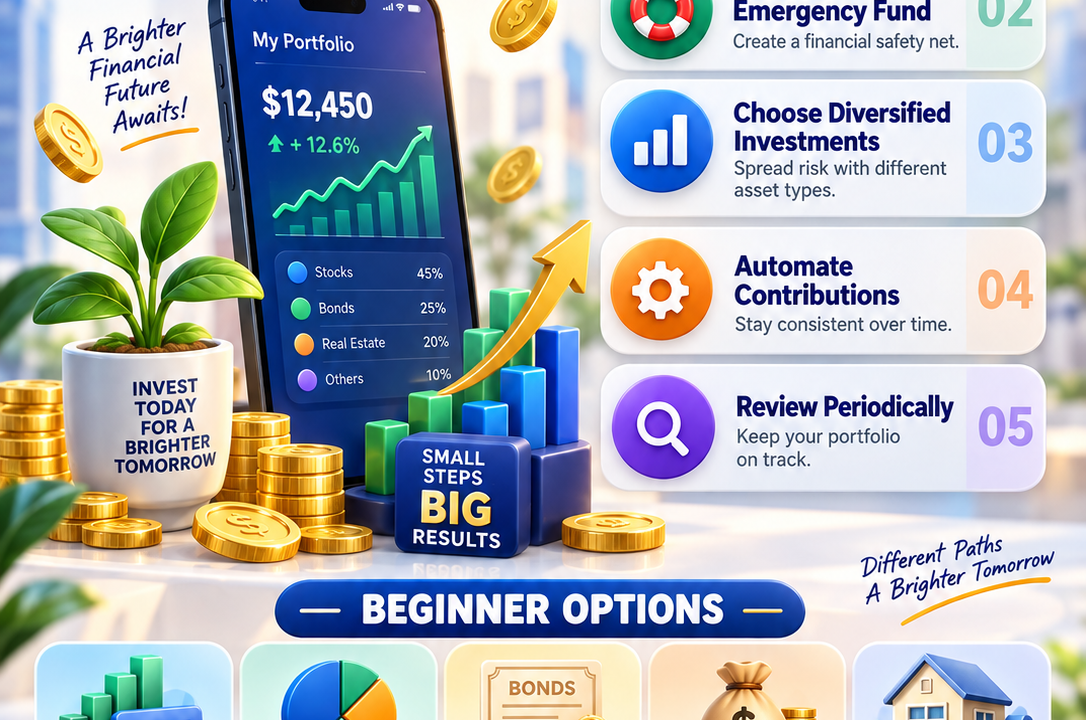
1. 🎯 Define Your Financial Goals: What is the ultimate purpose of this money? Is it for a comfortable retirement, a down payment on a home, building long-term wealth, funding education, or achieving another significant financial milestone? Your objectives will fundamentally shape your investment time horizon and influence the level of risk that is appropriate for your situation. 🗺️
2. 🛟 Build Your Safety Net: Before committing substantial funds to investments, ensure you have a well-established emergency fund that adequately covers your personal circumstances. This fund acts as an essential financial cushion for life’s unexpected events. 🛡️
3. 🧠 Choose Investments Aligned with Your Goals and Risk Tolerance: Carefully consider your investment time horizon and your capacity to withstand market fluctuations. A long-term investor might adopt a different asset allocation strategy compared to someone who anticipates needing their funds in the near future. Diversification is key to mitigating the risk associated with the performance of any single asset, company, sector, or market. 🌐
4. ⚙️ Automate Your Contributions: Setting up automatic contributions is a highly effective strategy for ensuring consistent investing. Instead of manually deciding each month whether to invest, an automated transfer ensures a predetermined amount is invested according to your chosen schedule. Consistency is particularly powerful for achieving long-term financial objectives. 🗓️
5. 🔎 Review Your Portfolio Periodically: Investing doesn’t necessitate constant, obsessive monitoring. Schedule periodic reviews of your portfolio to confirm that your investments continue to align with your overarching goals, your current risk tolerance, and your desired asset allocation. An annual or semi-annual review is often more beneficial than reacting to every minor daily market fluctuation. 🧐
Common Mistakes First-Time Investors Make: What to Avoid! ⚠️
Understanding what not to do can be just as vital as knowing what to do. Awareness of common pitfalls can save you considerable financial heartache.
📉 Trying to Time the Market: Consistently predicting market downturns to sell and market upturns to buy is an exceptionally difficult, if not impossible, feat. Short-term market movements are inherently unpredictable, and frequent trading can dramatically increase costs and foster emotionally charged decisions. A steadfast, long-term investment strategy is your best defense against making rash decisions based solely on short-term market noise. 🚫
🎲 Buying Speculative Investments Without Due Diligence: A rapidly ascending stock can be incredibly alluring, but its price surge doesn’t automatically validate its suitability as an investment. Before committing capital to an individual company, thoroughly understand its business model, financial health, valuation, competitive landscape, and the inherent risks involved. 🕵️♀️
😰 Panic Selling During Market Declines: Market downturns are an inevitable part of the investment cycle. Selling investments solely because prices have fallen can transform a temporary dip into a permanent loss. However, staying invested doesn’t mean ignoring all risk. If an investment no longer aligns with your original financial objective or risk profile, a reassessment is certainly warranted. 💡
🧱 Putting All Your Eggs in One Basket: Concentrating your entire investment portfolio into a single stock, industry, property type, or asset class creates significant concentration risk. Diversification is your strategy to spread your exposure across numerous assets, thereby reducing the impact of poor performance from any single investment. ⚖️
🕰️ Expecting Instant Gratification: Investing generally yields its most profound results when approached with a long-term perspective. Beginners should resist the urge to expect every investment to skyrocket overnight. Depending on your chosen strategy and prevailing market conditions, periods of growth, decline, or sideways movement are all possible. Patience is a virtue! 🧘
How Beginners Can Cultivate a Superior Long-Term Strategy 🌟
Developing a robust and effective investment strategy doesn’t need to be overly complicated. Focus on these core principles:
🧭 Keep it Simple: Understand every investment before you add it to your portfolio. Knowledge is power. 📚
🛡️ Manage Risk: Maintain a solid emergency fund and never invest money that you might need in the short term. Your financial security comes first. 🔒
🌐 Diversify Wisely: Aim to spread your investments across various suitable asset classes rather than pinning your hopes on a single investment. This is your shield against volatility. 🛡️
📅 Invest Consistently: Regular contributions, even small ones, can help build a disciplined long-term habit that compounds over time. 💪
🔍 Review Periodically: Regularly check if your portfolio still aligns with your evolving goals and risk tolerance. Stay adaptable. 🔄
👨💼 Consider Professional Guidance:** If your financial circumstances become complex or you feel uncertain about investment decisions, a qualified financial advisor can provide invaluable personalized guidance. 🤝
The SmartSave.top Final Takeaway 💡
Embarking on your investment journey doesn’t require you to be a psychic who can predict the next market sensation or possess a colossal sum of money. The fundamental principles are refreshingly straightforward: clearly define your financial objectives, establish a secure financial base, select suitable diversified investments, contribute consistently, diligently manage costs, and decisively avoid emotional decision-making. For many newcomers, ETFs, index funds, bonds, mutual funds, and REITs offer diverse pathways to constructing a well-rounded, diversified portfolio, tailored to individual circumstances and risk appetites. The most crucial distinction lies between investing with a well-defined plan and investing based on fleeting impulses. A disciplined, strategic approach grants your money a far greater opportunity to diligently work towards your long-term financial aspirations, all while keeping prudent risk management at the very heart of the entire process. Invest smart, save smarter, and watch your future flourish! 🌱✨