In the pursuit of a more fulfilling and prosperous life, many individuals focus solely on the accumulation of money. However, true, sustainable growth stems from a deeper understanding and skillful management of three fundamental currencies: knowledge 🧠, time ⏳, and money 💵. These aren’t just abstract concepts; they are powerful tools that, when wielded effectively, can unlock a cascade of opportunities and lead to unparalleled personal and financial advancement. At SmartSave.top, we believe in empowering you with the frameworks to make these conversions happen.
The core principle is deceptively simple yet profoundly impactful: when you find yourself lacking one of these essential currencies, you possess the power to leverage the other two to acquire it. This article delves into this powerful decision-making framework, revealing how to strategically invest your time to cultivate expertise, how your acquired knowledge can significantly accelerate your income generation, and how judiciously spent money can effectively buy back precious time. 🌱
Prepare to uncover practical, real-world examples, and adopt smarter decision-making principles and sustainable growth habits. These practices are designed to enhance your productivity, sharpen your financial awareness, and foster long-term personal development. ✨ Whether your aim is to build new skills, create exciting opportunities, or meticulously design a more robust and rewarding future, mastering the art of converting these three currencies can revolutionize the way you approach decisions every single day. 📈
Small, intentional shifts in how you allocate these resources today can pave the way for exponential returns tomorrow. Let’s explore how!
The Hidden Economy: Understanding Your True Resources 🌍
From childhood, we’re often conditioned to believe that money is the ultimate resource. The prevailing narrative is clear: earn more, save more, spend wisely. While these are important tenets, they represent only one facet of a much deeper economic system that governs progress and achievement. The reality is that beyond the monetary aspect, every individual participates in a hidden economy powered by three primary currencies:
- Knowledge (🧠): The accumulated understanding, skills, and insights that empower informed action.
- Time (⏳): The finite, non-renewable resource that allows for action, experience, and growth.
- Money (💵): The medium of exchange and stored value that facilitates transactions and provides options.
The groundbreaking insight is this: when you are in need of one of these currencies, you have the inherent capacity to utilize the other two to obtain it. This paradigm shift fundamentally alters how we approach growth, productivity, wealth creation, and decision-making. Success, in this view, becomes less about possessing an abundance of resources and more about the intelligent conversion and strategic deployment of the resources you already have.
Currency 1: Knowledge – The Foundation of Leverage 🧠
Knowledge is far more than just information; it is potent leverage. Unlike tangible assets that depreciate, useful knowledge has a remarkable ability to compound. The more valuable and relevant knowledge you acquire, the greater your capacity to make decisions that are not only faster and more accurate but also significantly more profitable. 🚀
The acquisition of knowledge unlocks a multitude of benefits:
- ✨ Better Opportunities: Knowledge equips you to identify and seize opportunities that others might miss.
- ✨ Higher Earning Potential: Specialized skills and deep understanding often command higher compensation.
- ✨ Improved Efficiency: Knowing the best way to do something drastically reduces wasted effort and time.
- ✨ Stronger Confidence: Expertise breeds self-assurance, enabling bolder actions and decisions.
- ✨ Faster Execution: With the right knowledge, you can implement plans more quickly and effectively.
Knowledge manifests in diverse forms:
- 🎯 Technical Skills: Proficiency in specific tools, software, or processes.
- 📚 Formal Education: Degrees, certifications, and structured learning programs.
- 🧩 Problem-Solving Abilities: The capacity to analyze issues and devise effective solutions.
- 📈 Market Understanding: Insight into industry trends, consumer behavior, and competitive landscapes.
- 🛠️ Practical Experience: Hands-on learning through doing, experimenting, and iterating.
Without a solid foundation of knowledge, both time and money can be squandered through inefficient strategies and avoidable errors. Consider this:
🌟 Example: Imagine an aspiring entrepreneur aiming to launch an online business. They might choose to:
- 🔵 Dedicate significant time to research and learning.
- 🔵 Invest money in courses, workshops, or educational materials.
- 🟢 Through this process, they acquire invaluable knowledge.
- 🔴 This knowledge then significantly reduces the likelihood of costly future mistakes, saving both time and money down the line.
In this scenario, knowledge acts as the ultimate multiplier, transforming initial investments of time and money into a more robust and successful venture.
Currency 2: Time – The Irreplaceable Asset ⏳
Time is the one currency that, once spent, cannot be recovered. Money can be earned again, skills can be honed, but time relentlessly marches forward. This makes the allocation of your time one of the most critical decisions you will ever make. When invested wisely and intentionally, time becomes a powerful engine for growth, capable of creating:
- ⚡ Skills Development: Consistent practice and learning over time build mastery.
- ⚡ Meaningful Relationships: Nurturing connections requires dedicated time and attention.
- ⚡ Improved Health: Investing time in exercise, healthy eating, and rest is fundamental.
- ⚡ Rich Experiences: Life is built on moments and experiences that unfold over time.
- ⚡ Long-Term Value: Many enduring achievements are the result of patient, sustained effort over time.
Time’s true power is unleashed when it is directed with purpose. Observe this:
🌟 Example: An individual with limited financial resources can still achieve significant progress by strategically investing their time:
- 🟠 They can commit to learning independently through free online resources.
- 🟠 They can engage in consistent practice of a desired skill.
- 🟠 They can dedicate time to building personal projects that showcase their abilities.
- 🟠 Through this dedication of time, they develop valuable expertise.
Over the passage of time, this invested time naturally transforms into knowledge. And as we’ve seen, knowledge often becomes the gateway to increased income and financial opportunities.
Currency 3: Money – The Accelerator of Progress 💵
Money, at its essence, is stored value and a facilitator of flexibility. Its most profound power lies not in immediate consumption but in its ability to accelerate progress and create leverage. Money can be strategically used to purchase:
- 🟣 Education: Access to advanced learning and specialized training.
- 🟣 Expertise: Hiring consultants, coaches, or mentors.
- 🟣 Tools and Technology: Acquiring the necessary equipment for efficiency.
- 🟣 Systems and Processes: Implementing frameworks that streamline operations.
- 🟣 Convenience: Outsourcing tasks to free up personal time.
The strategic use of money allows individuals and businesses to significantly compress timelines, achieving in months what might otherwise take years. Consider this:
🌟 Example: Instead of spending many months laboriously learning a complex process through trial and error, one could:
- 🟡 Hire an expert to teach them directly or perform the task.
- 🟡 Purchase a pre-built system or software that automates the process.
- 🟡 Invest in intensive training programs designed for rapid skill acquisition.
By deploying money thoughtfully, you can dramatically reduce delays and accelerate your journey toward your goals. When used wisely, money acts as a powerful tool for creating freedom and expanding possibilities.
The Conversion Rule: Mastering the Exchange ♻️
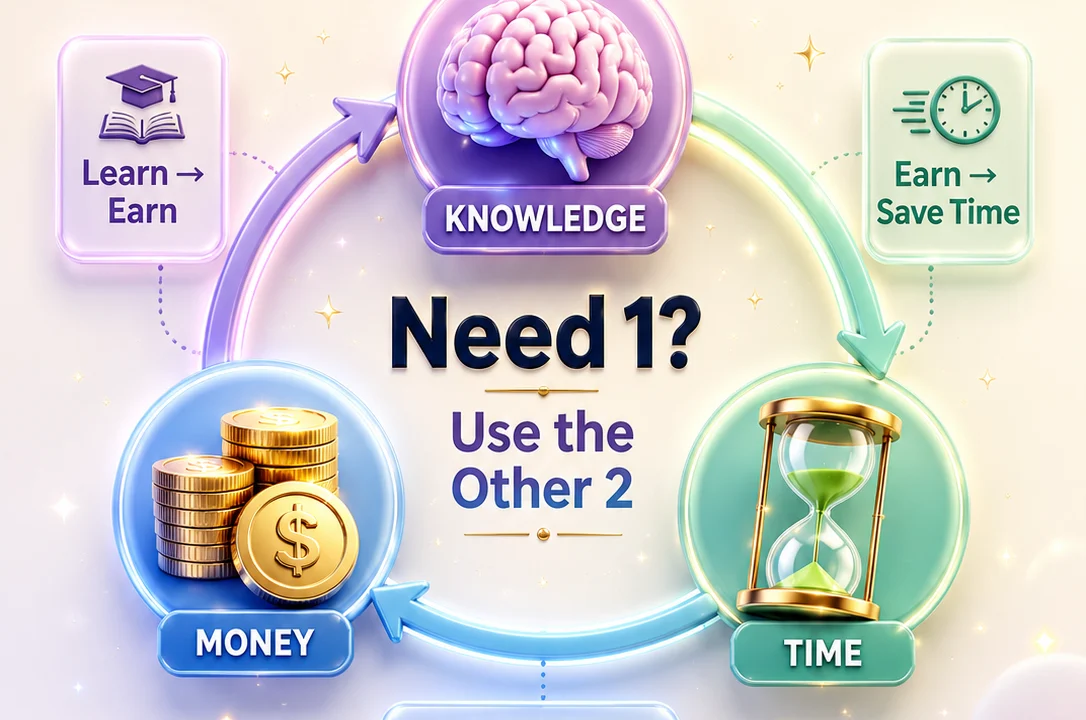
The true genius of this framework lies in its dynamic nature – the ability to convert one currency into another. Whenever you identify a deficit in any one of these three essential currencies, you have the power to leverage the remaining two to bridge that gap. This is the art of intelligent resource management.
🧠 + ⏳ → 💵: Convert Knowledge and Time into Money
This is a common and powerful starting point for many individuals and entrepreneurs. By investing your time into acquiring and applying knowledge, you can create tangible financial returns.
- 🟢 Learning Valuable Skills: Dedicating time to master in-demand skills that businesses or individuals will pay for.
- 🟢 Freelancing and Gig Work: Offering your knowledge and skills on a project basis.
- 🟢 Building Digital Assets: Creating content, software, or products that can generate passive income over time.
- 🟢 Growing a Business: Applying knowledge and effort to build a sustainable enterprise.
Here, your accumulated expertise and the time you dedicate to its application directly translate into income.
💵 + ⏳ → 🧠: Convert Money and Time into Knowledge
When you need to accelerate your learning curve and acquire knowledge quickly, money and time can be potent allies.
- 🔵 Enroll in High-Quality Courses: Investing money in structured educational programs.
- 🔵 Engage with Mentors: Paying for guidance and personalized advice from experienced individuals.
- 🔵 Purchase Books and Resources: Accessing curated knowledge from experts.
- 🔵 Attend Workshops and Seminars: Immersive learning experiences that condense information.
- 🔵 Pursue Certifications: Formal validation of acquired knowledge, often requiring investment of both time and money.
This approach bypasses much of the trial-and-error associated with self-discovery, significantly shortening the path to expertise.
🧠 + 💵 → ⏳: Convert Knowledge and Money into Time
This represents a more advanced stage of leverage, where those who have already built knowledge and accumulated money focus on reclaiming their most precious, finite resource: time.
- 🟣 Automation: Implementing systems that perform tasks automatically, powered by knowledge and investment.
- 🟣 Delegation: Entrusting tasks to others who have the expertise, often enabled by financial resources.
- 🟣 Implementing Efficient Systems: Designing and adopting workflows that minimize wasted effort.
- 🟣 Outsourcing Non-Core Activities: Using money to pay for services that can be handled by specialists, freeing you up for higher-value work.
High performers and successful leaders understand the immense value of protecting and optimizing their time, often through these strategic conversions.
A Smarter Approach to Decision-Making 📊
Before embarking on any significant decision, whether personal or professional, cultivate the habit of strategic questioning. This framework can guide you toward more intentional and effective choices:
- 💭 Which currency do I currently have the most of? Assess your immediate resources – are you flush with time but short on cash? Or do you possess valuable expertise but lack the capital to deploy it?
- 💭 Which currency do I critically need? Identify the specific resource that is limiting your progress or desired outcome.
- 💭 How can I strategically exchange my existing currencies to acquire the needed one? This is the crux of the conversion rule. Formulate a plan that leverages your strengths to obtain your weaknesses.
By consistently applying this process, you move from reactive choices to proactive, intentional growth.
Common Pitfalls That Drain All Three Currencies 🚫
Beware of common traps that can inadvertently deplete all your valuable resources, hindering progress and leading to stagnation:
- 🔴 Spending Money Without Learning: Making significant financial investments without understanding the underlying principles or required knowledge often leads to wasted capital and missed opportunities.
- 🔴 Using Time Without Direction: Engaging in activities aimlessly without a clear purpose or goal means your time is spent without yielding meaningful results or building valuable skills.
- 🔴 Collecting Knowledge Without Action: Accumulating information, books, or courses without applying what you learn results in theoretical understanding but no practical progress.
- 🔴 Waiting for Perfect Conditions: Delaying action until every factor is ideal is a recipe for perpetual procrastination; opportunities often arise from imperfect beginnings.
- 🔴 Chasing Speed Instead of Sustainability: Focusing solely on rapid short-term gains without building a solid foundation can lead to burnout and long-term failure. True growth is often a marathon, not a sprint.
A balanced approach, where all three currencies are managed and converted wisely, leads to more resilient and enduring success.
Building Your Personal Currency System 🌱
To effectively implement this framework in your daily life, focus on cultivating habits in each currency:
🧠 Grow Your Knowledge Base
- 🟢 Read Consistently: Dedicate time daily to reading books, articles, and industry reports.
- 🟢 Learn Practical Skills: Actively seek out and practice skills that have tangible value in the market.
- 🟢 Study Trends: Stay informed about emerging technologies, market shifts, and societal changes.
⏳ Protect and Optimize Your Time
- 🔵 Eliminate Distractions: Identify and minimize interruptions from social media, unnecessary notifications, and low-priority tasks.
- 🔵 Prioritize Outcomes: Focus on activities that yield the greatest results, not just the busiest ones. Learn to say no to time-consuming tasks that don’t align with your goals.
- 🔵 Build Effective Routines: Establish daily and weekly structures that support productivity, learning, and well-being.
💵 Deploy Your Money Intentionally
- 🟣 Invest in Assets: Allocate capital towards investments that generate passive income or appreciate in value.
- 🟣 Improve Efficiency: Use money to acquire tools or services that make you more productive.
- 🟣 Buy Leverage: Employ money to acquire knowledge, skills, or time-saving solutions.
Why This Framework Works: From Scarcity to Conversion ✨
This powerful model succeeds because it shifts the focus from perceived scarcity to active conversion. Instead of feeling limited by a lack of one resource, you are empowered by the knowledge that you can generate it using others.
- Not enough money? Leverage your knowledge and time to create income streams.
- Not enough time? Utilize your knowledge and money to buy back or save time.
- Not enough knowledge? Invest your time and money into learning and skill development.
Every individual inherently possesses all three currencies in varying degrees. True growth and potential realization begin the moment you consciously decide to exchange and convert these resources with intention and purpose.
Final Thought: The Compounding Cycle of Growth 🚀
The ultimate objective is not to hoard or maximize any single currency. Instead, the aim is to cultivate a continuous, self-reinforcing cycle of growth:
- 🧠 Knowledge fuels better decision-making, leading to more effective actions.
- ⏳ Time spent executing these decisions translates them into tangible outcomes and experiences.
- 💵 Money generated from these outcomes expands your possibilities, allowing for further investment in knowledge, time-saving, or new ventures.
When harmonized and utilized together, these three currencies transform into a robust system for continuous personal and financial advancement. Choose wisely. Invest with intent. Compound your efforts consistently. Your future is not predetermined; it is actively built by the intelligent exchanges you make with your currencies today.
Frequently Asked Questions About Currencies of Growth
❓ What are the three essential currencies for growth?
The three essential currencies are knowledge, time, and money. These are the fundamental resources that can be exchanged and leveraged for personal and financial advancement. 🧠⏳💵
❓ Which currency holds the most value?
The perceived value of each currency is situational and depends heavily on your current goals and circumstances. Their true power lies in your ability to convert them strategically. For example, time is irreplaceable, while knowledge can exponentially increase earning potential.
❓ Can acquiring knowledge lead to more money?
Absolutely! Knowledge is power, especially in the financial realm. By investing time in learning valuable skills or gaining market insights, you enhance your decision-making capabilities and increase your earning potential, directly leading to more money. 💡➡️💰
❓ How can money help save valuable time?
Money can significantly buy back your time by enabling you to outsource tasks, automate processes, invest in efficient tools, or purchase services that free you from time-consuming activities. This allows you to focus on higher-value endeavors. 💸➡️⏳
❓ Why is time considered so crucial?
Time is the ultimate finite resource. Unlike money or skills, once time is spent, it cannot be recovered. This makes its intentional allocation and protection paramount for achieving long-term goals and a fulfilling life. ⏳💨
❓ How does continuous learning support overall growth?
Learning is the bedrock of personal and professional growth. It equips you with the skills, insights, and adaptability needed to navigate challenges, seize opportunities, and improve your execution in all areas of life. 🌱📚
❓ What drives compounding growth?
Compounding growth is achieved through consistent, repeated investment and smart conversion across all three currencies. Each investment in knowledge, time, or money builds upon the last, creating exponential returns over time. 📈📈📈
❓ What are effective ways to gain new knowledge?
Effective methods include reading books and reputable online resources, taking structured courses, seeking mentorship, attending workshops, engaging in practical application through projects, and learning from real-world experiences. 🧐📖
❓ Can the time invested into developing skills eventually become money?
Yes, indeed. When you dedicate your time to acquiring and refining marketable skills, that invested time directly translates into expertise. This expertise can then be monetized through employment, freelancing, or entrepreneurship, turning your time into income. ⏳➡️💼➡️💵
❓ What constitutes smart resource allocation?
Smart resource allocation involves understanding your current assets (knowledge, time, money) and strategically deploying them to acquire any missing resources needed to achieve your goals. It’s about making intelligent exchanges rather than simply holding onto resources.