In the bustling world of business 🌍, revenue and profit figures often steal the spotlight. But beneath the surface of impressive sales numbers and healthy accounting profits lies a critical element that determines a business’s true financial vitality: cash flow. It’s the lifeblood that keeps operations humming, allows for expansion, and provides a buffer against unexpected challenges. Even a profitable business can falter if its cash isn’t moving efficiently. This comprehensive guide, brought to you by SmartSave.top, is designed to demystify cash flow management, breaking down complex financial concepts into actionable insights. No more financial jargon – just pure, practical wisdom to help you master your business’s money. 💡
What Exactly is Cash Flow Management? 🤔
At its core, cash flow management is about understanding the constant ebb and flow of money within your business. It’s the process of diligently tracking every dollar that enters and exits your accounts, grasping how quickly this money circulates, and strategically planning how much cash needs to be readily available for both immediate needs and future growth. It’s about gaining clarity, control, and confidence in your financial present and future. ✨
The Pillars of Effective Cash Flow Management: A Framework 🏗️
To truly master cash flow, we’ll explore four interconnected areas:
- The foundational Cash Flow Statement: Your business’s financial X-ray.
- How cash flow informs critical Business Decisions: Turning numbers into action.
- The crucial Cash Conversion Cycle: How fast your money circulates.
- Key Financial Performance Indicators (KPIs): Measuring your financial health.
1. The Cash Flow Statement: Your Financial Compass 🧭
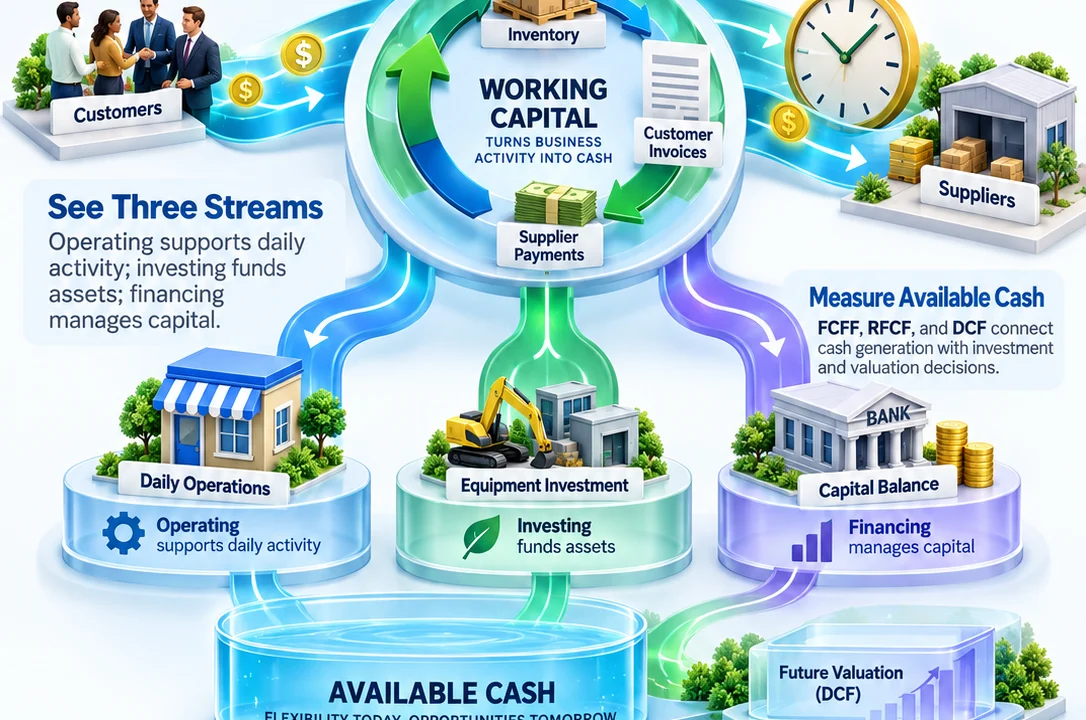
Think of the cash flow statement as your business’s financial report card, specifically focused on cash. It provides a clear, practical picture of where cash is generated and where it’s being utilized. To make it digestible, it’s typically broken down into three key sections, each answering a vital question about your business’s financial activities:
a) Operating Activities: The Engine of Your Business 🚗
Operating Cash Flow (OCF) is the cash generated from your business’s core, day-to-day operations. This includes the money you receive from selling your products or services, minus the cash you spend on things like inventory, salaries, rent, utilities, and other operational expenses. A strong OCF is a powerful indicator that your primary business activities are self-sustaining and generating actual cash. 💪
b) Investing Activities: Fueling Future Growth 🌱
Investing Cash Flow tracks the cash involved in acquiring or disposing of long-term assets. This encompasses capital expenditures (like purchasing new machinery or property), investments in other businesses, or the sale of assets. Understanding this section reveals how your business is investing in its future, whether through expansion, innovation, or strategic acquisitions. 🚀
c) Financing Activities: The Capital Structure 🏦
Financing Cash Flow deals with how your business raises and repays capital. This includes activities like taking out loans, issuing stocks (equity), repaying debt, or distributing dividends to shareholders. This section provides insight into your company’s funding strategies and its obligations to lenders and investors. 💸
By dissecting these three areas, you move beyond a single number and gain a nuanced understanding of the actual movement of cash within your organization. It’s not just about how much cash you have, but *why* and *from where* it came, and *where* it’s going. 🧐
2. Cash Flow: The Engine for Smart Decision-Making ⚙️
Cash flow isn’t just historical data to be reviewed at the end of a quarter. It’s a dynamic tool that can and should actively inform crucial business decisions. By understanding your cash flow patterns, you can make more strategic choices regarding:
- Investment Opportunities: Do you have the cash to seize a promising new venture? 📈
- Financing Needs: When is the best time to seek external funding, and how much will you need? 🤝
- Operational Planning: How can you optimize spending to maximize available cash? 📊
- Pricing Strategies: Does your pricing adequately reflect the cash cycle of your business? 💲
- Future Resource Allocation: How much cash can be reliably deployed for future projects? 🎯
Key Cash Flow Concepts for Decision Support:
Several concepts build upon the basic cash flow statement to provide deeper insights for strategic planning:
- Free Cash Flow to the Firm (FCFF): This represents the cash available to *all* capital providers – both debt and equity holders. It’s a fundamental metric used in business valuation and indicates the total cash-generating capability of a business before considering its capital structure. Think of it as the ultimate pool of cash your business generates. 🏊♂️
- Real Free Cash Flow (RFCF): Going a step further, RFCF focuses on the cash remaining *after* essential capital expenditures (like maintaining or replacing existing assets) and debt service payments. This metric gives a more realistic view of the cash available for discretionary investments, shareholder distributions, or strategic initiatives – essentially, the cash you can truly *use* for new opportunities. ✨
- Discounted Cash Flow (DCF): While primarily a valuation methodology, the DCF framework is invaluable for strategic planning. It involves projecting future cash flows and discounting them back to their present value. This process helps businesses understand the potential return on investment (ROI) for projects, inform pricing decisions, and guide long-term strategic development by estimating the future worth of current actions. ⏳
A practical question to always ask: After meeting all necessary operational expenses and financial obligations, how much actual cash is genuinely free for the next strategic move or investment? 🤔
3. The Cash Conversion Cycle (CCC): Speeding Up Your Money ⚡
A business can be incredibly successful in generating sales, but if it takes a long time to collect payment from customers, that cash remains tied up. This is where the Cash Conversion Cycle (CCC) becomes indispensable. The CCC measures how long it takes for a company to convert its investments in inventory and other resources into cash flow from sales. It’s a crucial indicator of operational efficiency and working capital management. ⏱️
Understanding the CCC Components:
The CCC is calculated using three key metrics:
- Days Inventory Outstanding (DIO): This measures how many days, on average, it takes for a company to sell its inventory. A lower DIO is generally better, indicating that inventory isn’t sitting on shelves for too long, tying up valuable cash. 📦➡️💰
- Days Sales Outstanding (DSO): This represents the average number of days it takes for a company to collect payments from its customers after a sale has been made. A lower DSO means faster collection and quicker cash inflow. 💳➡️💸
- Days Payables Outstanding (DPO): This shows the average number of days a company takes to pay its suppliers. A higher DPO can provide more flexibility by allowing the company to hold onto its cash longer. 🏦 🤝
The CCC Formula:
The magic formula is straightforward:
CCC = DIO + DSO − DPO
Why is a shorter CCC important? A shorter cycle means your business is efficiently managing its inventory, collecting payments quickly, and ideally leveraging supplier terms to keep cash flowing back into your business sooner. This readily available cash can then be reinvested, used to pay down debt, or provide a vital cushion during lean periods. 🛡️
Focus areas for managing your CCC:
- Inventory Management (DIO): Implement just-in-time inventory strategies, optimize stock levels, and forecast demand accurately to avoid excess inventory. 📉
- Customer Collections (DSO): Streamline invoicing processes, offer early payment discounts, and implement robust follow-up procedures for overdue accounts. 🏃♀️💨
- Supplier Payments (DPO): While a higher DPO can be beneficial, ensure you maintain good relationships with your suppliers and don’t incur late fees. Negotiate favorable payment terms where possible. 🤝📅
4. Key Performance Indicators (KPIs) for Cash Health 📊
To truly gauge your financial well-being and track progress, it’s essential to monitor specific cash flow KPIs. These metrics provide a lens through which to view your business’s ability to generate cash, meet its obligations, and maintain short-term financial stability. 🧐
- Operating Cash Flow Margin: This KPI expresses operating cash flow as a percentage of revenue. It highlights how effectively your revenue is being converted into actual cash generated from your core operations. A higher margin signifies greater operational efficiency and stronger cash generation from sales. 💯
- Cash Coverage Ratios (Cash DSCR & FCCR): While traditional debt service coverage ratios (DSCR) and fixed charge coverage ratios (FCCR) often use earnings before interest, taxes, depreciation, and amortization (EBITDA), cash-based versions focus on actual cash available. These ratios measure your business’s ability to meet its financial obligations (debt payments, lease payments, etc.) using its generated cash, providing a more conservative and realistic picture of solvency. 💰➡️✅
- Current Ratio: This is a fundamental liquidity ratio that compares your company’s current assets (assets expected to be converted to cash within one year) to its current liabilities (obligations due within one year). Calculated as Current Assets ÷ Current Liabilities, it’s a vital indicator of your business’s short-term financial health and its ability to meet immediate obligations. A ratio above 1 generally suggests a healthy short-term financial position. ⚖️
Connecting the Dots: The Holistic Cash Flow Picture 🖼️
These four pillars – the cash flow statement, cash flow for decision-making, the cash conversion cycle, and cash flow KPIs – are not isolated concepts. They work in synergy to paint a comprehensive picture of your business’s financial reality.
- The Cash Flow Statement shows you the ‘what’ and ‘where’ of cash movement.
- Free Cash Flow concepts help you understand the ‘how much’ is available for strategic deployment.
- The Cash Conversion Cycle explains the ‘how fast’ cash is circulating through your operations.
- Cash Flow KPIs provide ongoing metrics to track your financial performance and efficiency over time.
Looking at only one piece of this puzzle can lead to incomplete understanding. For instance, a business might show strong operating cash flow but have significant cash tied up in inventory (long DIO). Or, it might have readily available cash but also substantial debt obligations that consume a large portion of it. By integrating these elements, you gain a powerful, holistic view that empowers informed decision-making. 🚀
A Practical Cash Flow Checklist for Business Owners 📝
You don’t need a finance degree to implement effective cash flow management. Start by asking the right questions and establishing a routine review process:
- Analyze Cash Sources: Regularly review your cash flow statement, distinguishing between operating, investing, and financing activities. Where is your cash truly coming from? 🤔
- Scrutinize Operational Cash Ties: Examine your cash conversion cycle. How long is cash tied up in inventory (DIO)? How quickly are you collecting from customers (DSO)? What are your payment terms with suppliers (DPO)? 🧐
- Measure Cash Performance: Monitor your key cash flow KPIs, including operating cash flow margin, cash coverage ratios, and the current ratio. Are these metrics improving? 👍👎
- Leverage Cash Insights for Planning: Connect your cash flow analysis to your strategic planning. Use this information to guide investment decisions, determine financing needs, set pricing, and forecast future financial requirements. 🎯
Common Cash Flow Pitfalls to Sidestep 🚧
Effective cash flow management isn’t about hoarding cash. It’s about understanding its movement and purpose. Be aware of these common mistakes:
- Focusing Solely on Revenue: Ignoring when customers actually pay can lead to a misleading picture of available cash. 🚫💰
- Neglecting Inventory Cash Tie-Up: Excess inventory is dormant cash. Monitor DIO closely. 📦➡️😴
- Confusing Profit with Cash: Accounting profit is an accrual concept; actual cash in the bank is what matters for liquidity. 🧮 ≠ 🏦
- Overlooking Cash for Debt Obligations: Analyzing debt without considering your actual cash available to service it is risky. 🏦 💳
- Fixating on a Single Metric: A holistic view is crucial. Don’t let one positive number blind you to other areas needing attention. 👁️🗨️
The Key Principle: Visibility is paramount in cash flow management. The clearer your understanding of cash origins, its circulation speed, and the demands it must meet, the more confident and effective your financial decisions will be. 💡
Core Cash Flow Takeaways for SmartSavers 🧠
- Follow the Money Trail: Differentiate operating, investing, and financing activities to grasp cash movement. 👣
- Master Timing is Everything: The cash conversion cycle reveals how long your cash is working for you within operations. ⏰
- Quantify Cash Performance: Cash-based KPIs offer vital context beyond traditional accounting figures. 📈
- Plan with Precision: Use cash flow insights to inform investments, financing, pricing, and long-term strategic planning. 🔮
Final Thought: Cash Flow is Your Business’s True Financial Narrative 📖
Mastering cash flow doesn’t demand an advanced finance degree. Start by understanding the three core sections of your cash flow statement. Then, focus on the speed at which cash moves through your operations by analyzing your inventory, customer collections, and supplier payments via the cash conversion cycle. Layer on cash-based metrics like operating cash flow margin, coverage ratios, and the current ratio for deeper insights. Concepts like free cash flow will then help you bridge the gap between available cash and your strategic investment and financial planning. The ultimate lesson is simple: knowing precisely where your cash is, where it’s headed, and when it becomes available is the bedrock of sound financial decision-making. At SmartSave.top, we believe that understanding your cash flow empowers you to build a more resilient, profitable, and future-ready business. 🌟
Ready to take control? By implementing these strategies, you’re not just managing cash; you’re building a stronger, more secure financial future for your business. Keep saving smarter, keep growing bigger! 💪🌱