
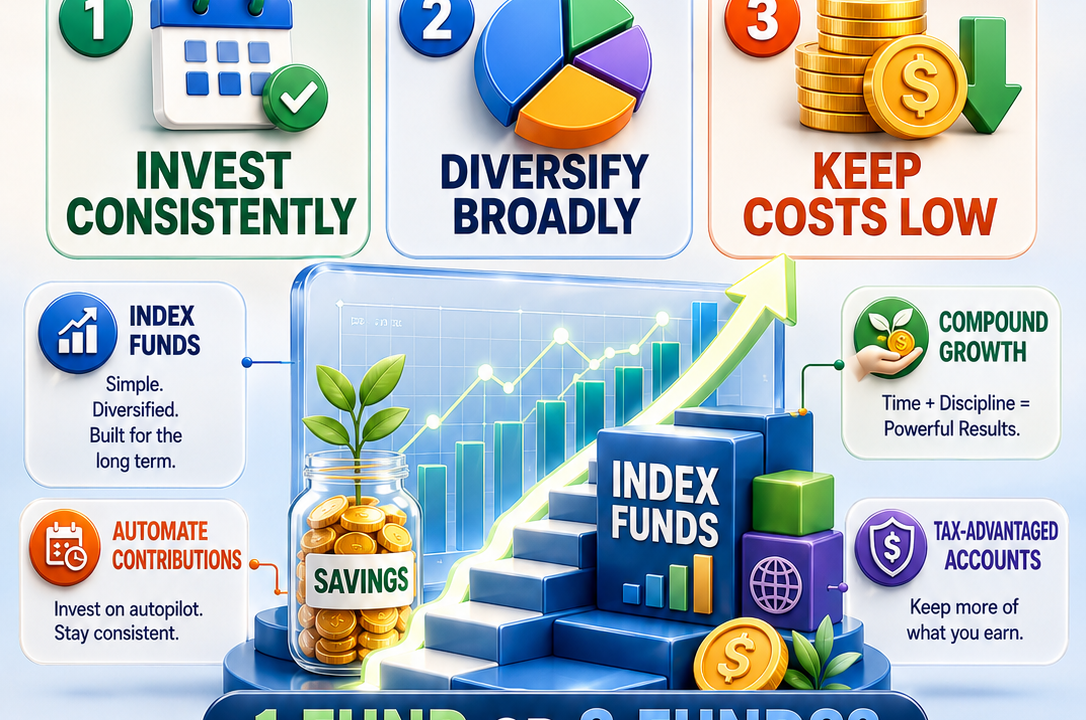
Embarking on the journey of building long-term wealth might seem daunting, especially for newcomers to the world of investing. The financial landscape can appear complex, filled with jargon, market fluctuations, and an overwhelming array of choices. However, at its core, investing for beginners doesn’t have to be complicated, expensive, or exclusive to seasoned financial experts. A straightforward, disciplined approach, combined with consistent saving and smart, diversified investments, can pave the way for significant financial growth over time. 📈 This comprehensive guide is designed to illuminate the fundamental principles of beginner investing from a financial independence (FI) perspective. We’ll delve into crucial concepts like compound growth, the power of low-cost index funds, strategic asset allocation, the benefits of dollar-cost averaging, and the importance of utilizing tax-advantaged accounts. 🏦 We will also explore practical portfolio options, including the elegant simplicity of a one-fund approach and the flexibility of a three-fund portfolio designed to cover U.S. stocks, international stocks, and bonds. 🎯 By the end of this guide, you’ll be equipped with the knowledge to sidestep common investing pitfalls, determine your personal FI target, automate your contributions for consistent progress, and navigate market volatility with confidence. Whether you’re starting with a modest monthly sum or have a larger amount to invest, our focus is on cultivating sustainable investing habits that will serve you well for decades to come, rather than chasing fleeting market trends or trying to predict the unpredictable. 🌱
How Can Beginners Start Investing and Cultivate Long-Term Prosperity?
The initial steps into investing can indeed feel intimidating. The influx of financial terminology, the visible ebb and flow of market values, the various types of investment accounts, and the sheer volume of available funds can create a sense of overwhelm. However, the underlying principles that drive successful long-term investing are surprisingly accessible and straightforward. 💡
From the perspective of achieving financial independence, investing is less about uncovering that one elusive, high-performing stock and more about consistently putting your capital to work. This involves keeping operational costs to a minimum, diversifying your holdings across a broad spectrum of assets, and crucially, allowing the magic of time and compounding to amplify your returns. For those just beginning their investment journey, the immediate goal isn’t to become a financial guru overnight. Instead, the objective is to establish a repeatable, sensible financial system that makes consistent, smart investing an easier endeavor. 💰
This guide is structured to break down the essential concepts, provide clear investment choices, explain different account types, highlight common mistakes to avoid, and offer practical, actionable steps that beginners can implement to build enduring wealth. 🛠️
The Fundamental Idea Behind Beginner Investing 🌱
At its most basic level, investing is the act of exchanging your current financial resources for the potential of possessing a greater amount of wealth in the future. The primary objective is to build assets that possess the capacity to grow and, over an extended period, potentially generate passive income. 🌟
It’s a common misconception that one must be exceptionally wealthy, possess an uncanny knack for analyzing companies, or be able to predict the market’s next move to invest successfully. In reality, sustained long-term investment success typically hinges on a consistent application of several core principles:
- Start Early: Begin investing as soon as it is practically feasible. The earlier you start, the more time compounding has to work its magic. 🕰️
- Invest Consistently: Make regular contributions to your investments, regardless of market conditions. 🗓️
- Diversify Widely: Spread your investments across a variety of asset classes and sectors to reduce risk. 🌐
- Keep Costs Low: Minimize investment fees and expenses, as these can significantly erode returns over time. 📉
- Utilize Tax Advantages: Make the most of tax-advantaged accounts whenever possible. 🏦
- Avoid Emotional Reactions: Refrain from making impulsive decisions based on market volatility. 🧘
- Maintain a Long-Term View: Stay invested through market ups and downs, focusing on your ultimate financial goals. 🎯
The financial independence approach champions simplicity because an investment strategy that is easy to grasp and maintain is invariably easier to adhere to consistently. This leads to more predictable and sustainable progress toward your financial objectives. ✨
Five Crucial Investing Concepts for Beginners 📈
To effectively build wealth, understanding a few key concepts is paramount. These principles form the bedrock of a sound investment strategy, especially for those new to the market.
1. The Power of Compound Growth 💫
Compound growth is arguably the most significant concept for long-term wealth accumulation. It’s often referred to as “interest on interest” or “earnings on earnings.” When your investments generate returns, those earnings are reinvested, and in turn, they begin to generate their own returns. Over extended periods, this snowball effect can lead to exponential growth. 🌨️
Time is the most critical ingredient in compounding. The longer your money is invested, the more opportunities it has to grow and generate further earnings. For instance, consistently investing a fixed sum each month for several decades will yield dramatically different results compared to waiting until much later in life and attempting to invest a much larger, lump sum. While the exact outcome is influenced by factors such as contribution amounts, investment returns, fees, taxes, and prevailing market conditions, the principle remains: time gives compounding the leverage it needs to work its wonders. ⏳
2. The Advantage of Low-Cost Index Funds 📊
Instead of trying to identify individual stocks that are predicted to outperform the broader market, beginners can benefit immensely from investing in broadly diversified index funds. An index fund’s primary objective is typically to mirror the performance of a specific market index, such as the S&P 500, rather than actively selecting investments in an attempt to beat it. 🏆
A total-market index fund can offer exposure to a vast array of companies across various sectors and sizes through a single, convenient investment. Furthermore, funds with lower expense ratios (the annual fees charged to manage the fund) can help preserve a larger portion of your investment returns over the long haul. While specific fund names like VTSAX, FSKAX, or SWTSX are often mentioned, the crucial takeaway is the underlying concept: broad diversification combined with minimal costs creates a robust and simple foundation for sustained wealth building. 💰
3. Strategic Asset Allocation 🔀
Asset allocation refers to the strategic division of an investment portfolio among different asset categories, most commonly stocks and bonds. Each asset class carries its own risk and return characteristics. 📈
- Stocks generally offer greater long-term growth potential but are also subject to significant short-term price fluctuations and potential declines.
- Bonds can provide diversification benefits and may help reduce overall portfolio volatility. However, they also carry their own risks and can lose value. 🛡️
A common, albeit simplified, guideline sometimes suggested is to allocate a percentage of your portfolio to stocks equal to 110 minus your age. However, this is merely a starting point and not a universally applicable formula. Your optimal asset allocation should be a personalized decision based on a thorough consideration of your investment time horizon, specific financial goals, personal risk tolerance, the stability of your income, and your capacity to withstand potential market downturns. ⚖️
4. Maximizing Tax-Advantaged Accounts 🏦
The impact of taxes on long-term investment outcomes can be substantial. Therefore, strategically choosing the right types of investment accounts is a vital component of effective financial planning. 📝
- Workplace Retirement Plans (e.g., 401(k), 403(b)): These accounts often come with significant tax advantages and, crucially, may include an employer match – essentially free money that boosts your investment growth.
- Health Savings Accounts (HSAs): For eligible individuals, HSAs offer a triple tax advantage: contributions are tax-deductible, earnings grow tax-free, and qualified withdrawals for medical expenses are tax-free.
- Roth IRAs: With a Roth IRA, eligible contributions are made with after-tax dollars, but qualified withdrawals in retirement are completely tax-free. This can be incredibly advantageous for long-term growth. 🌱
It’s important to note that contribution limits, eligibility requirements, and specific tax rules can change. Always consult the latest regulations and consider seeking professional tax advice to ensure you’re making the most informed decisions for your situation. 🤓
5. The Discipline of Dollar-Cost Averaging 📅
Dollar-cost averaging (DCA) is an investment strategy where you invest a fixed amount of money at regular, predetermined intervals, rather than attempting to time the market by investing a lump sum at what you believe is the perfect moment. ⏰
For instance, you could set up an automatic transfer to invest a specific dollar amount from your checking account into your investment account every month. This disciplined approach helps mitigate the emotional temptation to constantly try and predict market highs and lows. More importantly, it fosters a consistent financial routine: earn → save → invest → repeat. DCA does not eliminate investment risk entirely, nor does it guarantee profits. Its primary benefit for many beginners lies in its ability to promote behavioral consistency and remove subjective decision-making from the investment process. ✅
What Should Beginners Actually Invest In? 🛒
Once you have a grasp of these fundamental principles, a natural next question arises: What specific investments should I be purchasing? For the long-term investor focused on building wealth, a strategy centered around diversified index funds often proves considerably simpler and more effective than trying to pick individual stocks. Let’s explore two common approaches:
The One-Fund Portfolio Approach 🟢
This is perhaps the simplest way to construct an investment portfolio. A single, broad-market index fund can provide an extremely straightforward and highly diversified portfolio structure. For example, a total U.S. stock market index fund offers exposure to thousands of companies across all sectors and sizes within the United States. While this provides excellent diversification within the U.S. market, it may not offer complete global diversification or perfectly align with every investor’s specific risk profile and goals.
The Three-Fund Portfolio Approach 🔵
A slightly more nuanced but still very manageable approach is the three-fund portfolio. This strategy typically involves investing in three broad categories:
- U.S. Stocks: Provides exposure to the performance of American companies. 🇺🇸
- International Stocks: Offers diversification by investing in companies located outside the United States. 🌍
- Bonds: Can provide additional diversification and potentially help manage overall portfolio volatility, especially during stock market downturns. 🏛️
A classic three-fund structure allows for broader diversification and greater control over the specific allocation percentages between stocks and bonds, reflecting your individual risk tolerance and time horizon. For example, an investor with a longer time horizon might opt for a higher allocation to stocks, while someone nearing retirement might prefer a greater allocation to bonds for stability.
One Fund vs. Three Funds: Which is Right for You? ⚖️
Both the one-fund and three-fund approaches can be highly effective within a disciplined, long-term investing strategy. The best choice often depends on your personal preferences, comfort level with management, and desire for control.
One-Fund Strategy Advantages:
- Maximum Simplicity: Easiest to understand and implement. ✅
- Effortless Portfolio Management: Requires minimal ongoing attention. 🏖️
- Reduced Rebalancing Needs: Typically self-rebalancing to some degree. ⚙️
Three-Fund Strategy Advantages:
- Greater Control: Allows precise control over exposure to U.S. stocks, international stocks, and bonds. 🎯
- Enhanced Flexibility: Offers more options for fine-tuning asset allocation based on market conditions or personal circumstances. 🤸
- Slightly More Management: Requires occasional rebalancing to maintain target allocations. 📈
Ultimately, the superior approach is the one that an investor understands thoroughly and can consistently maintain over the long term. Complexity does not automatically equate to better investment results; simplicity can often be a powerful ally in achieving financial goals. 👍
Common Mistakes Beginners Make (And How to Avoid Them) 🚫
Many of the challenges beginners face in investing stem from behavioral tendencies rather than technical investment knowledge. Being aware of these common pitfalls can help you steer clear of costly errors.
- Chasing Individual Stocks: While the allure of picking a winning stock is strong, buying individual companies introduces significant concentration risk. It also demands a substantially greater amount of research and ongoing monitoring compared to holding a diversified index fund. 🎯
- Paying Excessive Fees: Even seemingly small annual fees can have a substantial negative impact on your long-term wealth due to the effect of compounding costs. For example, a fund charging 1% annually will cost considerably more over decades than a comparable fund charging 0.03%, assuming similar investment performance. 💸
- Waiting for the “Perfect” Time: Markets are inherently unpredictable. Delaying your investment decisions indefinitely in the hope of finding the absolute ideal entry point can prevent you from participating in valuable long-term market growth. ⏳
- Panic Selling During Downturns: Market declines are a normal and expected part of the investment cycle. Selling your investments solely because prices have fallen can transform temporary paper losses into permanent, realized losses. 📉
- Overcomplicating the Portfolio: Owning an excessive number of accounts, funds, complex strategies, or niche financial products does not necessarily lead to better diversification or superior returns. Often, a smaller selection of well-understood investments is easier to manage and more effective. 🧩
The Financial Independence (FI) Framework Explained 🧭
Financial independence (FI) is a state where you have accumulated enough assets to comfortably cover your future living expenses without needing to rely on active income from employment. One widely used framework for estimating the capital required to achieve FI begins with your current annual spending.
Estimating Your FI Number: A Simplified Calculation 🎯
A straightforward method to estimate your FI number is:
FI Number = Annual Spending ÷ Target Withdrawal Rate
For example, if your annual living expenses are $50,000 and you assume a conservative withdrawal rate of 4% from your investment portfolio in retirement, your theoretical FI target would be approximately $1.25 million ($50,000 / 0.04 = $1,250,000).
It’s crucial to remember that this is a planning framework, not a guaranteed outcome. Actual withdrawal strategies should take into account various factors, including your portfolio’s composition, tax implications, inflation rates, prevailing market conditions, your expected lifespan, and your spending flexibility.
The overarching lesson here is significant: reducing unnecessary expenses and increasing the portion of your income that is available for investment can dramatically accelerate your progress toward financial independence. 🚀
The Crucial Role of Your Savings Rate 💵
While investment returns often capture a lot of attention, the sheer amount of money you save and invest can be equally, if not more, important, particularly during the initial phases of wealth building. This is where the power of your savings rate truly shines.
- Earning More: Increasing your income provides a larger pool of funds that can be directed towards investment. 💰
- Spending Less: Reducing your expenditures directly increases your savings rate, meaning a larger percentage of your income is available to invest. 📉
- Investing the Difference: Directing these increased savings into your investments gives them the opportunity to compound and grow over time. ✨
This creates a powerful, virtuous cycle:
Income → Savings → Investments → Growth → Greater Financial Flexibility
The focus should always remain on controlling the factors that are within your reasonable influence, rather than expending energy trying to predict every minute fluctuation in the market. 💪
Practical Steps to Begin Your Investment Journey 🚀
Getting started with investing does not necessitate the creation of an overly complex financial system. You can begin with a few simple, actionable steps.
- Choose a Broad, Low-Cost Investment: Begin by researching diversified index funds. Compare their expense ratios, the breadth of their diversification, any tax implications, and their stated investment objectives. Look for funds that track broad market indexes and have minimal fees. 🔎
- Open the Appropriate Account: Based on your eligibility and personal circumstances, select the most suitable account type. This could be a workplace 401(k), a Traditional IRA, a Roth IRA, an HSA, or a taxable brokerage account. Each offers different benefits. 🏦
- Automate Your Contributions: Set up automatic, recurring contributions from your bank account to your investment account. This ensures that investing happens consistently without requiring constant manual effort or relying solely on monthly motivation. ⚙️
- Build the Habit: Even a modest, recurring contribution can be instrumental in establishing the crucial habit of investing consistently. Starting with $50 or $100 per month is less about the initial amount and more about creating a sustainable system that can potentially grow as your income increases. 🗓️
- Stay Invested Through Volatility: Market downturns are inevitable. Your long-term investment plan should anticipate periods of uncertainty and include a commitment to remain invested rather than reacting impulsively to market swings. 🌊
Pros and Cons of a Simple Index-Investing Approach 🏆
A simplified approach to investing, often centered around index funds, offers distinct advantages and a few considerations.
Pros:
- Broad Diversification: Instant exposure to a wide range of assets. 🌍
- Low Ongoing Costs: Minimal fees preserve more of your returns. 💰
- Simple Portfolio Management: Easy to understand and maintain. ✅
- Effortless Automation: Streamlined contribution process. ⚙️
- Reduced Reliance on Stock Picking: Less need to identify individual winners. 🎯
- Potential Tax Efficiency: Depending on account structure and fund type. 🏦
Cons:
- Market Value Fluctuations: Investment values can decline substantially. 📉
- Account Restrictions: Withdrawals from certain accounts may be restricted or taxable. 🏦
- Market-Average Performance: Investors typically accept market-average returns rather than aiming to outperform. 📊
- Risk Remains: Diversification does not eliminate all investment risk. ⚠️
The fundamental objective isn’t to eliminate risk entirely but rather to take on an appropriate level of risk that aligns with your specific long-term financial goals. 🎯
Frequently Asked Questions About Beginner Investing ❓
Is investing safe for beginners?
Investing inherently involves risk. While diversified funds spread risk across many securities, investment values can still decline. Beginners should thoroughly understand their investment time horizon and personal risk tolerance before investing. 🛡️
How much money should a beginner start investing with?
There isn’t a universal minimum amount. A modest, recurring contribution can be a practical and effective starting point, provided that essential living expenses and other high-priority financial obligations are already being met. 💵
Should beginners buy individual stocks?
Individual stocks can carry a higher degree of concentration risk. For many beginners, broadly diversified index funds offer a simpler and more prudent starting point for gaining long-term market exposure. 📊
Is a stock index fund better than individual stocks?
Neither is universally “better” for every investor. However, an index fund provides instant diversification across numerous companies while significantly reducing the dependency on the performance of any single business. 🌐
Should I pay off debt before investing?
This decision depends on various factors, including the interest rate on the debt, the type of debt, whether your employer offers a retirement plan match, your emergency savings, and your overall financial picture. High-interest debt often warrants significant priority. ⚖️
Is a Roth IRA better than a brokerage account?
They serve different purposes. A Roth IRA provides specific tax advantages but has eligibility and contribution limits. A taxable brokerage account generally offers greater flexibility but doesn’t come with the same tax benefits. 🏦
Can investors lose money in index funds?
Yes. Index funds track the markets they represent, and their values fluctuate accordingly. They can lose value, particularly over shorter time frames. 📉
What is the simplest portfolio for a beginner?
A diversified one-fund portfolio can be one of the simplest ways to start. Alternatively, a three-fund portfolio offers more control over U.S. stocks, international stocks, and bonds. 🟢
How often should an investment portfolio be checked?
Long-term investors generally do not need to monitor market prices constantly. Periodically reviewing your portfolio and rebalancing when necessary is often more beneficial than reacting to daily market movements. 📅
What is dollar-cost averaging?
Dollar-cost averaging involves investing a predetermined amount of money at regular intervals, irrespective of short-term market fluctuations. 🗓️
How does compound growth build wealth?
When investment earnings are reinvested, they can generate further earnings. Over long periods, this compounding effect can dramatically amplify the value of consistent contributions. 💫
What is an FI number?
An FI number is an estimated portfolio value calculated to support financial independence. A simplified method involves dividing your annual spending by a chosen target withdrawal rate. 🎯
The Bottom Line: Your Path to Financial Freedom 🌟
Achieving financial independence and building long-term wealth as a beginner investor does not require a crystal ball, intricate strategies, or an extensive collection of complex financial products. The essential framework is elegantly simple: save consistently, invest broadly across diversified assets, keep your investment costs as low as possible, utilize tax-advantaged accounts strategically, automate your contributions, and most importantly, maintain a steadfast long-term perspective. 🚀
Financial independence is less about discovering that one perfect, magical investment and more about cultivating a sustainable, harmonious relationship between your income, your spending, your savings, and your investments. For many beginners, the most valuable initial step is not finding the next hot stock. It is about establishing an investment system – a repeatable process – that can effectively work for you through market highs, market declines, shifting news cycles, and all the different seasons of your life. ✨