👋 Are you caught in the endless cycle of tracking every single penny? Ditching the exhaustive budget sheets might be the key to unlocking substantial savings and achieving your financial goals with less stress. ✨ Enter the anti-budget method – a refreshing approach that flips traditional budgeting on its head by prioritizing your savings *before* any discretionary spending. Instead of meticulously assigning every dollar to a specific category, this powerful strategy empowers you to decide how much to save and invest right on payday. By automating these crucial transfers, covering your essential bills, and then freely enjoying the remainder, you can cultivate consistent savings habits without the daily grind of expense tracking. This comprehensive guide will delve deep into the mechanics of the anti-budget, help you determine the right savings percentage, suggest optimal accounts, and explore its suitability for your unique financial landscape. We’ll walk through a practical monthly income example, dissect its key advantages and potential drawbacks, and even compare it to popular budgeting frameworks like the traditional, 50/30/20, zero-based, and “pay yourself first” methods. Whether you’re seeking a smoother, more automated savings plan or simply want to inject more flexibility and ease into your money management, the anti-budget framework offers a sustainable path to building consistent financial habits. We’ll also highlight vital safeguards for managing debt, building emergency funds, and navigating irregular income streams. 🌟
What Exactly is the Anti-Budget Method? 🤔
💡 The anti-budget method is a revolutionary personal finance strategy meticulously crafted for individuals who crave consistent saving and investing without the burden of scrutinizing every single transaction. Forget painstakingly categorizing your grocery hauls, entertainment splurges, wardrobe updates, dining-out adventures, or subscription services. This method elegantly reverses the conventional budgeting process.
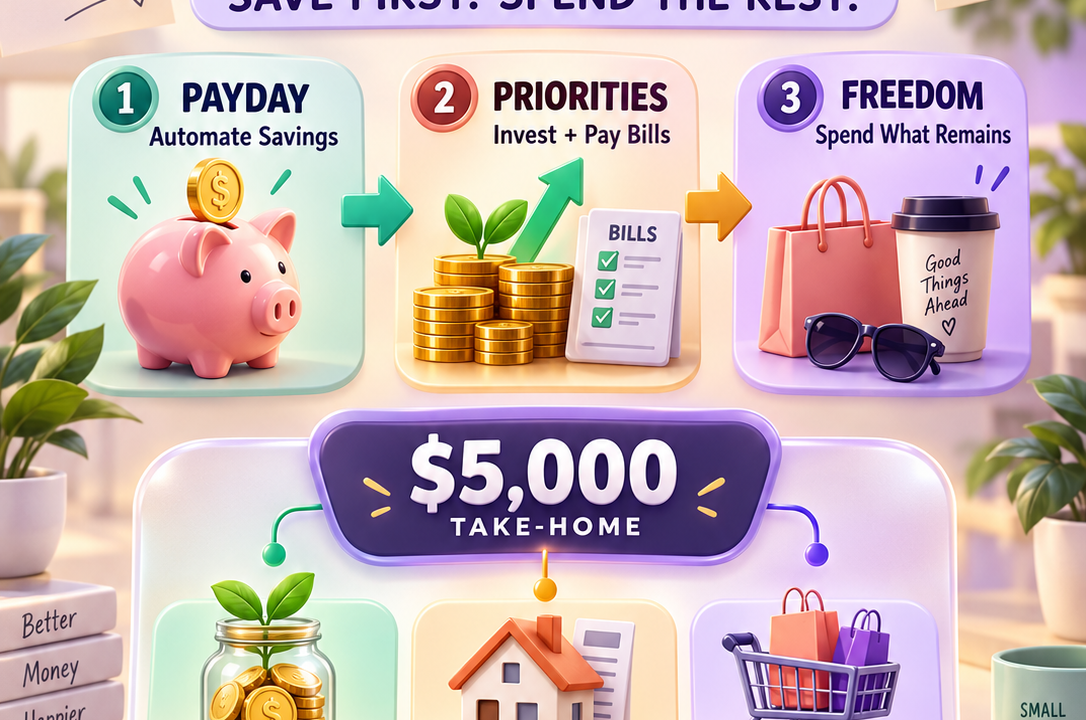
On the day you get paid, your financial priorities are addressed first. Your savings and investments are automated, your non-negotiable bills are settled, and the remaining balance transforms into your freely spendable income. The core principle is elegantly simple and profoundly effective:
💰 Save First. Pay Fixed Expenses. Spend What Remains.
This elegant approach significantly reduces your reliance on day-to-day decision-making when it comes to managing your money. Once your automated transfers for savings and investments are set up, along with your recurring bill payments, the need for constant expense logging or the anxiety of shifting funds between categories diminishes considerably. However, it’s crucial to understand that the anti-budget is by no means a green light for unchecked spending. Its effectiveness hinges entirely on ensuring that the amounts allocated to savings, investments, and bills are realistic and sustainable relative to your income. ⚖️
How the Anti-Budget Works on Payday: A Step-by-Step Breakdown 🗓️
The anti-budget method is fundamentally built upon the bedrock of automation. Here’s how it unfolds seamlessly on payday:
- 🎯 Decide Your Savings Rate: Determine a specific percentage or a fixed dollar amount of your after-tax income that you commit to saving. A common and effective starting point is often around 20%, but the ideal figure is highly personal, influenced by your income level, existing financial obligations, debt repayment status, emergency fund size, and your overarching financial aspirations.
- 📈 Automate Your Savings: Immediately transfer your chosen savings amount into a dedicated savings vehicle. A high-yield savings account (HYSA) is an excellent choice for maximizing your returns on these funds while keeping them accessible for short-term goals or unexpected needs. 🏦
- 🌱 Automate Your Investing: If you’ve established a solid financial foundation, consider directing a separate, predetermined amount towards investment or retirement accounts. This could include contributing to your workplace retirement plan (like a 401(k) or 403(b)) or funding an individual investment account. 💹
- 🧾 Pay Your Fixed Bills: Next, ensure all your essential recurring expenses are covered. This typically includes your rent or mortgage payments, utility bills, insurance premiums, subscriptions, loan repayments, and any other predictable financial obligations. Setting these up for automatic payment can further streamline the process, provided you maintain sufficient funds. 🏠
- 🛍️ Spend the Remainder Freely: After your savings, investments, and fixed bills are accounted for, the money left in your primary checking account is designated for your flexible, day-to-day spending. This is your allowance for groceries, entertainment, dining out, and all other non-essential purchases. ☕
- ⏳ Stop Spending When the Account Reaches Zero: This is a critical self-governing mechanism. If your designated flexible spending balance is depleted before your next payday arrives, you must consciously pause non-essential spending. Crucially, avoid dipping into your savings or resorting to credit cards. This creates a natural and effective spending boundary without the need to track every single transaction. 🛑
Setting Up Your Anti-Budget System: The Foundation 🏗️
Establishing an anti-budget system requires a more thoughtful initial setup than its ongoing maintenance. Here’s how to lay a strong foundation:
- 🏦 Choose the Right Accounts: A practical setup typically involves three key accounts:
- A Dedicated Savings Account: Specifically for your automated savings, emergency fund, and short-term goals.
- An Investment or Retirement Account: For your long-term wealth-building efforts.
- A Primary Checking Account: To receive your income, pay bills, and manage your flexible spending.
Clearly separating these accounts by purpose makes the system intuitive and prevents confusion between funds earmarked for specific goals and those available for daily use.
- ⚙️ Automate, Automate, Automate: Automation is the absolute cornerstone of the anti-budget method. Schedule recurring transfers for your savings and investing activities to occur automatically around your payday. For fixed bills, setting up automatic payments can also be highly beneficial, provided you consistently monitor your account balances and payment due dates to avoid overdrafts. The ultimate goal here is to shift significant financial decisions from the end of the month to the proactive beginning of your pay cycle. ⏰
- 🛟 Maintain a Financial Buffer: Your automation efforts should never leave your primary checking account so lean that an unexpected bill immediately triggers an overdraft or forces you to accrue credit card debt. A strategically maintained cash buffer within your checking account provides crucial flexibility for irregular expenses and helps bridge any timing differences between your income arrival and bill payment due dates. This buffer acts as a safety net, preventing minor fluctuations from derailing your entire system. 🛡️
Determining Your Optimal Savings Rate with the Anti-Budget Method 💰
There’s no one-size-fits-all savings percentage that magically works for every household. The right rate is deeply personal and should align with your unique financial circumstances. Consider these points:
- 🎯 A 20% Starting Point: For many individuals beginning to build a robust savings habit, a 20% savings rate can serve as an excellent and achievable benchmark.
- 📊 For Stronger Cash Flow: Households blessed with robust cash flow and relatively low fixed expenses might comfortably aim for 30% or even more.
- 🏡 For Higher Expenses: Conversely, if your housing costs, childcare expenses, debt repayments, or other essential outlays consume a substantial portion of your income, a lower percentage might be more realistic. The key is to establish a savings rate that actively supports your financial progress without setting you up for repeated failure. A sustainable rate is infinitely more valuable than an aggressive target that proves impossible to maintain.
Before committing to a specific rate, ask yourself these critical questions:
- 🔹 Are you actively addressing and paying down high-interest debt?
- 🔹 Do you have a sufficiently robust emergency fund in place?
- 🔹 Are your retirement contributions on track to meet your long-term goals?
- 🔹 Are there any short-term financial objectives that require significant cash accumulation?
- 🔹 Can you realistically maintain this chosen savings rate even after encountering unexpected expenses?
A Simple Monthly Example: Putting the Anti-Budget into Practice 📊
Let’s illustrate the anti-budget method with a hypothetical household earning $5,000 in monthly take-home pay:
- 💰 Take-home Pay: $5,000
- 🌱 Savings and Investing: If 20% is allocated, this amounts to $1,000 per month. This $1,000 can be strategically divided between a savings account and long-term investments based on the household’s specific financial priorities.
- 🏠 Fixed Bills: Let’s assume essential recurring bills total $2,000 per month. These are covered separately and automatically.
- 🛍️ Flexible Spending: After setting aside $1,000 for savings/investing and $2,000 for bills, the remaining $2,000 becomes the flexible spending amount available for all other expenses.
The structure looks like this:
- Income: $5,000
- Savings & Investing: $1,000 (20%)
- Fixed Bills: $2,000 (40%)
- Flexible Spending: $2,000 (40%)
Remember, these percentages and dollar figures are illustrative. The most effective approach involves tailoring them precisely to your individual circumstances, rather than adhering to rigid universal rules. 📏
The Remarkable Benefits of the Anti-Budget Method ✨
Embracing the anti-budget strategy offers a wealth of advantages:
- ✨ Reduced Day-to-Day Tracking: Perhaps the most significant benefit is the dramatic decrease in administrative effort. Instead of meticulously logging every single purchase, your focus shifts to ensuring your primary financial priorities – savings, investments, and bills – are adequately funded.
- 🧠 Fewer Spending Decisions: The power of automation significantly curtails the number of financial decisions you need to make throughout the month. Savings and investments are handled proactively, freeing up your mental energy and ensuring these critical goals are met before discretionary spending even enters the picture.
- 📈 Consistent Saving Habits: Regular, automated transfers are instrumental in transforming saving into a reliable, consistent financial behavior. It’s no longer dependent on whatever money might be “left over” at the end of the month.
- ⚙️ Ease of Automation: Once the initial setup of your accounts and automated transfers is complete, the anti-budget system requires remarkably little ongoing effort to maintain.
- 🎈 Enhanced Spending Flexibility: Unlike highly restrictive, traditional budgets that often dictate spending limits for every single category, the anti-budget approach generally allows you a great deal of freedom with your discretionary dollars without needing to pre-assign them.
Potential Drawbacks and Limitations to Consider ⚠️
While powerful, the anti-budget method isn’t a perfect fit for every financial scenario. Be aware of its limitations:
- ⚠️ Limited Visibility into Spending: Individuals who require granular detail about where every dollar is going might find the lack of specific category tracking a significant drawback.
- 💳 Debt Management Concerns: If you are currently carrying substantial high-interest debt, a more structured and aggressive strategy that explicitly prioritizes debt repayment might be more appropriate.
- 💵 Risk of Insufficient Income: If your income barely covers your essential living expenses, automatically transferring a large percentage to savings could inadvertently create cash-flow problems.
- 🔍 Hidden Spending Patterns: Without conscious transaction tracking, it can be more challenging to identify subtle or recurring overspending habits.
- 🌦️ Navigating Variable Income: Freelancers, commission-based sales professionals, and others with highly unpredictable income streams will likely need a more substantial cash buffer and a more actively managed financial plan to effectively utilize this method.
The anti-budget method truly shines when you possess sufficient predictable cash flow to comfortably fund your savings, essential expenses, and discretionary spending simultaneously. 🚀
Who Stands to Benefit Most from the Anti-Budget? 🤔
The anti-budget method is particularly well-suited for:
- 👔 Individuals with Stable Income: Those who receive consistent salaries or have highly predictable income streams will find this method exceptionally straightforward and easy to implement.
- 💪 Those with Good Spending Discipline: If you generally have reasonable control over your discretionary spending, the flexibility offered by the anti-budget can be highly appealing without the need for micromanaging categories.
- 📱 People Who Dislike Detailed Tracking: If the thought of maintaining spreadsheets or manually logging every transaction fills you with dread, the automated nature of the anti-budget offers a welcome alternative.
- 🛟 Households with Established Foundations: Individuals or families who already have a solid emergency fund in place and manageable debt levels will find they have the financial flexibility to embrace this approach.
Conversely, this method may be less ideal for individuals who:
- Frequently overspend when excess money is visible.
- Have unstable income without an adequate cash reserve.
- Need or want detailed visibility into every aspect of their spending.
Anti-Budget vs. Other Popular Budgeting Methods: A Comparative Look ⚖️
Let’s see how the anti-budget stacks up against other common financial strategies:
- Anti-Budget vs. Pay Yourself First: Both methods champion the principle of prioritizing savings before discretionary spending. The key differentiator for the anti-budget is its explicit emphasis on *minimizing detailed expense tracking* once your core financial priorities are met. It’s essentially a highly streamlined version of the “pay yourself first” philosophy.
- Anti-Budget vs. Traditional Budgeting: Traditional budgeting typically involves meticulously assigning spending limits to specific, granular categories (e.g., $300 for groceries, $150 for dining out). The anti-budget, however, places a greater emphasis on the *total amount saved* and the essential obligations covered, leaving the remainder available for more flexible, uncategorized spending.
- Anti-Budget vs. 50/30/20 Rule: The 50/30/20 framework generally suggests dividing after-tax income into 50% for needs, 30% for wants, and 20% for savings or debt repayment. The anti-budget doesn’t strictly enforce these predefined categories for all remaining dollars. Its central focus remains on automating your primary financial goals *before* engaging in discretionary spending.
- Anti-Budget vs. Zero-Based Budgeting: Zero-based budgeting requires that every single dollar of income is assigned a specific purpose (spending, saving, investing, debt repayment) before the budgeting period begins, ensuring that income minus expenses equals zero. The anti-budget offers a simpler approach: savings and essential obligations receive priority, and the remaining funds can be spent more freely without assigning each dollar a distinct category.
Maximizing the Effectiveness of Your Anti-Budget 🚀
To ensure your anti-budget system continues to serve you well, consider these strategies:
- 📅 Regularly Review Your Savings Rate: Your savings rate shouldn’t remain static forever. Periodically reassess it as your income, expenses, debt levels, and financial goals evolve. What works today might need adjustment tomorrow.
- 🏦 Differentiate Short-Term and Long-Term Funds: It’s crucial to plan separately for emergency savings and near-term goals (like a down payment) versus long-term objectives like retirement. Different accounts and strategies may be needed for each.
- 🚦 Guard Against Lifestyle Creep: As your income increases, make a conscious effort to automatically boost your savings or investment contributions. This proactive step helps prevent every raise from being silently absorbed by an increase in discretionary spending.
- 🔎 Monitor the Big Picture: While the anti-budget reduces micro-tracking, it doesn’t eliminate the need for overall financial awareness. Periodically review your account balances, debt repayment progress, overall savings growth, recurring subscriptions, and significant upcoming expenses to ensure your system remains sustainable and on track.
When to Pause and Reconsider the Anti-Budget 🛑
An overly automated system might not be the best choice when your finances are already under considerable strain. You might want to reconsider the anti-budget if:
- You are accumulating high-interest debt at an alarming rate.
- You frequently miss bill payments.
- Your income fluctuates dramatically and unpredictably without sufficient reserves.
- Your discretionary spending consistently exceeds your available funds.
In such situations, a more detailed and hands-on budgeting approach might provide the enhanced control and visibility needed to stabilize your finances. Similarly, individuals who gain satisfaction or crucial insights from understanding precisely where every dollar goes may benefit from combining automated saving with traditional expense tracking. 🧐
The Bottom Line: Simplify Your Savings with the Anti-Budget 💡
The anti-budget method elegantly replaces tedious daily budgeting with a clear, powerful financial sequence: Save and invest first, cover your essential fixed bills, and then freely spend the remainder.
Its paramount strength lies in its sheer simplicity. By automating your savings and investment contributions on payday, this method liberates your consistent financial progress from the whims of willpower or the drudgery of daily transaction tracking. However, this simplicity should never come at the cost of crucial financial awareness. Essential components like building emergency reserves, strategically managing debt, planning for irregular expenses, and ensuring healthy cash flow still demand careful consideration.
For individuals who benefit from stable income, manage their obligations effectively, and possess a reasonable degree of spending discipline, the anti-budget presents an exceptionally effective pathway to automate your savings while preserving the flexibility you need for everyday life. It’s a smart, streamlined approach to building wealth, one automated transfer at a time. 💰✨
Frequently Asked Questions (FAQ) 🤔
- What exactly is the anti-budget method?
💡 The anti-budget method is a personal finance strategy where savings and investments are prioritized and funded first, followed by paying fixed bills, with the remaining money then available for discretionary spending. - Is the anti-budget method superior to traditional budgeting?
⚖️ Neither method is universally “better.” The anti-budget prioritizes simplicity and automation, making it ideal for many. Traditional budgeting, on the other hand, offers greater insight into specific spending categories, which some individuals prefer. - How much should I aim to save using the anti-budget?
🎯 A starting point of around 20% of your income is often recommended. However, the optimal savings rate is highly individual and depends on your income, expenses, debt load, emergency savings status, and overall financial objectives. - Can the anti-budget method incorporate investing?
📈 Absolutely! Automated investing can be seamlessly integrated alongside your automated savings, provided that your essential expenses and necessary cash reserves are adequately covered first. - Does the anti-budget require detailed expense tracking?
🧾 Detailed, transaction-by-transaction tracking is not the core focus of this method. However, periodic reviews of your financial situation remain highly beneficial for identifying any significant changes or unwanted spending patterns. - Who should consider avoiding the anti-budget?
🚨 Individuals struggling with significant high-interest debt, those with highly unstable income lacking sufficient cash reserves, people experiencing recurring cash-flow problems, or those with poor spending control may find a more structured, detailed budgeting system to be more beneficial.