In the pursuit of robust financial well-being and the ultimate prize of financial independence, relying on a single source of income is akin to navigating a vast ocean in a tiny rowboat. 🛶 The truly affluent, those who have cultivated lasting wealth, understand a fundamental principle: diversification. They don’t just have one stream feeding their financial river; they’ve strategically engineered multiple tributaries, ensuring a steady, abundant flow of wealth. 🌊 This comprehensive guide will illuminate the seven core income streams that form the bedrock of millionaire financial strategies. We’ll delve into the mechanics of each, explore their inherent advantages and potential pitfalls, and provide actionable insights for beginners eager to cultivate their own diverse income portfolio. Whether your ambition is to fortify your financial security, build a reliable passive income engine, or achieve a life of true financial autonomy, grasping these seven pillars of wealth generation is paramount to making informed and impactful financial decisions. 🌱 Let’s embark on this journey to understand how to strategically weave together active and passive income, constructing a resilient financial future and diminishing your dependence on any single pay stub. 🌟
The Indispensable Power of Multiple Income Streams 🚀
Achieving a state of true financial stability is not an overnight sensation; it’s a cultivated garden that rarely flourishes from a single seed. The hallmark of individuals who have achieved significant financial success is their commitment to diversification. Instead of pinning their hopes and dreams on one solitary income source, they meticulously cultivate several, creating a synergistic ecosystem that amplifies cash flow and significantly mitigates financial vulnerabilities. 🛡️
Embracing multiple income streams bestows a cascade of benefits:
- 🌟 Enhanced Financial Security: A safety net woven from diverse earnings provides unparalleled peace of mind, knowing that a setback in one area won’t cripple your entire financial structure.
- 💵 Accelerated Wealth Accumulation: More income streams mean more capital available for investment, savings, and strategic growth, propelling you towards your financial aspirations at a faster pace.
- 📉 Reduced Employer or Business Dependency: Breaking free from the sole reliance on a single employer or business venture liberates you from market fluctuations and industry-specific downturns.
- 🏡 Fortified Resilience Against Economic Volatility: During times of economic uncertainty, a diversified income portfolio acts as a robust shield, protecting your finances from unforeseen storms. ⛈️
- 🚀 Expedited Path to Financial Independence: By consistently building and optimizing various income sources, you pave a significantly shorter and more direct route to achieving your ultimate goal of financial freedom.
Each income source possesses its own unique character and contribution. Some demand your active participation and dedicated time, while others, once skillfully established, continue to generate revenue with minimal ongoing intervention, becoming true passive income powerhouses. 💪
Deconstructing the Seven Pillars of Wealth: The Millionaire’s Income Blueprint 🏗️
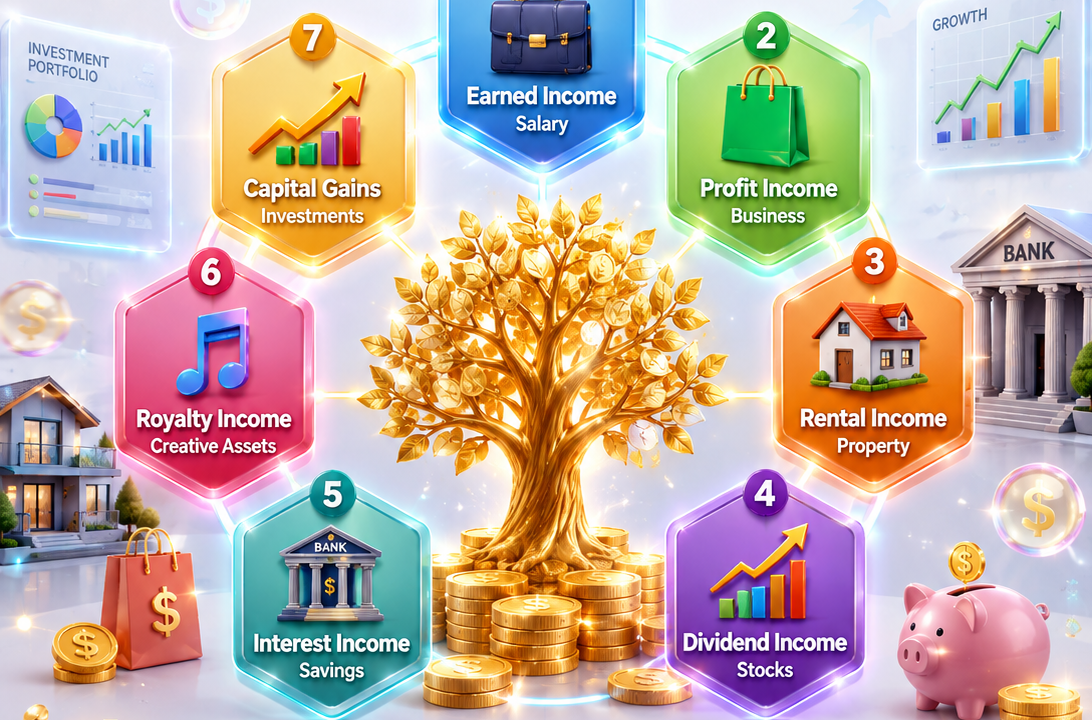
The financially elite don’t stumble upon their wealth; they engineer it through a strategic combination of these seven fundamental income streams:
- 💼 Earned Income: The foundation of most financial journeys.
- 🛍️ Profit Income: The reward for astute entrepreneurship and smart business acumen.
- 🏠 Rental Income: Generating cash flow from appreciating assets.
- 📈 Dividend Income: Earning from your ownership stake in successful companies.
- 🏦 Interest Income: The steady return on lending your capital.
- 🎵 Royalty Income: Monetizing your intellectual creations and intellectual property.
- 📊 Capital Gains: Profiting from the appreciation of your investments.
Let’s embark on a detailed exploration of each of these crucial wealth-building engines. 🔍
1. Earned Income: The Starting Line 🏁
What is Earned Income?
Earned income represents the compensation received for services rendered, whether as an employee or as a self-employed professional whose time and expertise directly translate into revenue. This is typically the initial stepping stone for the vast majority embarking on their financial odyssey. 🚶
Common manifestations of earned income include:
- 💼 Full-time employment in a corporate setting.
- 👨💻 Engaging in freelance work across various industries.
- 🛠️ Providing skilled trade services (plumbing, electrical, carpentry).
- 🏥 Offering professional expertise (doctors, lawyers, accountants).
- 📚 Delivering consulting services to businesses or individuals.
The primary allure of earned income lies in its predictability and the sense of financial stability it provides. However, its inherent limitation is that it ceases the moment you stop actively working. ⌛
Advantages:
- ✅ Consistent Monthly Cash Flow: Predictable paychecks make budgeting and financial planning significantly easier.
- ✅ Streamlined Budgeting: Knowing your regular income allows for more effective allocation of funds.
- ✅ Foundation for Savings and Investments: Earned income provides the capital necessary to start building other income streams.
Limitations:
- ⚠️ Constrained by Time: Your earning potential is directly tied to the hours you can dedicate.
- ⚠️ Vulnerability to Interruption: Income can be halted by unemployment, illness, or retirement.
The strategic imperative is to leverage earned income not as an endpoint, but as a powerful launchpad for establishing and nurturing additional income streams. 🚀
2. Profit Income: The Entrepreneurial Edge 💡
What is Profit Income?
Profit income is generated through the fundamental business principle of acquiring goods or services at a lower cost and subsequently selling them at a higher price, thereby capturing the difference as profit. This income stream is a direct reflection of entrepreneurial success. 🏆
Classic examples of profit-driven ventures include:
- 🛒 Operating an e-commerce store, selling a curated selection of products.
- 📦 Engaging in product reselling or arbitrage, buying low and selling high.
- 🏪 Running a brick-and-mortar retail business.
- 🎨 Creating and selling unique handmade crafts or artisanal products.
- 📱 Developing and marketing digital products (e-books, online courses, software).
Unlike earned income, which is directly correlated with the time spent working, profit income is dictated by the performance and scalability of the business itself. 📈
Benefits:
- ✅ Unlimited Growth Potential: The ceiling for profit is dictated by market demand and your business’s ability to scale, not your personal time.
- ✅ Business Scalability: Successful businesses can grow exponentially without a proportional increase in your workload.
- ✅ Flexible Earning Opportunities: You set the pace and direction of your income generation.
Risks:
- ⚠️ Inventory Costs and Management: Holding physical products incurs expenses and requires careful management.
- ⚠️ Intense Market Competition: Standing out in a crowded marketplace can be challenging.
- ⚠️ Fluctuating Customer Demand: Consumer preferences and market trends can shift unexpectedly.
The cornerstone of a thriving profit-generating business is its ability to identify and solve genuine customer problems while meticulously maintaining healthy profit margins. 🎯
3. Rental Income: The Asset Multiplier 🏠
What is Rental Income?
Rental income is the steady stream of revenue generated by allowing others to utilize your property or assets in exchange for periodic payments. This is a cornerstone of building passive wealth through tangible assets. 💰
Common applications include:
- 🏠 Renting out residential properties (houses, apartments).
- 🏢 Leasing commercial spaces (offices, retail units).
- 🚗 Offering vehicle rental services (cars, RVs).
- 🛠️ Providing access to equipment for rent (construction tools, event supplies).
Beyond the consistent monthly cash flow, rental properties often possess the dual benefit of appreciating in value over time, offering both income generation and long-term capital appreciation. 📈
Advantages:
- ✅ Regular Passive Cash Flow: A reliable source of income that requires less active management once set up.
- ✅ Potential for Property Appreciation: The value of the underlying asset can grow, increasing your net worth.
- ✅ Portfolio Diversification: Adds a tangible asset class to your investment portfolio, reducing overall risk.
Challenges:
- ⚠️ Ongoing Property Maintenance: Regular upkeep and repairs are necessary.
- ⚠️ Periods of Vacancy: Finding reliable tenants can sometimes involve downtime between leases.
- ⚠️ Unexpected Repair Expenses: Major repairs can arise, requiring significant capital outlay.
Effective property management is crucial to maximizing the long-term returns and minimizing the challenges associated with rental income. 📋
4. Dividend Income: Owning a Piece of the Pie 🍰
What is Dividend Income?
Dividend income is the passive cash flow received by shareholders when companies distribute a portion of their profits back to those who own their stock. It’s a way to profit from a company’s success without having to sell your shares. 🤑
Sources of dividend income typically include:
- 📈 Stocks of established, profitable companies.
- 🏦 Banks and financial institutions that regularly distribute profits.
- ⚡ Utility companies, known for their stable earnings and consistent dividends.
- 🥤 Consumer goods companies with enduring demand for their products.
A powerful strategy employed by many investors is the reinvestment of dividends. This practice harnesses the magic of compounding, allowing your wealth to grow at an accelerated rate over time. ✨
Benefits:
- ✅ Passive Cash Flow: Receive payments simply for holding shares, requiring no active trading.
- ✅ Long-Term Investment Growth: Combines regular income with potential capital appreciation of the stock itself.
- ✅ Compounding Wealth Potential: Reinvesting dividends amplifies your returns exponentially over time.
Considerations:
- ⚠️ Dividend Payments Are Not Guaranteed: Companies can reduce or suspend dividends during challenging periods.
- ⚠️ Stock Price Volatility: The value of your investment can fluctuate with market sentiment.
A diversified stock portfolio, holding shares in various industries and companies, is essential to mitigate investment risk. 🌐
5. Interest Income: The Reward for Saving 🏦
What is Interest Income?
Interest income is the return earned by lending your money, whether through traditional banking products or more innovative lending platforms. It’s the compensation for allowing others to use your capital. 💸
Common avenues for earning interest include:
- 🏦 High-yield savings accounts offering competitive annual percentage yields.
- 📜 Government and corporate bonds, providing fixed or variable interest payments.
- 💳 Peer-to-peer (P2P) lending platforms, connecting borrowers and lenders directly.
- 💰 Certificates of Deposit (CDs), offering a fixed interest rate for a set term.
While typically associated with lower risk compared to many equity investments, interest income often yields more modest returns. It’s primarily used for capital preservation and generating steady, predictable earnings. 🛡️
Benefits:
- ✅ Predictable Earnings: Interest payments are generally calculated and disbursed on a defined schedule.
- ✅ Lower Investment Risk: Often considered a safer option, especially with insured accounts and government bonds.
- ✅ Ease of Management: Typically requires minimal effort to set up and monitor.
Drawbacks:
- ⚠️ Returns May Not Outpace Inflation: In some economic conditions, interest earned might not keep pace with the rising cost of living.
- ⚠️ Interest Rate Fluctuations: Rates can change, impacting future earnings, especially with variable-rate accounts.
Interest income plays a vital role in a balanced financial strategy, offering a stable component for capital preservation. ⚖️
6. Royalty Income: Monetizing Your Creativity 🎵
What is Royalty Income?
Royalty income is earned when individuals or entities pay for the right to use your intellectual property or creative works. This income stream offers the potential for long-term, passive revenue from assets created once. 🎨
Examples of intellectual property that can generate royalties include:
- 🎵 Music compositions and recordings.
- 📚 Books, articles, and other written content.
- 🎬 Films, scripts, and other audiovisual works.
- 📷 Photographs and visual art.
- 💻 Software code and digital applications.
- ✨ Patents and other forms of licensed intellectual property.
The beauty of royalty income lies in its scalability and its potential to generate earnings for years, even decades, after the initial creative effort. 🌟
Benefits:
- ✅ Highly Scalable: Once created, your intellectual property can be licensed repeatedly without additional production costs.
- ✅ Long-Term Passive Income Potential: Can become a consistent revenue stream with minimal ongoing effort.
- ✅ Global Earning Opportunities: Intellectual property can be licensed and sold worldwide.
Challenges:
- ⚠️ Significant Upfront Creative Effort: Requires substantial time, skill, and often investment to create valuable intellectual property.
- ⚠️ Competitive Markets: Standing out in creative industries can be difficult.
- ⚠️ Complex Licensing and Legal Requirements: Navigating intellectual property law can be intricate.
Developing strong, unique intellectual property can transform into an incredibly valuable and enduring asset. 💎
7. Capital Gains: The Appreciation Advantage 📈
What are Capital Gains?
Capital gains are realized when you sell an asset for more than its original purchase price. This represents the profit earned from the appreciation in value of your investments. 💰
Common assets that generate capital gains include:
- 📈 Stocks and bonds.
- 🏠 Real estate (residential, commercial, land).
- 🪙 Precious metals (gold, silver, platinum).
- 💼 Investment funds (mutual funds, ETFs).
- 🏢 Businesses and private equity stakes.
For example, purchasing shares of a company for $1,000 and selling them later for $1,500 results in a capital gain of $500. 💲
Advantages:
- ✅ Significant Long-Term Wealth Potential: Successful investments can yield substantial returns over time.
- ✅ Portfolio Growth: Directly contributes to the overall increase in your net worth.
- ✅ Flexible Investment Choices: Allows for a wide range of investment strategies and asset classes.
Risks:
- ⚠️ Market Volatility: Asset values can fluctuate significantly, leading to potential losses.
- ⚠️ Timing Uncertainty: Predicting the optimal time to buy and sell can be challenging.
- ⚠️ Risk of Investment Losses: There’s always a possibility that an investment may not appreciate as expected.
Adopting a long-term investment perspective is often the most effective strategy for mitigating the impact of short-term market fluctuations and maximizing the potential for capital gains. ⏳
Active vs. Passive Income: A Harmonious Blend ☯️
Understanding the distinction between active and passive income is fundamental to crafting a well-rounded and robust financial strategy.
Active Income: This income requires your continuous effort and direct involvement to generate. It’s the money earned from trading your time for money.
- 💼 Salaries and wages from employment.
- 👨💻 Income from freelance projects or contract work.
- 🏪 Revenue generated from the day-to-day operations of a small business.
Passive Income: This income continues to flow with minimal ongoing active effort after the initial investment or work has been completed. It’s income that works for you.
- 🏠 Rental income from properties.
- 📈 Dividend income from stocks.
- 🏦 Interest income from savings and loans.
- 🎵 Royalty income from intellectual property.
The most successful and resilient financial plans strategically integrate both active and passive income streams, creating a powerful synergy for wealth creation. 🤝
A Beginner’s Roadmap to Building Multiple Income Streams 🗺️
It’s important to recognize that building all seven income streams simultaneously is an ambitious undertaking, especially for beginners. A more practical and sustainable approach involves a phased strategy:
- 🌱 Establish a Stable Earned Income Foundation: Focus on a reliable primary income source to provide the financial bedrock.
- 💰 Build an Emergency Fund: Create a safety net of 3-6 months of living expenses to handle unexpected events without derailing your financial progress.
- 📈 Begin Consistent Investing: Start investing small amounts regularly in diversified assets like index funds or ETFs to allow compounding to work its magic.
- 🏠 Explore Income-Producing Assets: Once your emergency fund is solid and investing is underway, consider avenues like dividend stocks or real estate crowdfunding.
- 🛒 Investigate Small Business Opportunities: Look for scalable side hustles or e-commerce ventures that align with your interests and skills.
- 📚 Develop Valuable Skills or Intellectual Property: Invest in yourself by learning new skills or creating content that can be monetized through royalties or services.
- 🔄 Reinvest Profits Strategically: Channel the earnings from your developing income streams back into your ventures or investments to accelerate growth and compounding.
Remember, consistency and patience are far more critical than rapid execution. Small, consistent steps lead to significant long-term results. 🐢➡️🐇
Navigating the Pitfalls: Common Mistakes to Sidestep ⚠️
To ensure your journey towards multiple income streams is both successful and sustainable, be mindful of these common financial missteps:
- ⚠️ Solely Relying on One Paycheck: This creates an inherent vulnerability to economic downturns or job loss.
- ⚠️ Chasing Unrealistic Returns: Be wary of get-rich-quick schemes that promise astronomical gains with little risk; they are often unsustainable or fraudulent.
- ⚠️ Neglecting Financial Education: Continuous learning about personal finance, investing, and business is crucial for making informed decisions.
- ⚠️ Spending Instead of Investing: Prioritize allocating a portion of your income towards wealth-building activities rather than immediate consumption.
- ⚠️ Taking on Unnecessary Debt: High-interest debt can severely hinder your ability to save and invest effectively.
- ⚠️ Failing to Diversify Income Sources: The core principle of this strategy is diversification; neglecting it defeats the purpose.
A balanced and well-thought-out financial plan is the bedrock of sustainable wealth creation. 🏗️
Frequently Asked Questions (FAQs) 🤔
What is the most common income stream?
Earned income is the most prevalent, as most individuals begin their careers by working for wages or salaries.
Which income streams are considered passive?
Rental income, dividend income, royalty income, and interest income are typically categorized as passive once they are established and require minimal ongoing active management.
Do I need a substantial amount of money to start investing?
Not at all! Many modern investment platforms allow individuals to begin with relatively modest sums and build their portfolios through consistent, regular contributions over time.
Which income stream offers the highest growth potential?
Profit income derived from successful businesses and capital gains from well-timed, strategic investments often exhibit the highest growth potential, though they typically come with elevated levels of risk.
Is it possible for one person to build all seven income streams?
Absolutely. Many financially successful individuals gradually construct and nurture multiple income streams over many years, rather than attempting to establish all of them simultaneously. It’s a marathon, not a sprint. 🏃♀️💨
The Grand Finale: Your Path to Financial Liberation 🎉
Cultivating lasting wealth is not about discovering a single, elusive perfect income source. Instead, it’s about the strategic construction of a diversified and resilient financial foundation. Each of the seven identified income streams serves a distinct and valuable purpose, from providing essential stability through earned income to unlocking long-term growth via astute investments, lucrative rentals, valuable royalties, and thriving business profits. 🏆
Rather than feeling overwhelmed by the prospect of developing every income stream at once, focus your energy on fortifying your primary income source, continuously enhancing your financial literacy, and consistently allocating capital to opportunities that genuinely align with your aspirations. Over time, the synergistic interplay of these multiple income streams will not only bolster your financial resilience and expand your earning potential but will also pave the most direct and attainable route to achieving your ultimate goal of long-term financial independence. 🔑 The journey to financial freedom begins with understanding, strategizing, and taking consistent action. Let’s build that future, together. 💪🌍