
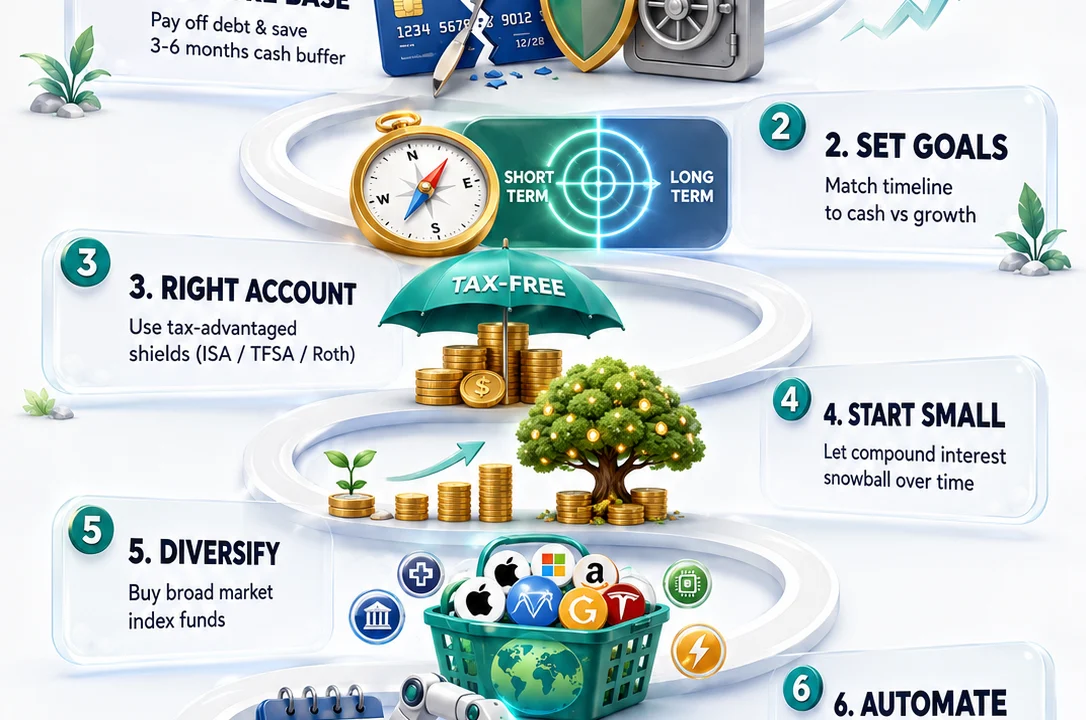
Embarking on your investment journey from an absolute standstill can feel like staring up at an insurmountable mountain. ⛰️ The financial world is a dizzying spectacle of charts, complex terminology, and a cacophony of advice from self-proclaimed experts. 📢 It’s understandable to feel paralyzed by the sheer volume of information. 🤯
But here’s a liberating truth: you don’t need a finance degree or a six-figure salary to sculpt a robust, high-performing investment portfolio. 🏆 By establishing a strong foundation and employing intelligent, automated strategies, anyone can cultivate enduring financial security over time. 💎 This is your definitive roadmap to igniting your wealth-building engine, safely and effectively. 📈 Let’s unlock your potential, step by step!
How do beginners start investing money from scratch step by step?
To start investing from scratch, first eliminate high-interest debt and build a 3-to-6-month emergency cash buffer. Next, define clear long-term financial goals, choose a tax-advantaged investment account, and invest consistently into low-cost, diversified index funds using automated monthly transfers.
If you’ve been waiting for the ‘perfect moment’ to begin, that moment is unequivocally *now*. ⏱️ Join us as we navigate the seven crucial steps that will transform you from a complete novice into a confident, lifelong investor. 🌟
🏠 Step 1: Fortify Your Financial Foundation First 🛡️
Diving headfirst into the stock market without essential financial safeguards in place is a precarious strategy, akin to building a house on quicksand. 🏗️ Sadly, a significant portion of adults report struggling to manage unexpected expenses without resorting to borrowing. 💸 When life inevitably throws a curveball, a lack of readily available cash can force you to divest from your investments at the most inopportune times. 📉
Before you allocate even a single dollar towards market investments, prioritize these three fundamental actions: 📌
- 💳 Conquer High-Interest Debt: Prioritize eliminating credit card balances and personal loans that charge exorbitant annual interest rates (often 20% to 40% or more) before engaging in investing.
- 🏦 Establish a Solid Emergency Fund: Secure 3 to 6 months’ worth of your essential living expenses in a high-yield savings account, ensuring easy access to funds when needed.
- 📊 Stabilize Your Spending: Gain a clear understanding of your monthly cash flow. Knowing precisely how much surplus income you generate will empower you to invest safely and consistently.
Attempting to grow your wealth through investments while simultaneously carrying substantial high-interest debt is like trying to fill a leaky bucket. 🪣 The average historical annual return of the stock market typically hovers around 8% to 10%. 📈 If your credit card debt is costing you 25% annually, you are effectively losing money at a far greater rate than your investments can realistically generate. 🧯
⚠️ Common Mistake: The urge to skip building your emergency savings buffer because you’re eager to catch up to the large portfolios you see online. However, if the market experiences a downturn and your car breaks down, you might be forced to sell your investments at a loss to cover the repair costs. 🚗💥
Organizing your basic cash reserves is not a delay tactic; it’s a crucial strategic move. ⏱️ Consider it completing level one of your lifelong wealth-building strategy. 🎮 With a robust financial foundation firmly established, you’ll possess the resilience to navigate market volatility with a steady hand. 🧘♂️
🎯 Step 2: Define Your Clear Goals and Time Horizon ⏳
Did you know that a surprisingly small fraction of casual investors actually articulate specific long-term financial objectives when they open investment accounts? 🔍 Many individuals impulsively invest in trending individual stocks, hoping for rapid gains, only to succumb to panic when market fluctuations occur. 🎢
Your unique financial timeline should dictate precisely how every dollar you possess is allocated: 🧭
- 🏡 Short-Term Goals (Less than 5 years): Funds designated for a down payment on a home, purchasing a new vehicle, or covering wedding expenses should be kept securely in high-yield savings or money market accounts.
- 🌴 Long-Term Goals (5 to 30+ years): Capital intended for early retirement or achieving long-term financial independence should be strategically invested in growth-oriented assets like stocks.
Engaging in short-term stock trading is an inherently unpredictable and volatile endeavor. 🌊 Over a 12-month period, major market indexes can experience significant fluctuations based on economic news and global events. 📰 However, when you extend your investment horizon over 10, 20, or even 30 years, historical data consistently demonstrates that global equities tend to outperform cash holdings by a substantial margin. 💸
📌 Key Takeaway: Aligning your investment choices with your financial timeline is paramount to preventing costly errors. Keep your short-term funds readily accessible, and allow your long-term capital to weather short-term market fluctuations without interference. 🎯
When you possess a clear understanding of *why* you are investing, temporary market downturns lose their power to instill fear. 🛡️ You begin to perceive these short-term dips not as losses, but as temporary discount opportunities on your path toward multi-decade financial independence. 🛒
🏦 Step 3: Select the Optimal Tax-Advantaged Investment Account 📑
The process of choosing an investment account is a common pitfall where many beginners fall prey to ‘analysis paralysis.’ 🌀 Spending countless hours poring over brokerage reviews without actually opening an account can significantly hinder your ability to benefit from compounding returns. ⏳ In reality, opening an investment account typically takes less than ten minutes directly from your smartphone. 📱
The ideal account structure for you will depend on your employment status and geographical location: 🌐
- 💼 Workplace Retirement Contributions: If your employer offers a retirement plan with matching contributions, always contribute enough to secure the full employer match. This is essentially ‘free money’ that instantly boosts your returns. 💸
- 🛡️ Tax-Free Growth Accounts: Leverage accounts such as a Stocks & Shares ISA (United Kingdom), a Tax-Free Savings Account (TFSA) in Canada, or a Roth IRA in the United States. These accounts allow your investments to grow and generate returns completely tax-free. 🏆
- 💻 Retirement Plans for Self-Employed: If you are an independent contractor or run your own business, establishing a dedicated retirement savings account is a highly efficient way to save for your future. ⚙️
When you engage in trading stocks within a standard taxable brokerage account, taxes on capital gains and dividends can significantly erode your long-term investment returns. ✂️ By utilizing a tax-advantaged wrapper, you ensure that 100% of your compounding returns remain within your account, dramatically accelerating your portfolio’s growth over the long haul. 🚀
💡 Quick Tip: Avoid getting bogged down in trying to find the ‘ultimate’ trading platform with elaborate charting tools. Focus instead on selecting a reputable, low-fee brokerage that offers straightforward index fund options and reliable automated transfer capabilities. ⚙️
Once your chosen account is successfully opened, you are already positioned significantly ahead of the majority of your peers. 🏃♂️ You don’t need a business degree to navigate this process; the crucial step is simply taking that initial, intentional action. 👟
🌱 Step 4: Start Modestly and Let Compounding Work Its Magic 📈
A pervasive misconception that prevents many beginners from starting is the belief that you must possess thousands of dollars to begin investing. 💰 The reality is that investing small, consistent amounts regularly can lead to extraordinary wealth accumulation over time, thanks to the unparalleled power of compound interest. ⚙️
Consider the remarkable outcome of investing just $100 every month, assuming an average annual return of 8%: 📊
- 📅 After 10 Years: Total invested: $12,000 ➡️ Estimated portfolio value: ~$18,400 ✨
- 📅 After 20 Years: Total invested: $24,000 ➡️ Estimated portfolio value: ~$59,000 🚀
- 📅 After 30 Years: Total invested: $36,000 ➡️ Estimated portfolio value: ~$149,000 💎
Notice how the growth trajectory accelerates dramatically in the final decade? 🏋️♂️ This is the phenomenon of compound interest in full effect. Your initial investments earn returns, and subsequently, those generated returns begin to earn their own returns, creating a powerful, self-reinforcing financial snowball. ☃️
🧠 Expert Insight: Consistently investing over time (‘time in the market’) is always more powerful than trying to predict short-term market movements (‘timing the market’). Starting today with a modest $25 per month is significantly more impactful than waiting five years to begin with $250 per month, as you’d miss out on years of invaluable compounding growth. ⏳
The fear of potential financial loss deters over 40% of prospective investors from taking any action. 🙈 By commencing with smaller contributions, you can safely build your tolerance for market risk without compromising your peace of mind. 🧘
🍕 Step 5: Achieve Instant Diversification with Broad Market Index Funds 🌍
Imagine approaching a buffet and loading your entire plate with nothing but raw garlic. 🧄 The experience would likely be unpleasant and regrettable! 🤢 A balanced and satisfying meal requires variety, and your financial portfolio operates on the exact same principle. 🥗
If your entire net worth is concentrated in a single technology company or a speculative cryptocurrency, your financial well-being is exceptionally vulnerable. ⚡ Should that specific entity encounter negative news or face operational challenges, your entire portfolio could plummet overnight. 💥 Diversification acts as a crucial protective shield against single-company risk. 🛡️
- 🏛️ S&P 500 Index Funds: These funds allow you to acquire a fractional ownership in the 500 largest publicly traded companies in the United States with a single investment.
- 🌐 Total World Stock Funds: These funds instantaneously spread your capital across thousands of global corporations spanning diverse sectors like healthcare, technology, and energy.
- ⚖️ Automatic Rebalancing: Index funds possess an inherent mechanism that automatically divests from underperforming companies and reallocates capital to emerging industry leaders over time.
Index funds empower you to own a stake in the entire market rather than attempting the challenging task of hand-picking individual winning stocks. 🪡 This means you won’t need to dedicate hours to deciphering company financial statements or constantly monitoring stock tickers amidst breaking news. 📺
🏆 Best Practice: Opt for low-cost, broad-market index funds or Exchange Traded Funds (ETFs) that have expense ratios below 0.10%. Minimizing investment fees ensures that a larger portion of your money remains within your portfolio, where it can compound and grow over time. 💎
By capturing the overall growth trajectory of global innovation, the performance of successful companies inherently offsets the performance of those experiencing setbacks. 📈 This inherent balance allows you to maintain peace of mind, knowing your capital is prudently spread across the diversified global economy. 💤
🤖 Step 6: Automate Your Contributions and Streamline Your Process ⚙️
Here’s a fascinating financial insight: internal studies conducted by major investment firms have revealed that some of their most consistently successful investment accounts belonged to individuals who had, in essence, forgotten about their accounts or had even passed away! 😮 The underlying lesson is remarkably clear – the less you actively interfere with your investment portfolio, the more likely you are to achieve superior results. 🛑
Human emotions often act as the single greatest impediment to long-term wealth accumulation. 🧠 When markets are experiencing a bullish run, greed can tempt individuals into buying assets at inflated prices. Conversely, when markets decline, fear can drive investors to sell their holdings at a loss. 📉
- 📆 Schedule Automatic Transfers on Payday: Program your bank to initiate automatic transfers directly to your investment account immediately following the arrival of your paycheck.
- ⚙️ Enable Automatic Investing: Configure your brokerage platform to automatically purchase your selected index fund on a predetermined monthly schedule.
- 🙈 Remove Ticker Tracking Apps: Resist the temptation to check your investment performance daily. For long-term investors, reviewing your portfolio once per quarter is more than sufficient.
Automating your investments effectively removes the element of human decision-making and emotional response from the equation. 🤖 You are no longer expending mental energy debating whether today is an opportune moment to invest or anxiously waiting for market news cycles to conclude. ☁️
📖 Mini Summary: Automation eradicates emotional hesitation. By prioritizing ‘paying yourself first’ through automated contributions, you ensure your wealth-building engine operates silently and consistently in the background, allowing you to focus on living your life. 🚀
Simple, disciplined systems consistently outperform complex, high-stress trading strategies. 🏆 Establish an automated routine once, and allow it to quietly accumulate capital for you over the decades. 🌲
🧘 Step 7: Cultivate Calmness During Market Downturns 🌊
Throughout history, spanning over 150 years, the stock market has endured numerous significant crashes, economic recessions, and periods of global panic. 📉 Yet, remarkably, after every single historical downturn, the market has consistently recovered and proceeded to reach unprecedented all-time highs. ⛰️
Understanding the cyclical nature of market behavior can profoundly alter your perspective on volatility: 📜
| Historic Event 📉 | Market Reaction ⚡ | Long-Term Outcome 🚀 |
|---|---|---|
| Dot-Com Crash (2000) | Sharp decline as tech bubble burst | Market rebounded to achieve new record highs 📈 |
| Financial Crisis (2008) | Severe global economic recession | Followed by an unprecedented decade-long bull market 🐂 |
| COVID Crash (2020) | Rapid drop of over 30% within weeks | Experienced the fastest market recovery in history ⏱️ |
When your investment portfolio turns red during a market downturn, your primal brain instincts can trigger a crisis response. 🚨 It can feel as though your hard-earned capital is dissolving into thin air. However, it’s crucial to remember: a market drop represents a ‘paper loss’ only if you choose to liquidate your assets. 🛑
Investors who demonstrate patience and continue their automated monthly contributions during periods of market decline are essentially purchasing shares at significant bargain prices. 🏷️ When the market inevitably rebounds, these strategically acquired discounted shares contribute to substantial portfolio growth. 💥
📌 Key Takeaway: The stock market rewards patience and disciplined behavior, not panic-driven decisions. By zooming out and viewing multi-decade charts, you can remind yourself that even terrifying market dips are merely minor speed bumps on a long, upward trajectory. 🧗♂️
Maintaining emotional composure becomes significantly easier as you gain experience. 🧠 By ensuring your emergency fund remains intact, you will never be compelled to sell your investments during a market storm, thereby giving your capital ample opportunity to recover and emerge even stronger. 💎
📌 Essential Takeaways for New Investors 🌟
Cultivating substantial wealth does not necessitate extraordinary innate talent; it requires consistent, disciplined behavior. 🧘 Here is your concise action checklist to initiate and accelerate your investment portfolio: 📋
- ✅ Eliminate High-Interest Debt First: Eradicate costly credit card balances before allocating funds to stock market investments.
- ✅ Build a Financial Safety Net: Assemble a cash reserve equivalent to 3 to 6 months of your living expenses in an easily accessible savings account.
- ✅ Define Your Investment Horizon: Keep funds needed within the next five years in cash equivalents; invest long-term capital intended for durations exceeding five years.
- ✅ Utilize Tax-Efficient Accounts: Open tax-advantaged accounts such as ISAs, TFSAs, or Roth IRAs to shield your investment gains from taxation.
- ✅ Choose Diversified Index Funds: Invest in broad-market index funds, like those tracking the S&P 500, to achieve instant diversification across numerous industries and companies.
- ✅ Automate Your Contributions: Schedule recurring monthly transfers directly from your bank account on payday to remove emotional decision-making.
- ✅ Navigate Market Volatility: Maintain a calm demeanor during market downturns and allow the power of compound interest to drive long-term growth.
🏁 Final Thoughts: Initiate Your First Step Today 🚀
You do not need to make perfectly flawless decisions to achieve financial success – you simply need to begin. 🌟 The single most significant misstep you can make is remaining on the sidelines for years, perpetually waiting for the ‘ideal’ moment to invest. ⏳
Focus on taking small, manageable steps starting right now. Open that tax-advantaged investment account, schedule a modest recurring deposit of $25, and select a straightforward index fund. 📈 As your confidence and understanding grow, your financial habits will naturally expand and evolve alongside them. 💼
Your future self will undoubtedly express gratitude for the courage you demonstrated today in quietly initiating the process of building genuine financial security. 💎 Take command of your financial routine, steadfastly adhere to your well-defined plan, and allow time to perform its magical mathematical work on your growing wealth! 🏆
{
“@context”: “https://schema.org”,
“@graph”: [
{
“@type”: “Article”,
“headline”: “Your 7-Step Blueprint to Investing from Zero & Building Lasting Wealth”,
“description”: “Start investing from scratch with our 7-step guide! Learn to build wealth safely, overcome fear, and automate your financial future at SmartSave.top.”,
“author”: {
“@type”: “Organization”,
“name”: “SmartSave.top”
},
“publisher”: {
“@type”: “Organization”,
“name”: “SmartSave.top”,
“logo”: {
“@type”: “ImageObject”,
“url”: “https://www.smartsaves.top/logo.png”
}
},
“mainEntityOfPage”: {
“@type”: “WebPage”,
“@id”: “https://www.smartsaves.top/blog/investing-from-scratch”
}
}
]
}
{
“@context”: “https://schema.org”,
“@type”: “FAQPage”,
“mainEntity”: [
{
“@type”: “Question”,
“name”: “How do beginners start investing money from scratch step by step?”,
“acceptedAnswer”: {
“@type”: “Answer”,
“text”: “To start investing from scratch, first eliminate high-interest debt and build a 3-to-6-month emergency cash buffer. Next, define clear long-term financial goals, choose a tax-advantaged investment account, and invest consistently into low-cost, diversified index funds using automated monthly transfers.”
}
},
{
“@type”: “Question”,
“name”: “Why should high-interest debt be paid off before investing?”,
“acceptedAnswer”: {
“@type”: “Answer”,
“text”: “High-interest debt like credit cards often carries interest rates between 20% and 40%, whereas average stock market returns are around 8% to 10%. Paying off debt guarantees a higher return than what you would typically earn from investments.”
}
},
{
“@type”: “Question”,
“name”: “How much money should be kept in an emergency fund?”,
“acceptedAnswer”: {
“@type”: “Answer”,
“text”: “You should set aside 3 to 6 months of essential living expenses in a high-yield, easily accessible cash savings account before putting capital into market investments.”
}
},
{
“@type”: “Question”,
“name”: “How does time horizon affect investment strategy?”,
“acceptedAnswer”: {
“@type”: “Answer”,
“text”: “Money needed in under 5 years should be kept in high-yield cash accounts to avoid short-term market volatility, while long-term capital meant for 5 to 30+ years should be invested in equities for growth.”
}
},
{
“@type”: “Question”,
“name”: “What is a tax-advantaged investment account?”,
“acceptedAnswer”: {
“@type”: “Answer”,
“text”: “A tax-advantaged account, such as a Stocks & Shares ISA in the UK, TFSA in Canada, or Roth IRA in the US, allows your investments to grow without paying capital gains or dividend taxes.”
}
},
{
“@type”: “Question”,
“name”: “Should you take advantage of workplace pension matching?”,
“acceptedAnswer”: {
“@type”: “Answer”,
“text”: “Yes, if your employer offers matching contributions to your workplace pension, you should always contribute enough to claim the full match, as it represents immediate free money.”
}
},
{
“@type”: “Question”,
“name”: “Do you need a lot of money to start investing?”,
“acceptedAnswer”: {
“@type”: “Answer”,
“text”: “No, you can start investing with small amounts like $25 or $100 per month. Thanks to compound interest, consistent small contributions grow significantly over long periods.”
}
},
{
“@type”: “Question”,
“name”: “How does compound interest work in stock market investing?”,
“acceptedAnswer”: {
“@type”: “Answer”,
“text”: “Compound interest occurs when your principal investment earns returns, and those returns begin earning their own returns, creating an accelerating growth snowball over time.”
}
},
{
“@type”: “Question”,
“name”: “What is diversification in personal finance?”,
“acceptedAnswer”: {
“@type”: “Answer”,
“text”: “Diversification spreads your money across hundreds or thousands of companies and sectors rather than single stocks, reducing the risk of massive losses if one company fails.”
}
},
{
“@type”: “Question”,
“name”: “What is an index fund?”,
“acceptedAnswer”: {
“@type”: “Answer”,
“text”: “An index fund is a low-cost basket of investments designed to track the performance of an entire market, such as the S&P 500, giving you instant broad-market diversification.”
}
},
{
“@type”: “Question”,
“name”: “Why is automating monthly investments important?”,
“acceptedAnswer”: {
“@type”: “Answer”,
“text”: “Automating monthly transfers right after payday removes human emotion, ensures consistency, and stops you from overthinking market timing or talking yourself out of investing.”
}
},
{
“@type”: “Question”,
“name”: “What should you do when the stock market drops?”,
“acceptedAnswer”: {
“@type”: “Answer”,
“text”: “Stay calm and continue your automated contribution strategy. Historically, stock markets have always recovered from dips and gone on to reach new all-time highs over the long term.”
}
},
{
“@type”: “Question”,
“name”: “How often should you check your investment portfolio?”,
“acceptedAnswer”: {
“@type”: “Answer”,
“text”: “Long-term investors should avoid checking portfolios daily to minimize emotional stress. Reviewing your balance quarterly or annually is sufficient for automated index fund strategies.”
}
},
{
“@type”: “Question”,
“name”: “What is an expense ratio in index funds?”,
“acceptedAnswer”: {
“@type”: “Answer”,
“text”: “An expense ratio is the annual fee charged by an index fund or ETF to manage the investment. Choosing funds with low expense ratios (under 0.10%) preserves more of your returns.”
}
},
{
“@type”: “Question”,
“name”: “What is the biggest mistake beginner investors make?”,
“acceptedAnswer”: {
“@type”: “Answer”,
“text”: “The biggest mistake is waiting on the sidelines for the ‘perfect time’ to invest or panic-selling assets during temporary market downturns instead of holding for the long term.”
}
}
]
}


