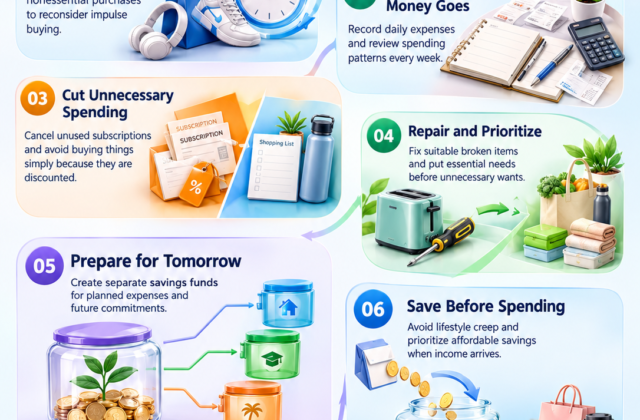

Embarking on a journey to financial prosperity doesn’t always mean you need to earn a higher salary. Often, the most profound transformations in wealth accumulation stem from mastering the art of wise money management. 🧠 This comprehensive guide unveils 10 essential money-saving rules, meticulously designed to fortify your financial stability, trim unnecessary expenditures, and pave the way for enduring wealth. Explore innovative techniques like automating your savings, cultivating a robust emergency fund, adhering to the acclaimed 50/30/20 budgeting framework, mastering the art of avoiding impulsive buys, strategically dismantling recurring costs, leveraging cash with purpose, and ensuring every paycheck works harder for you. Whether you are just beginning your financial voyage or seeking to refine your existing saving discipline, these time-tested strategies are refreshingly simple to integrate and remarkably effective over the long haul. Uncover actionable insights, practical illustrations, and intelligent budgeting approaches that simplify saving money without necessitating drastic lifestyle compromises. The small financial decisions you consistently make today hold the power to unlock greater financial autonomy, enhance security, and cultivate lasting prosperity for the future. Begin implementing these intelligent money habits now and seize confident command over your personal finances. ✨
Unlock Financial Freedom: The Ultimate Guide to Smart Money-Saving Rules 🗝️
The pursuit of wealth isn’t solely about the money coming in; it’s equally, if not more importantly, about how intelligently you manage the income you already possess. Consistently applying sound financial habits month after month can aggregate into substantial financial security and growth over time. Many individuals mistakenly believe that increasing their income is the only viable path to building wealth. In reality, diligently managing your existing earnings often yields a more significant and sustainable impact. This guide introduces ten proven money-saving rules that are accessible, practical, and adaptable to virtually any income bracket. 🌱
🌟 Why Prioritizing Smart Saving is Crucial
Genuine financial security is the bedrock of a well-lived life, and it’s built upon the foundation of healthy financial habits. Life is unpredictable; unforeseen medical expenses, unexpected job transitions, critical vehicle repairs, or sudden family emergencies can arise without warning. A well-structured savings strategy acts as your shield against these eventualities while simultaneously propelling you toward your larger financial aspirations. 💪
The profound benefits of consistent saving include:
- ✅ Reduced financial stress and anxiety.
- ✅ Enhanced preparedness for unexpected life events.
- ✅ Expanded opportunities for strategic investments.
- ✅ Greater personal financial independence and autonomy.
- ✅ Increased confidence in making significant life decisions.
The ultimate objective extends beyond mere accumulation of savings; it is about establishing a financial ecosystem that operates with automated efficiency. ⚙️
💳 1. Embrace the Power of Automated Savings
One of the most effective strategies for ensuring consistent saving is to eliminate the need for manual decision-making. Instead of adopting a ‘save what’s left over’ mentality at the end of the month, schedule an automatic transfer of funds to a dedicated savings account the moment your salary is credited. This proactive approach embodies the principle of “Pay Yourself First.” By moving savings before any spending commences, you significantly reduce the likelihood of diverting those funds toward non-essential purchases. Consider this example: If your monthly income is ₹40,000, set up an automatic transfer of ₹5,000 to your savings account on each payday. This simple action builds savings reliably, removes emotional spending biases, and cultivates enduring financial discipline. 🚀
🚨 2. Construct a Robust Emergency Fund
Unexpected expenses should never be the catalyst for accumulating debt. Your emergency fund serves as your indispensable financial safety net, offering crucial protection during challenging periods. Financial experts universally recommend accumulating savings equivalent to three to six months of essential living expenses. For instance, if your monthly expenditures hover around ₹25,000, your target emergency fund should range between ₹75,000 and ₹1,50,000. Critically, this money should be held in an easily accessible savings account, not in high-risk investment vehicles. This fund is your shield against medical crises, job loss, urgent home or vehicle repairs, and other unforeseen emergencies. 🛡️
🎁 3. Strategically Save Bonuses and Windfall Income
Financial windfalls such as salary bonuses, tax refunds, incentives, commissions, or even monetary gifts often tend to vanish quickly, primarily because they are perceived as ‘extra money.’ Resist the temptation to spend the entire amount. Instead, make a conscious decision to save or invest a substantial portion of these unexpected incomes. For example, if you receive an annual bonus of ₹20,000, setting aside even 80% of it can provide a significant boost to your long-term financial objectives. Unexpected income represents one of the most accessible avenues for augmenting your savings without disrupting your regular monthly budget. 💰
📈 4. Amplify Savings Post-Salary Increment
Beware of lifestyle inflation, a subtle yet potent force that can quietly erode your future wealth. It’s a common human tendency to upgrade one’s lifestyle with increased spending as soon as a salary hike is received. Instead of immediately raising your expenditure levels, make it a habit to increase your monthly savings contributions proportionally. For example, if your salary increases by ₹10,000 per month, commit to directing at least ₹5,000 of that increase towards savings or investments before adjusting your lifestyle. This disciplined approach ensures that your wealth grows in tandem with your career progression, fostering sustainable financial growth. 🌟
📊 5. Embrace the 50/30/20 Budgeting Framework
Budgeting need not be an arduous or complicated undertaking. The widely adopted 50/30/20 Rule offers a refreshingly straightforward and balanced framework for managing your finances. This rule suggests allocating your after-tax income as follows:
- 🟢 50% for Essential Needs (Needs): This category covers your fundamental living costs, including housing, utilities, groceries, transportation, and insurance premiums.
- 🔵 30% for Personal Wants (Wants): This portion is dedicated to discretionary spending on entertainment, dining out, travel, shopping for non-essentials, and various subscriptions.
- 🟠 20% for Savings and Investments: This crucial segment is allocated towards building your emergency fund, contributing to retirement accounts, investing in mutual funds or stocks, and making accelerated debt repayments.
Let’s illustrate with an example: If your monthly income is ₹50,000, your allocation would be ₹25,000 for needs, ₹15,000 for wants, and ₹10,000 for savings and investments. This balanced structure is instrumental in curbing overspending while simultaneously encouraging consistent saving habits. ⚖️
⏳ 6. Implement the 24-Hour Pause Rule for Purchases
Impulse purchases are one of the most significant adversaries of financial progress. Before committing to any significant purchase, institute a mandatory waiting period of at least 24 hours. During this pause, critically assess the item: Do I truly require this? Will I still desire it tomorrow? Can this purchase realistically wait? Does it align with and support my overarching financial objectives? In many instances, the initial excitement diminishes after a day, effectively preventing unnecessary spending. For more substantial purchases, consider extending this waiting period to 7 or even 30 days to ensure the decision is well-considered and financially sound. 🤔
❌ 7. Ruthlessly Eliminate Recurring Expenses
Subtle, recurring charges can silently drain hundreds or even thousands of your hard-earned money each year without you even noticing. Conduct a thorough and regular review of your monthly expenses. Scrutinize your statements for items such as streaming subscriptions, gym memberships you rarely use, mobile app subscriptions, cloud storage plans, credit card annual fees, duplicate insurance policies, or any memberships that are no longer beneficial. Actively cancel services that you infrequently utilize. Furthermore, the act of negotiating lower rates or switching to alternative providers can yield substantial reductions in your recurring expenses. ✂️
💵 8. Leverage Cash for Variable Spending Categories
The convenience of digital payment methods can often create a sense of detachment from actual spending, making it harder to track expenditures. Conversely, using physical cash for variable spending categories inherently fosters greater spending awareness, as you physically see your money diminishing from your wallet. Consider employing cash for categories such as groceries, entertainment, dining out, general shopping, and other personal miscellaneous expenses. Allocate a fixed weekly cash budget and commit to avoiding additional withdrawals until the start of the following week. This straightforward habit naturally imposes a limit on overspending. 💸
🔄 9. Master the Art of Rounding Down and Saving the Difference
Many modern banking systems offer a convenient feature that automatically rounds up your purchases, transferring the difference to your savings account. For instance, if you spend ₹480 on an item, the transaction might be rounded to ₹500, with the extra ₹20 automatically channeled into your savings. Even without this automated feature, you can manually transfer small amounts after each purchase. While these tiny savings may seem insignificant individually, their cumulative effect over time can become surprisingly substantial. Remember, consistency in saving, regardless of the amount, is far more impactful than the size of the individual savings. 🤏
🎯 10. Prioritize Saving Before Spending
A common financial pitfall is the practice of saving whatever income remains after all monthly expenses have been paid. Successful savers, however, reverse this process entirely. Instead of adhering to the formula: Income → Spending → Savings, adopt the far more effective approach: Income → Savings → Spending. By deliberately treating savings as a mandatory monthly expense, akin to rent or utilities, you proactively build wealth without relying on leftover funds. This fundamental mindset shift is arguably one of the most potent and transformative financial habits any individual can cultivate. 🏆
🌱 Cultivating Financial Success Through Small Habits
Achieving significant financial success is rarely the outcome of a single, dramatic decision. Rather, it is the result of hundreds of small, consistent choices repeated diligently over months and years. Each rule presented in this guide may appear simple in isolation, but when implemented collectively, they forge a powerful financial system that underpins long-term stability and robust wealth creation. Keep these principles in mind:
- 💰 Automate your finances wherever possible.
- 💰 Be intentional and mindful with your spending.
- 💰 Save consistently and without fail.
- 💰 Regularly review and adjust your financial plan.
- 💰 Prioritize investing in your future before indulging in immediate gratification.
The sooner these habits are ingrained into your daily routine, the greater your opportunity to experience financial freedom, bolstered confidence, and enduring peace of mind in the years to come. 🕊️
🎯 Final Reflections on Your Financial Journey
Building wealth is not about making one perfect financial move; it’s about the persistent execution of smart decisions. By automating your savings, establishing a resilient emergency fund, adhering to a practical budget, maintaining control over impulsive spending, and steadfastly prioritizing your long-term financial objectives, anyone can cultivate stronger, more effective money habits. Begin by incorporating one or two of these rules into your daily life today, maintain unwavering consistency, and gradually integrate the others. Over time, these seemingly small strategies can significantly enhance your financial security, boost your confidence, and lead to lasting prosperity without requiring you to make substantial sacrifices to your lifestyle. Your financial future is in your hands! 🌟
{
“@context”: “https://schema.org”,
“@graph”: [
{
“@type”: “Article”,
“@id”: “#smart-save-money-rules”,
“headline”: “10 Smart Money-Saving Rules That Can Transform Your Financial Future”,
“alternativeHeadline”: “Mastering Wealth: The 10 Essential Money-Saving Rules for Financial Growth”,
“description”: “Unlock financial freedom with 10 practical money-saving rules to budget smarter, grow savings faster, reduce expenses, and build lasting financial security effortlessly.”,
“datePublished”: “2024-03-15”,
“dateModified”: “2024-03-15”,
“inLanguage”: “en”,
“isAccessibleForFree”: true,
“articleSection”: [
“Personal Finance”,
“Saving Money”,
“Budgeting”,
“Money Management”
],
“keywords”: [
“money saving rules”,
“saving money”,
“personal finance”,
“budgeting tips”,
“50/30/20 rule”,
“emergency fund”,
“automated savings”,
“financial planning”,
“wealth building”,
“smart money habits”,
“reduce expenses”,
“financial freedom”
],
“wordCount”: 1999,
“author”: {
“@type”: “Organization”,
“name”: “SmartSave Top”
},
“publisher”: {
“@type”: “Organization”,
“name”: “SmartSave Top”,
“logo”: {
“@type”: “ImageObject”,
“url”: “https://www.smartsavetop.com/logo.png”,
“width”: 206,
“height”: 60
}
},
“about”: [
{
“@type”: “Thing”,
“name”: “Saving Money Strategies”
},
{
“@type”: “Thing”,
“name”: “Personal Budgeting Techniques”
},
{
“@type”: “Thing”,
“name”: “Building Emergency Funds”
},
{
“@type”: “Thing”,
“name”: “Achieving Financial Security”
}
],
“mentions”: [
{
“@type”: “Thing”,
“name”: “50/30/20 Budget Rule”
},
{
“@type”: “Thing”,
“name”: “24-Hour Purchase Rule”
},
{
“@type”: “Thing”,
“name”: “Pay Yourself First Principle”
},
{
“@type”: “Thing”,
“name”: “Lifestyle Inflation Concept”
}
],
“mainEntityOfPage”: {
“@type”: “WebPage”,
“@id”: “#smart-save-money-rules-webpage”
}
},
{
“@type”: “WebPage”,
“@id”: “#smart-save-money-rules-webpage”,
“name”: “10 Smart Money-Saving Rules That Can Transform Your Financial Future”,
“description”: “A comprehensive guide to automating savings, building an emergency fund, controlling expenses, and developing lasting financial habits for wealth creation.”,
“inLanguage”: “en”,
“isPartOf”: {
“@type”: “WebSite”,
“name”: “SmartSave Top”
},
“about”: {
“@id”: “#smart-save-money-rules”
}
},
{
“@type”: “FAQPage”,
“@id”: “#smart-save-money-faq”,
“name”: “Frequently Asked Questions About Smart Money-Saving Rules”,
“inLanguage”: “en”,
“mainEntity”: [
{
“@type”: “Question”,
“name”: “What’s the simplest way to start saving money consistently?”,
“acceptedAnswer”: {
“@type”: “Answer”,
“text”: “Automating your savings is the easiest method. Set up an automatic transfer from your primary bank account to a dedicated savings account for a fixed amount immediately after you receive your salary. This action removes the daily decision-making process, ensuring savings are prioritized.”
}
},
{
“@type”: “Question”,
“name”: “How much money should I aim to keep in my emergency fund?”,
“acceptedAnswer”: {
“@type”: “Answer”,
“text”: “The standard recommendation is to have three to six months’ worth of essential living expenses saved. If your income is irregular, you have dependents, or your job security is uncertain, consider building a larger reserve.”
}
},
{
“@type”: “Question”,
“name”: “Where is the best place to store an emergency fund?”,
“acceptedAnswer”: {
“@type”: “Answer”,
“text”: “An emergency fund should be kept in a secure, easily accessible account, such as a high-yield savings account. It should be separate from your everyday spending money and not subject to significant investment risk.”
}
},
{
“@type”: “Question”,
“name”: “What does the concept ‘Pay Yourself First’ mean in personal finance?”,
“acceptedAnswer”: {
“@type”: “Answer”,
“text”: “‘Pay Yourself First’ means allocating a portion of your income to savings and investments before you spend it on anything else. Savings are treated as a non-negotiable expense, not as whatever is left over at the end of the month.”
}
},
{
“@type”: “Question”,
“name”: “How does the 50/30/20 budgeting rule function?”,
“acceptedAnswer”: {
“@type”: “Answer”,
“text”: “The 50/30/20 rule guides you to allocate approximately 50% of your income to needs (essentials), 30% to wants (discretionary spending), and 20% to savings, investments, or debt repayment. These percentages can be adjusted to fit individual circumstances.”
}
},
{
“@type”: “Question”,
“name”: “Is the 50/30/20 rule suitable for all income levels?”,
“acceptedAnswer”: {
“@type”: “Answer”,
“text”: “While it serves as an excellent starting framework, the 50/30/20 rule may require adjustments for some households. Individuals with high fixed costs (like rent), lower incomes, or significant debt may need to modify the percentages while still aiming for a consistent savings target.”
}
},
{
“@type”: “Question”,
“name”: “What is the 24-hour pause rule concerning spending?”,
“acceptedAnswer”: {
“@type”: “Answer”,
“text”: “The 24-hour pause rule encourages a waiting period of at least one full day before completing any non-essential purchase. This delay helps reduce impulsive buying by allowing emotional spending urges to subside and providing time for rational evaluation.”
}
},
{
“@type”: “Question”,
“name”: “What are effective strategies to curb impulse buying?”,
“acceptedAnswer”: {
“@type”: “Answer”,
“text”: “To reduce impulse buying, implement a waiting period, shop with a pre-made list, set strict spending limits, remove saved payment details from online retailers, and regularly question if a purchase aligns with your financial goals.”
}
},
{
“@type”: “Question”,
“name”: “Should I save unexpected income like bonuses or refunds?”,
“acceptedAnswer”: {
“@type”: “Answer”,
“text”: “Saving or investing a significant portion of any unexpected income, such as bonuses, tax refunds, or commissions, is highly beneficial. It can accelerate your progress towards financial goals without negatively impacting your regular monthly budget.”
}
},
{
“@type”: “Question”,
“name”: “What should I do with my savings after receiving a salary increase?”,
“acceptedAnswer”: {
“@type”: “Answer”,
“text”: “It’s advisable to increase your savings contributions whenever your income rises. Allocating a portion of each salary raise towards savings or investments is a key strategy to prevent lifestyle inflation from consuming the entire increase.”
}
},
{
“@type”: “Question”,
“name”: “How can I effectively reduce recurring monthly expenses?”,
“acceptedAnswer”: {
“@type”: “Answer”,
“text”: “Regularly review your bank and credit card statements for subscriptions, memberships, app charges, overlapping insurance policies, or underutilized service plans. Cancel unused services, negotiate better rates with providers, and consider switching to more cost-effective alternatives.”
}
},
{
“@type”: “Question”,
“name”: “Is using cash generally better than digital payment methods for saving money?”,
“acceptedAnswer”: {
“@type”: “Answer”,
“text”: “Using cash can enhance spending awareness because the amount of money available is tangible and visible. While digital payments offer convenience, they should be used in conjunction with clear spending limits and diligent expense tracking to ensure financial control.”
}
},
{
“@type”: “Question”,
“name”: “Do very small savings amounts contribute significantly over time?”,
“acceptedAnswer”: {
“@type”: “Answer”,
“text”: “Absolutely. Small amounts saved consistently can accumulate into a substantial sum over an extended period. Their impact can be amplified further if the saved money earns interest or benefits from investment growth.”
}
},
{
“@type”: “Question”,
“name”: “Can you explain the ’round-up’ saving method?”,
“acceptedAnswer”: {
“@type”: “Answer”,
“text”: “The ’round-up’ saving method automatically rounds up your purchases to a predetermined amount and transfers the difference into your savings account. For example, a purchase of ₹480 might be rounded to ₹500, with ₹20 saved.”
}
},
{
“@type”: “Question”,
“name”: “How often should I review and update my personal budget?”,
“acceptedAnswer”: {
“@type”: “Answer”,
“text”: “A monthly review of your budget is recommended. More comprehensive reviews should be conducted whenever there are significant changes to your income, living expenses, debt obligations, or financial goals.”
}
}
]
}
]
}