Embarking on the journey to build substantial, lasting wealth can often feel like navigating a complex maze. 🧭 With the constant buzz of financial news, the allure of rapidly changing markets, and the traditional comfort of savings accounts, it’s easy to feel a bit lost when deciding where to best place your hard-earned money. 🤷♀️ The truth is, achieving significant financial growth isn’t about chasing the latest hot stock or a single, miraculous investment. Instead, the bedrock of sustained wealth creation lies in a strategic approach known as asset allocation – specifically, dividing your investments into four distinct categories, or ‘buckets,’ each serving a unique purpose. 💎
This systematic division is the secret sauce that helps balance risk, optimize growth potential, and ensure your money is working diligently for you over the long haul. 🌱 By understanding the individual roles and combined power of these four investment buckets, you can move from feeling overwhelmed to feeling empowered, confidently building a financial future that aligns with your aspirations. Let’s dive deep into each of these crucial components and discover how they can form the foundation of your prosperity. 🚀
The Pillars of Prosperity: Understanding the Four Core Investment Buckets 🏦
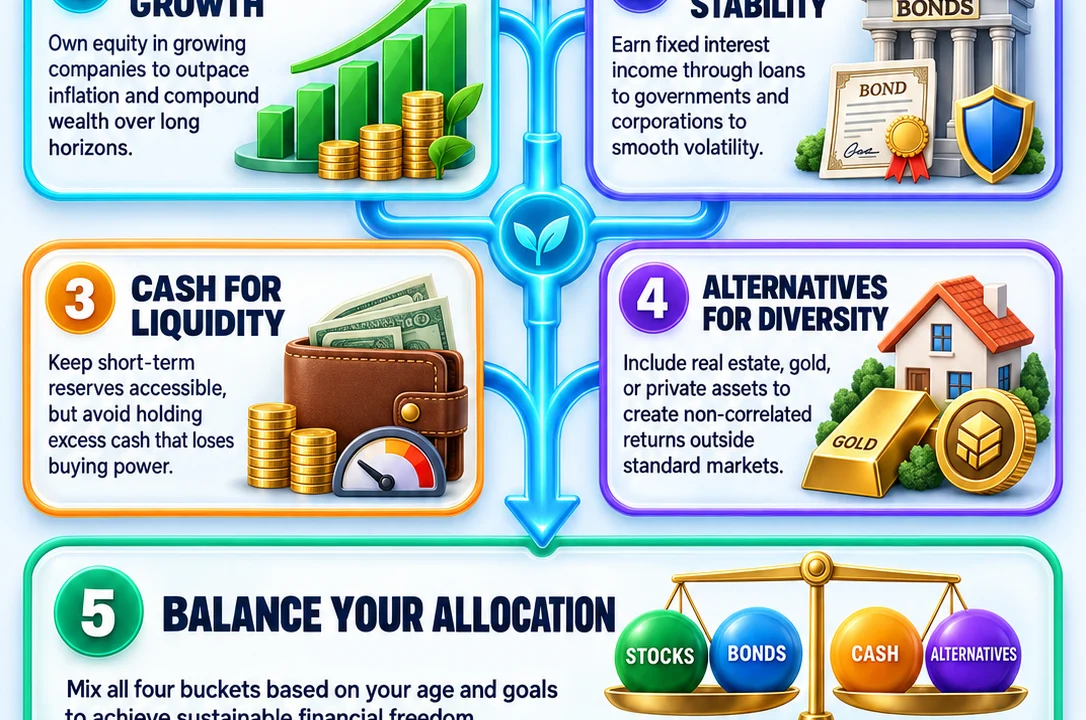
At the heart of any robust investment strategy are four fundamental asset classes. Each plays a vital role in creating a diversified portfolio designed to weather market fluctuations while capitalizing on growth opportunities. Think of them as the essential ingredients in a recipe for financial success.
Bucket 1: Stocks – The Engine of Long-Term Capital Growth 📈
When you invest in stocks, you’re essentially becoming a part-owner of a publicly traded company. 🏢 The value of your ownership stake, represented by shares, typically increases as the company grows, innovates, and becomes more profitable. This inherent link between business success and shareholder value makes stocks a powerful driver of long-term wealth accumulation.
It’s true that stocks can experience considerable volatility in the short term. Prices can swing up and down based on company performance, industry trends, and broader economic conditions. 🎢 However, history has shown that over extended periods – think decades – investments in diversified stock markets have consistently delivered some of the highest returns available to everyday investors. 🏆
For many, the most effective way to access this growth potential is through diversified stock market index funds or exchange-traded funds (ETFs). These investment vehicles allow you to own tiny pieces of thousands of companies simultaneously, providing broad market exposure and inherent diversification without requiring you to pick individual stocks. 🧺 It’s like buying a small slice of the entire economy!
Key Role: Stocks are the primary engine for compounding your wealth over time. Their potential for significant capital appreciation is unmatched in the long run. They also offer the possibility of receiving dividend income, which is a portion of a company’s profits paid out directly to shareholders. 💰
Risk Profile: Higher short-term volatility compared to other asset classes. 🎢
Inflation Protection: Historically strong performance has outpaced inflation over long periods. 🚀
Strategic Insight: Focus on the long-term growth trajectory of businesses and the broader market, rather than getting caught up in daily price movements. Patience and a long-term perspective are your greatest allies here. ⏳
Bucket 2: Bonds – The Anchor of Stability and Income Generation 📜
Moving beyond ownership, bonds represent a different kind of investment relationship: lending. When you purchase a bond, you are essentially loaning money to an entity, such as a government or a corporation, for a specified period. 🤝 In return for your loan, the issuer promises to pay you regular interest payments (coupons) and to repay the original principal amount (face value) on a set maturity date. 🏦
Because bond issuers are contractually obligated to make these payments, bonds are generally considered less risky than stocks. They provide a predictable stream of income and act as a stabilizing force within a portfolio, especially during periods when the stock market is experiencing turbulence. Think of them as a steady hand in a storm. ⚓
The risk level of a bond can vary significantly depending on the issuer’s creditworthiness. Government bonds from stable nations are typically very low risk, while corporate bonds from companies with weaker financial standing will carry higher risk and offer higher interest rates to compensate. 🛡️
Key Role: Bonds provide a reliable income stream through interest payments and offer price stability, helping to cushion portfolio losses during stock market downturns. 🧘♂️
Risk Profile: Lower volatility compared to stocks. 🛡️
Inflation Protection: Moderate protection. While fixed interest payments can lose purchasing power in high inflation, they still provide a predictable return. ⚖️
Strategic Insight: Diversify your bond holdings across different issuers and maturities to manage risk effectively. Consider government bonds for safety and corporate bonds for potentially higher yields, while being mindful of credit quality. 🤓
Bucket 3: Cash – The Foundation of Liquidity and Safety 💵
Cash, held in easily accessible accounts like checking or high-yield savings accounts, offers unparalleled security in terms of nominal value. Your $10,000 emergency fund is unlikely to magically shrink to $7,000 overnight due to market forces. 🔒 This makes cash indispensable for immediate needs and unexpected events.
However, this security comes at a cost: the silent erosion of purchasing power due to inflation. 📉 While your dollar amount remains the same, the rising cost of goods and services means that your cash buys less over time. Standard bank interest rates rarely keep pace with the rate of inflation, leading to a negative *real* return. 🍞 This is why holding excessive amounts of cash for the long term is detrimental to wealth building.
Key Role: Provides immediate liquidity for emergencies, short-term goals, and peace of mind. Essential for maintaining financial stability. 🧯
Risk Profile: Near-zero nominal risk. However, a significant risk of losing purchasing power due to inflation. 🟢
Inflation Protection: Negative. Cash holdings are actively devalued by inflation over time. 🕳️
Strategic Insight: Maintain an adequate emergency fund covering 3-6 months of living expenses in a high-yield savings account. Beyond that, consider investing excess cash to outpace inflation and grow your wealth. 💡
Bucket 4: Alternative Assets – The Diversifiers and Potential Return Enhancers 🎨
This broad category encompasses investments that fall outside the traditional realms of stocks, bonds, and cash. 🌳 It includes a diverse range of assets such as physical real estate, precious metals like gold and silver, commodities (oil, agricultural products), private equity, venture capital, and even cryptocurrencies. 🪙
The primary appeal of alternative assets lies in their potential to provide returns that are *non-correlated* with traditional markets. This means their prices may move independently of stock and bond markets, offering a powerful tool for diversification. When stocks are falling, certain alternative assets might be rising or holding steady, thus reducing the overall volatility of your portfolio. 🧱
For example, real estate can generate rental income and potentially appreciate in value, offering a different income stream and growth path than equities. 🏡 Precious metals have historically been seen as a hedge against inflation and economic uncertainty. 🌟
Key Role: Adds diversification by offering returns that are not directly tied to stock and bond market movements, potentially enhancing overall portfolio resilience and returns. 🧠
Risk Profile: Varies widely, from relatively stable (e.g., some real estate) to highly speculative (e.g., certain cryptocurrencies). Thorough research is crucial. 🎛️
Inflation Protection: Varies by asset class; some, like real estate and gold, have historically offered good inflation hedging properties. 🧱
Strategic Insight: Allocate a smaller, carefully considered portion of your portfolio to alternative assets, especially those with higher volatility. Focus on understanding the unique risks and potential rewards of each alternative investment before committing capital. 🧭
Crafting Your Personalized Investment Blueprint: The Art of Asset Allocation 🎯
There’s no universally perfect asset allocation strategy. The ideal mix of stocks, bonds, cash, and alternatives is deeply personal and depends on several key factors:
- Your Age and Time Horizon: Younger investors with decades until retirement can afford to take on more risk (a higher allocation to stocks) to maximize long-term growth potential. Conversely, those nearing retirement will likely shift towards more conservative assets like bonds to preserve capital. ⏳
- Your Financial Goals: Are you saving for a down payment in five years, or are you building a retirement nest egg for 40 years from now? Short-term goals require more conservative allocations, while long-term goals can accommodate greater growth-oriented investments. 🏠➡️👴
- Your Risk Tolerance: How comfortable are you with the possibility of your investments losing value in the short term? Understanding your emotional capacity for market swings is crucial for sticking to your plan. Some investors sleep better with more stability, while others are driven by growth. 🎢🧘♀️
- Your Income and Expenses: Your current income stability and essential expenses will influence how much cash you need readily available and how much you can afford to invest. 💼
The goal is to create a blend that allows you to pursue your growth objectives while ensuring you can sleep soundly at night, even when the markets are unpredictable. A well-balanced portfolio acts as a powerful tool, helping you capture market gains while mitigating excessive risk.
Key Takeaways for the Savvy Investor: Your Action Plan 📝
- Stocks for Growth: Embrace equities as the primary engine for compounding your wealth over the long term. Think decades, not days. 📈
- Bonds for Stability: Utilize bonds to generate steady income and reduce overall portfolio volatility, particularly during stock market downturns. 📜
- Cash for Liquidity: Maintain an adequate emergency fund (3-6 months of expenses) in a safe, liquid account. Avoid keeping excessive idle cash long-term. 💵
- Alternatives for Diversification: Strategically incorporate alternative assets like real estate or commodities to broaden your investment base and potentially enhance returns. 🎨
- Personalized Allocation: Tailor your investment mix to your unique circumstances – age, timeline, and comfort with risk – to create a sustainable wealth-building strategy. 🚀
Conclusion: Charting Your Course to Financial Independence 🏁
Achieving significant wealth and genuine financial freedom is not about finding a get-rich-quick scheme or taking reckless gambles. 💎 It’s about making informed decisions, strategically allocating your capital across proven asset classes, and harnessing the incredible power of compounding over time. 🌱
Start today, no matter where you are. Secure your immediate financial safety net with an emergency fund, begin building your long-term investment portfolio, and commit to consistency through all market cycles. The discipline you practice now will pay dividends for years to come. Your future self will undoubtedly thank you for taking these proactive steps. 🚀
Ready to build your personalized wealth roadmap? Explore the practical asset calculators, comprehensive investment guides, and powerful portfolio tools available right here at SmartSave.top to start compounding your cash flow and transforming your financial future today! 👇
Frequently Asked Questions About Asset Allocation 🤔
What are the 4 main investment categories for long-term wealth?
The four primary investment categories are Stocks (company ownership for growth), Bonds (loans to governments or corporations for income), Cash (bank deposits for liquidity), and Alternatives (real estate, gold, crypto for diversification). A balanced mix protects capital while outpacing inflation over time.
What is the primary role of stocks in a portfolio?
Stocks represent ownership equity in businesses and serve as the primary capital growth engine for long-term wealth building, alongside generating potential dividend income.
How do bonds provide stability to an investment portfolio?
Bonds act as loans made to governments or corporations that pay regular fixed interest, offering steady income and acting as a stabilizing anchor during stock market downturns.
Why is keeping too much money in cash a risk?
While cash carries minimal short-term price volatility, standard bank account interest rates rarely keep pace with inflation, resulting in a silent loss of purchasing power over time.
How much cash should be kept in an emergency fund?
It is generally recommended to keep 3 to 6 months of essential living expenses in a liquid high-yield savings account as an emergency buffer.
What assets belong to the alternative investment bucket?
Alternative assets include non-traditional investments such as physical real estate, precious metals like gold, private business equity, commodities, art, and digital crypto assets.
What is non-correlated asset return?
Non-correlated assets move independently of standard stock and bond exchanges, helping diversify risk so that a drop in one market doesn’t affect all your investments.
What is asset allocation?
Asset allocation is the strategy of dividing an investment portfolio among different asset categories—such as stocks, bonds, cash, and alternatives—to balance risk and potential return based on individual goals.
How does inflation impact cash held in standard bank accounts?
Inflation causes a negative real return on uninvested cash because the rising cost of goods outpaces the low interest rates offered by traditional checking or savings accounts.
How do stock index funds reduce individual company risk?
Stock market index funds allow investors to hold fractional shares in hundreds or thousands of profitable companies simultaneously, spreading risk across the broader economy.
Who should hold a higher percentage of stocks in their portfolio?
Younger investors with longer time horizons until retirement can generally tolerate higher stock market volatility to maximize multi-decade compound growth.
What is the difference between equity and debt investing?
Equity investing (stocks) means buying direct ownership in a business to share in its profits, whereas debt investing (bonds) means lending money to an entity for guaranteed fixed interest repayments.
Can alternative investments replace stocks and bonds completely?
No, alternative assets are meant to complement a core portfolio of stocks and bonds to add non-correlated diversification rather than serve as a complete replacement.
Why is there no single ‘one-size-fits-all’ asset allocation formula?
Asset allocation depends directly on an individual’s unique age, financial timeline, income stability, personal goals, and emotional tolerance for market risk.
How does SmartSave.top assist investors with asset allocation?
SmartSave.top provides practical asset allocation tools, portfolio calculators, and straightforward investment guides to help users build and maintain a balanced wealth roadmap.
Disclaimer: This article is for informational purposes only and does not constitute financial advice. Always consult with a qualified financial advisor before making any investment decisions.