True financial abundance is rarely the result of a single “get rich quick” scheme or the product of relentless, directionless labor. Instead, the architecture of long-term prosperity is built upon a foundation of intentional habits, strategic foresight, and the cultivation of high-impact skills. Many individuals find themselves tethered to stagnant financial situations because they are unknowingly operating under outdated beliefs—often inherited from family or social environments—that limit their growth potential. The encouraging truth is that your financial trajectory is not set in stone; it can be entirely redirected through conscious awareness, discipline, and a reimagined relationship with your finances.
The Architecture of Financial Success
For most people, the quest for wealth is framed solely as a quest for higher income. While earning capacity matters, it is an incomplete metric. Wealth is ultimately a byproduct of decision-making. Those who achieve lasting financial stability rarely focus on the temporary highs of market trends. Instead, they prioritize sustainable growth, the compounding effect of smart habits, and the long-term utility of their assets. By shifting focus from the immediate satisfaction of a larger paycheck to the systemic management of capital and personal value, you create a trajectory that naturally accelerates over time.
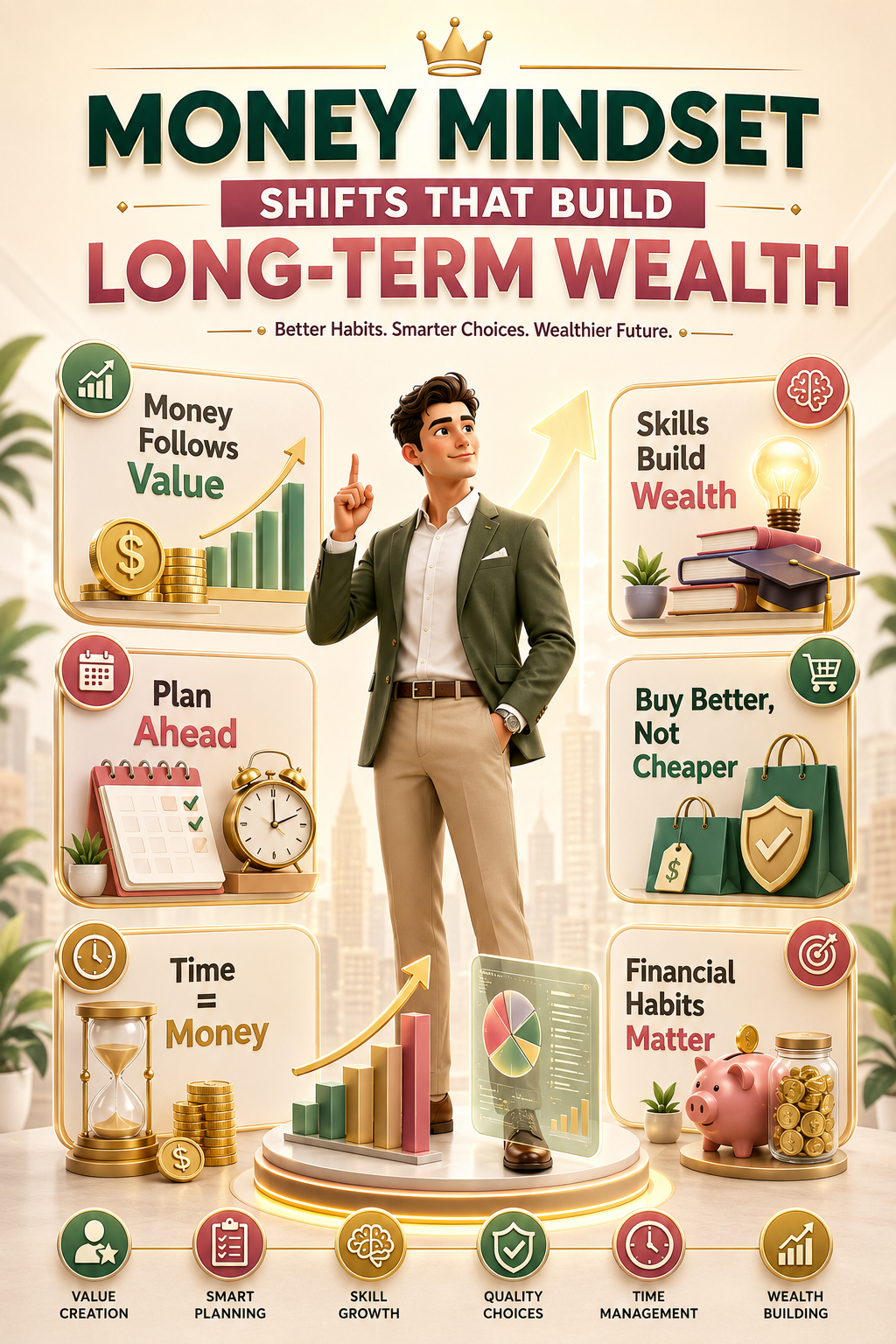
Shift 1: Prioritizing Value Over Mere Effort
There is a pervasive myth that financial output is always proportional to the amount of physical labor invested. However, in the modern economy, effort is a commodity, whereas value is a currency. To scale your wealth, you must transition from a mindset of “working hard” to one of “working effectively.” This involves moving away from activities that offer linear returns and toward systems that offer scalable growth.
Consider the difference between a task that requires your physical presence and a system that functions independently of your hourly labor. Successful wealth builders look for opportunities to solve significant problems. When you become a problem-solver rather than just a task-executor, your market value increases exponentially. This shift requires you to evaluate how your current work contributes to the ecosystem of the market. Are you trading time for money, or are you building assets, systems, or intellectual property that provide value long after you finish a project?
Shift 2: Breaking the Cycle of Inherited Financial Patterns
Many of our deepest assumptions about money were programmed long before we reached adulthood. The way our parents handled debt, their views on risk, and their comfort levels with spending often become our default settings. If you grew up in an environment where finances were a source of anxiety or a subject of avoidance, you might unconsciously carry those same triggers into your adult life.
Breaking these cycles requires radical honesty. You must audit your financial behavior. Do you spend emotionally when stressed? Do you view investing as a form of gambling? Do you avoid opening your bank statements because of a deep-seated fear of what you might find? Recognizing these inherited patterns is the first step toward dismantling them. Once you identify a habit as a learned behavior rather than an objective reality, you empower yourself to replace it with a strategy rooted in logic and future-oriented thinking.
Shift 3: Skill Acquisition as the Ultimate Asset Class
In a volatile economic landscape, the most resilient asset you can own is your ability to learn and adapt. While trendy side-hustles come and go, fundamental skills remain the pillars of income stability. Skills like expert-level communication, data analysis, high-end sales, and strategic negotiation are recession-proof; they provide utility regardless of which way the market swings.
When you invest in your own education, you are investing in a source of compound interest that no market correction can erode. Focus on acquiring “stacked skills”—the intersection of two or more disciplines that makes you uniquely valuable. For instance, an accountant who understands data science is exponentially more valuable than one who does not. By shifting your mindset to prioritize skill development, you insulate yourself against the instability of modern job markets and position yourself to command higher compensation, regardless of the economy.
Shift 4: The Economics of Quality Consumption
There is a distinct difference between being cheap and being frugal. Being cheap involves choosing the lowest price tag, which often leads to the hidden, recurring expense of replacement and maintenance. Being frugal involves choosing the highest value, which prioritizes the long-term cost of ownership.
When you shift your mindset to evaluate purchases based on their life cycle rather than their initial cost, you stop bleeding money on low-quality items. Whether it is technology, clothing, or essential business tools, high-quality items represent an investment in efficiency. When your tools work perfectly and last for years, you save time, reduce stress, and avoid the “hidden taxes” associated with poor craftsmanship. A wealth-building mindset recognizes that spending a bit more upfront for durability is often the most cost-effective decision you can make over a five- or ten-year horizon.
Shift 5: Viewing Financial Planning as a Tool for Freedom
Many people shy away from budgeting because they view it as an instrument of restriction. They believe that if they track their money, they are effectively putting themselves in a cage. In reality, the exact opposite is true. Budgeting is a tool of empowerment; it provides the roadmap for where your money goes, ensuring that your spending aligns with your values.
A well-maintained financial plan provides clarity. When you know exactly where your capital is allocated, you eliminate the “decision fatigue” that often leads to impulse purchases. Financial freedom is not about having an infinite amount of money; it is about having total command over the money you do have. By treating your budget as a strategic plan—rather than a restrictive document—you reclaim control over your future and ensure that your resources are fueling your long-term goals instead of disappearing into the void of convenience spending.
Shift 6: Mastering the Relationship Between Time and Money
Wealth is not just a collection of numbers in a bank account; it is the freedom to choose how you spend your time. Many people live their lives in a state of constant reaction, constantly putting out financial fires or stressing over late payments. This cycle is both exhausting and expensive. By planning ahead, you transition from a reactive state to a proactive state.
Proactive management involves setting up automated savings, establishing emergency funds, and forecasting upcoming expenses. When you anticipate your future financial needs, you avoid the predatory traps of late fees, high-interest debt, and panicked, last-minute spending. Time and money are effectively interchangeable. If you spend time managing your money properly now, you buy yourself more time—and freedom—in the future.
Cultivating the Long-Term Perspective
The transition from a scarcity mindset to a wealth-building mindset is a marathon, not a sprint. It is defined by the small, intentional decisions you make every single day. By focusing on increasing the value you provide, breaking free from the financial ghosts of your past, and prioritizing long-term durability over the lure of the “next big thing,” you create a financial foundation that can weather any storm.
Wealth-building is a quiet process. It rarely happens in front of cameras or through viral success. It happens in the quiet moments of choosing to learn a new skill, in the discipline of sticking to a budget, and in the refusal to let short-term desires compromise your long-term vision. Start today by examining your own money habits. Ask yourself which beliefs are serving you and which ones are anchoring you to a smaller life. With the right mindset, your financial evolution can begin immediately, laying the groundwork for a life of sustained prosperity, security, and true freedom.
Frequently Asked Questions
- Why is financial mindset important? Financial mindset shapes your daily behavior, influencing everything from how you perceive risk to how you prioritize your spending and savings. It is the filter through which all your financial decisions pass.
- Can financial habits be changed? Yes, habits are malleable. Through consistent self-reflection, education, and the implementation of new systems, you can replace negative, limiting behaviors with constructive ones.
- Why do skills matter more than trends? Skills provide enduring value. While trends and fads are fleeting and often capitalize on temporary market emotions, refined skills remain useful for a lifetime, providing sustainable income potential.
- Is budgeting restrictive? Budgeting is liberating. It removes the guesswork and guilt from spending by ensuring that your money is working toward your intentional, long-term goals.
- How does buying quality save money? High-quality items reduce the need for replacements and repairs. This “cost-per-use” approach is a cornerstone of wealthy, efficient money management.