💡 Why Your Mindset is the Bedrock of Your Financial Future 🧠
The journey toward financial success is frequently misconstrued as a mere outcome of substantial income or fortunate coincidences. In truth, the genesis of wealth creation lies within the mind, long before any tangible riches materialize in your bank account. The fundamental way in which individuals conceptualize and interact with money profoundly influences their earning capacity, spending habits, saving strategies, and investment decisions. 🏦
A significant portion of financial struggles stems not from a deficit of opportunity, but from recurring mental blueprints that inherently cap growth potential. These patterns, over time, ossify into habitual responses, dictating financial behavior without conscious intervention. Understanding these deeply embedded mindsets and consciously choosing to reframe them forms the essential bedrock for establishing long-term financial stability and fostering sustained prosperity. 🌱
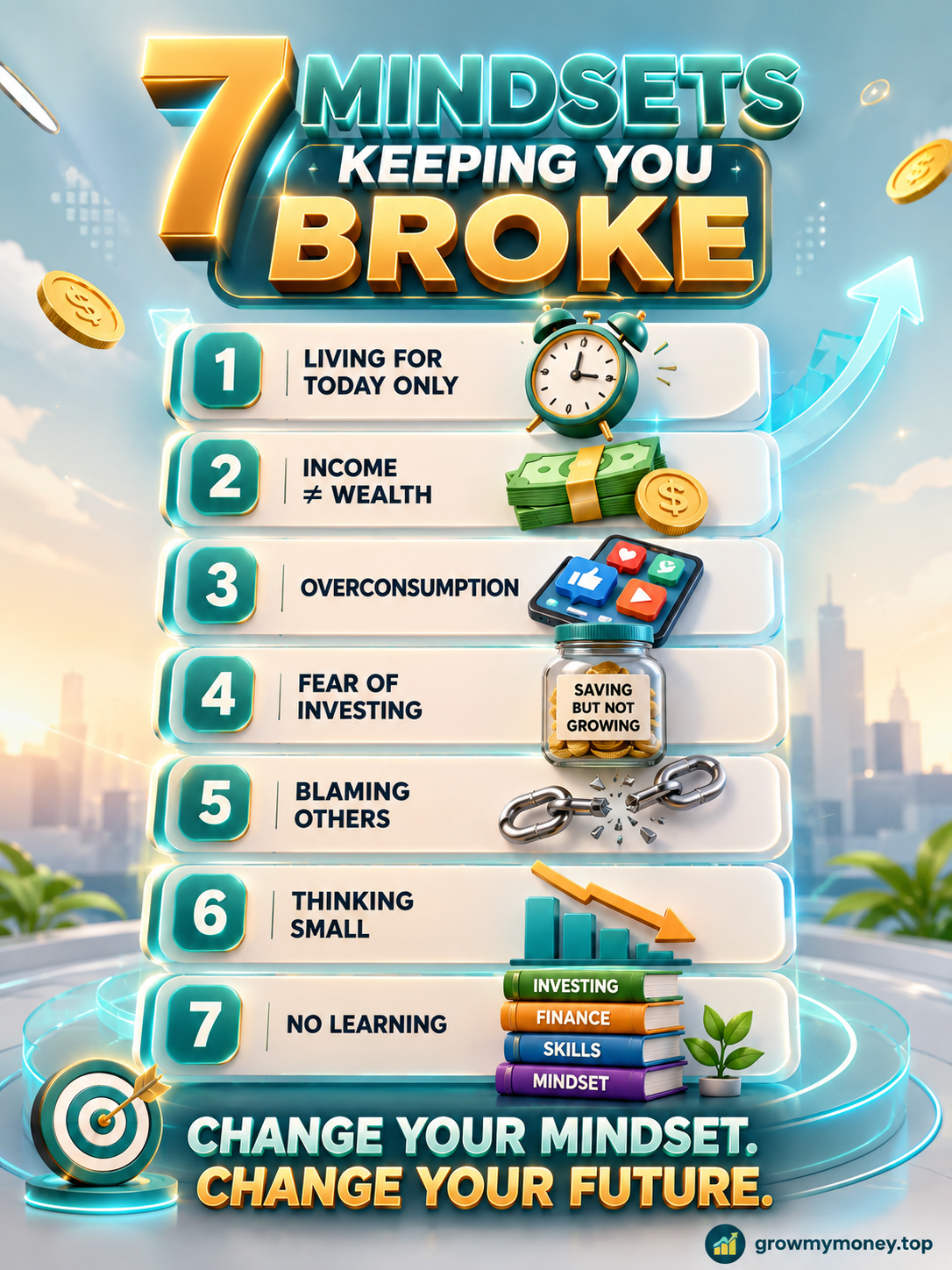
⏳ 1. The ‘Live-for-Today’ Trap: Sacrificing Tomorrow for Now ☀️➡️🗓️
One of the most pervasive and insidious financial pitfalls is the overwhelming inclination to focus exclusively on the present moment. This prevalent mindset champions immediate pleasure and gratification, often at the direct expense of future security and stability. 💸
Individuals ensnared by this perspective typically exhibit the following behaviors:
- Spending their entire income as soon as it arrives, with little to no forward planning or allocation for future needs.
- Actively avoiding the creation and adherence to a budget, viewing it as restrictive rather than empowering.
- Constantly prioritizing fleeting, short-term satisfaction over the pursuit of meaningful, long-term financial objectives.
While it’s vital to savor and enjoy life in the present, a complete disregard for the future inevitably cultivates a precarious and unstable financial existence. True wealth accumulation is a marathon, not a sprint, and it fundamentally demands the practice of delayed gratification. Those who successfully construct robust financial futures are those who habitually think in terms of years and even decades, not merely days or weeks. When financial resources are consistently and deliberately channeled toward future aspirations, the ambitious goal of financial freedom transforms from an abstract dream into an attainable reality. 🚀
💰 2. The Myth: More Income Solves Everything ⬆️💵❓
There’s a widespread belief that a substantial increase in income is the ultimate panacea for all financial ailments. However, this notion, while appealing, can be profoundly misleading and even detrimental to long-term financial health. 😮
The reality is that even individuals commanding high salaries can find themselves perpetually teetering on the brink of financial distress if they possess poor money management habits. Without the crucial element of financial discipline, a surge in income often translates not into increased savings or investments, but rather into a proportional escalation of spending – a phenomenon often dubbed ‘lifestyle creep.’ 📈➡️💸
The critical insight here is: Income alone does not automatically generate wealth; it is one’s financial behavior and management practices that truly build lasting affluence. Enhancing budgeting acumen, exercising stringent control over expenses, and making well-informed, strategic financial decisions are exponentially more impactful for wealth creation than simply focusing on earning more money. The focus should be on financial intelligence, not just income volume. 🧠✨
📱 3. The Consumption Vortex: Drowning in Spending, Starving Creation 🛋️➡️💡
The modern digital landscape has rendered consumption astonishingly effortless. Endless scrolling through social media feeds, binge-watching streaming services, and navigating a plethora of digital distractions have become ingrained aspects of daily existence for many. 🌐
However, the trajectory of true financial growth is intrinsically and powerfully linked to the act of value creation. Understanding this distinction is paramount:
- Consumption Mindset: Characterized by passive engagement with entertainment, perpetual scrolling without purpose, and minimal focus on productive output or skill development. This mindset often leads to a feeling of being drained and unfulfilled. 😵💫
- Creation Mindset: Involves actively building valuable skills, developing assets that generate income or provide utility, and producing tangible value that benefits others. This mindset fuels growth and empowerment. 💪
Ultimately, those who adopt a creation mindset tend to build sustainable, income-generating systems over time. Conversely, individuals perpetually stuck in a consumption loop often remain reliant on external sources of income, susceptible to economic fluctuations and personal circumstances. A conscious and deliberate shift from a passive consumption pattern to an active, value-generating creation approach is absolutely essential for achieving robust and enduring financial advancement. 🌟
🏦 4. The Investment Paralysis: Conquering the Fear of Growth 🥶📈
A significant barrier to wealth accumulation for many is the pervasive fear and apprehension surrounding investment. This often stems from a lack of knowledge, a distrust of financial markets, or a general uncertainty about where to begin. Consequently, individuals frequently opt to keep their money stagnant in low-yield savings accounts for extended periods, effectively allowing its value to erode. 📉
A particularly common issue is the perpetual postponement of investment decisions, waiting indefinitely for that mythical “perfect moment” that rarely, if ever, arrives. The stark reality is that inflation relentlessly chips away at the purchasing power of money over time. Holding cash without allowing it to grow leads to a predictable sequence of negative outcomes:
- A gradual but steady reduction in your money’s real purchasing power.
- The forfeiture of invaluable compounding opportunities, where your earnings start generating their own earnings.
- A significantly slower and more arduous path to wealth accumulation.
Building substantial wealth necessitates a willingness to engage in calculated risk-taking. Investments, when approached with adequate understanding, proper diversification, and a long-term perspective, provide the essential mechanism for your money to actively grow and work for you over the passage of time. It’s about putting your money to work, not just keeping it safe. 🏦➡️🌳
🔁 5. The Blame Game: Shifting Responsibility, Stifling Progress 😞➡️💪
A hallmark of a limiting financial mindset is the pervasive tendency to deflect personal responsibility, attributing financial setbacks and struggles to external factors beyond one’s control. Common scapegoats include:
- Dismal economic conditions or recessions.
- Unfavorable government policies or tax laws.
- A challenging family background or upbringing.
- Sheer bad luck or unfortunate circumstances.
While it’s undeniable that external forces can and do exert influence on individual financial trajectories, they should never serve as an excuse for inaction or a justification for a lack of progress. True financial growth is ignited by embracing personal accountability. By diligently focusing on the actions that are within your direct control—such as diligently acquiring new skills, cultivating disciplined saving habits, and making informed investment choices—you begin to create tangible momentum and achieve meaningful advancement. Taking firm ownership of your financial outcomes, rather than passively accepting them, is an indispensable and empowering step toward achieving genuine financial independence. You are the captain of your financial ship. 🚢
📉 6. The Small-Thinking Syndrome: Limiting Your Potential Before Trying 🤏💭
Operating with a “small-thinking” mentality inherently curtails your financial potential, often before you’ve even had a chance to truly test your limits. This subconscious self-sabotage manifests as unconsciously setting exceedingly low expectations for your income, career progression, and overall financial success. 😞
This restrictive mindset typically includes:
- Aversion to setting ambitious, stretch goals that push you outside your comfort zone.
- A tendency to prematurely dismiss or reject promising opportunities, often before fully exploring their potential.
- A persistent underestimation of your own capabilities, talents, and potential for achievement.
Financial growth is profoundly enabled by the expansion of one’s belief systems. As your thinking broadens and your aspirations climb higher, your actions invariably follow suit. Setting larger, more challenging goals compels you to make better, more strategic decisions, cultivate stronger, more resilient habits, and exhibit greater persistence in the face of obstacles. The financial ceilings that many people encounter are frequently psychological constructs long before they become practical realities. Dare to dream bigger! ✨🌟
📚 7. The Knowledge Stagnation: Avoiding Lifelong Learning’s Power 🎓➡️💡
The world of finance is dynamic and ever-evolving. Market conditions shift, new investment vehicles emerge, and economic tools are constantly being refined. Individuals who cease their pursuit of knowledge and learning inevitably find themselves falling behind. 📚
This mindset of stagnation often involves:
- Actively ignoring or dismissing opportunities for financial education.
- A reluctance or outright refusal to learn new, relevant skills that could enhance earning potential.
- A strong preference for remaining within the confines of one’s existing comfort zone, avoiding new challenges.
Lifelong learning is arguably one of the most potent and accessible wealth-building tools available. The skills and knowledge you acquire directly impact your earning capacity and the quality of your decision-making. Just as compound interest accelerates financial growth, knowledge compounds over time. The more you learn, the sharper your financial acumen becomes, leading to progressively better and more profitable decisions. Invest in your education; it pays the best interest. 🧠📈
📊 The Unvarnished Truth About True Wealth Creation 💎
Genuine wealth is seldom a product of income alone. Instead, it is meticulously constructed through the unwavering application of consistent, disciplined habits and a forward-thinking, strategic mindset. The fundamental pillars of sustainable wealth creation include:
- Long-Term Vision: Prioritizing future financial security over immediate gratification.
- Consistent Investment: Regularly allocating funds to assets that grow over time.
- Continuous Skill Development: Committing to lifelong learning to enhance earning potential.
- Personal Accountability: Taking full ownership of financial decisions and outcomes.
- Value Creation over Consumption: Focusing on producing value rather than merely consuming.
Achieving financial success is the cumulative result of aligned actions undertaken consistently over an extended period, not the product of sporadic, short-lived bursts of effort. It’s a journey of consistent small wins. 🏆
🔄 The Art of Transforming Your Financial Mindset 🦋
Transitioning from limiting, self-sabotaging beliefs to empowering, growth-inducing habits requires a dual commitment: acute self-awareness and unwavering consistency. Even seemingly small, incremental improvements in your daily financial behaviors can precipitate significant, life-altering transformations over the long term. 🌟
Key shifts to embrace:
- From prioritizing spending today → to meticulously planning for tomorrow.
- From passive consumption → to active, value-driven creation.
- From a place of fear → to empowered, informed action.
- From habitual blaming → to embracing proactive responsibility.
Financial transformation is not an overnight phenomenon; it’s a gradual, organic process, painstakingly built through repeated, disciplined actions and conscious choices. Patience and persistence are your allies. ⏳💪
🌱 The Ultimate Insight: Perception Dictates Reality 💖
The way in which we handle and manage our money is deeply and inextricably linked to our fundamental perception and beliefs about money itself. Consequently, altering your financial outcomes begins, unequivocally, with altering your financial thinking. 💡
By diligently identifying, acknowledging, and consciously replacing those detrimental, limiting mindsets with empowering, growth-oriented perspectives, individuals can gradually, but surely, construct a more stable, prosperous, and future-ready financial existence. Your mindset is your most powerful financial tool. 🛠️
🚀 Conclusion: Your Blueprint for Lasting Financial Freedom 🗺️
Financial freedom is not an exclusive privilege reserved for a select few. Rather, it is the tangible outcome of consistent, disciplined habits, a forward-thinking and strategic mindset, and the ability to make informed, intelligent decisions. The crucial first step on this transformative path toward building enduring wealth is the deliberate elimination of harmful money mindsets that have held you back. Growth commences with awareness, and true, lasting transformation is initiated by decisive action. Take that first step today! 🚀✨
Frequently Asked Questions (FAQ) ❓
Why do most people struggle financially?
Most financial struggles stem from limiting money mindsets rather than income levels or external conditions alone.
Does higher income guarantee wealth?
No. Wealth depends more on financial habits, spending behavior, and long-term planning than income alone.
Why is investing important for wealth building?
Investing allows money to grow over time through compounding and helps protect against inflation.
What mindset helps build wealth?
Long-term thinking, continuous learning, disciplined saving, and value creation are key wealth-building mindsets.
How does consumption affect financial growth?
Excessive consumption without creation limits financial growth by reducing savings and investment potential.
Is blaming external factors helpful for finances?
No. Taking personal responsibility for financial decisions leads to better control and outcomes.
Why is continuous learning important for money management?
Financial knowledge improves decision-making, increases earning potential, and supports long-term wealth building.
Can small thinking limit financial success?
Yes. Limiting beliefs reduce ambition and prevent individuals from pursuing higher financial opportunities.
{
“@context”: “https://schema.org”,
“@graph”: [
{
“@type”: “Article”,
“headline”: “7 Mindsets Keeping You Broke — And How to Break Free for Financial Growth”,
“description”: “An in-depth guide exploring seven limiting financial mindsets and how to replace them with wealth-building habits and long-term thinking.”,
“author”: {
“@type”: “Organization”,
“name”: “Grow My Money”
},
“publisher”: {
“@type”: “Organization”,
“name”: “Grow My Money”,
“url”: “https://www.growmymoney.top”
},
“mainEntityOfPage”: {
“@type”: “WebPage”,
“@id”: “https://www.growmymoney.top/”
},
“articleSection”: “Personal Finance”,
“inLanguage”: “en”
},
{
“@type”: “FAQPage”,
“mainEntity”: [
{
“@type”: “Question”,
“name”: “Why do most people struggle financially?”,
“acceptedAnswer”: {
“@type”: “Answer”,
“text”: “Most financial struggles come from limiting money mindsets rather than income levels or external conditions alone.”
}
},
{
“@type”: “Question”,
“name”: “Does higher income guarantee wealth?”,
“acceptedAnswer”: {
“@type”: “Answer”,
“text”: “No. Wealth depends more on financial habits, spending behavior, and long-term planning than income alone.”
}
},
{
“@type”: “Question”,
“name”: “Why is investing important for wealth building?”,
“acceptedAnswer”: {
“@type”: “Answer”,
“text”: “Investing allows money to grow over time through compounding and helps protect against inflation.”
}
},
{
“@type”: “Question”,
“name”: “What mindset helps build wealth?”,
“acceptedAnswer”: {
“@type”: “Answer”,
“text”: “Long-term thinking, continuous learning, disciplined saving, and value creation are key wealth-building mindsets.”
}
},
{
“@type”: “Question”,
“name”: “How does consumption affect financial growth?”,
“acceptedAnswer”: {
“@type”: “Answer”,
“text”: “Excessive consumption without creation limits financial growth by reducing savings and investment potential.”
}
},
{
“@type”: “Question”,
“name”: “Is blaming external factors helpful for finances?”,
“acceptedAnswer”: {
“@type”: “Answer”,
“text”: “No. Taking personal responsibility for financial decisions leads to better control and outcomes.”
}
},
{
“@type”: “Question”,
“name”: “Why is continuous learning important for money management?”,
“acceptedAnswer”: {
“@type”: “Answer”,
“text”: “Financial knowledge improves decision-making, increases earning potential, and supports long-term wealth building.”
}
},
{
“@type”: “Question”,
“name”: “Can small thinking limit financial success?”,
“acceptedAnswer”: {
“@type”: “Answer”,
“text”: “Yes. Limiting beliefs reduce ambition and prevent individuals from pursuing higher financial opportunities.”
}
}
]
}
]
}