While school curriculums prioritize complex mathematical theories and historical timelines, there remains a glaring absence in the standard education system: functional financial literacy. Most young people navigate their formative years without understanding how to manage a bank account, let alone how to grow an investment portfolio. Consequently, millions of young adults step into the workforce with significant academic knowledge but zero practical skills to handle the complexities of personal finance.
The financial patterns established during your teenage years are rarely fleeting. They act as the blueprint for your adult life, dictating whether you will spend your thirties struggling with debt or living with financial security. By mastering the fundamental rules of money now, you gain a massive, unfair advantage over peers who wait until their late twenties to get serious about their fiscal health.
Why Delaying Financial Education Is a Strategic Error
Many believe that financial planning is reserved for those with a professional career or a significant inheritance. This is a common misconception that acts as an anchor on your future success. Your brain is most receptive to habit formation during adolescence, and delaying this learning phase forces you to adopt defensive habits later in life. If you wait until you are twenty-five to grasp cash flow, you will likely spend your most productive earning years paying off early mistakes like high-interest credit debt or consumer traps.
1. Mastering the Asset-Liability Distinction
Financial intelligence starts with a simple, life-altering distinction: understanding exactly what separates an asset from a liability. While most people define these terms through the lens of accounting, the wealth-builder’s definition is more practical.
- Assets: An asset is any vehicle, investment, or tool that puts money into your pocket consistently over time. Think of low-cost index funds, high-yield savings accounts, or even small, scalable online projects.
- Liabilities: A liability is anything that extracts cash from your wallet. Recurring, unused subscriptions, fashion trends bought on credit, or depreciating luxury goods fall squarely into this category.
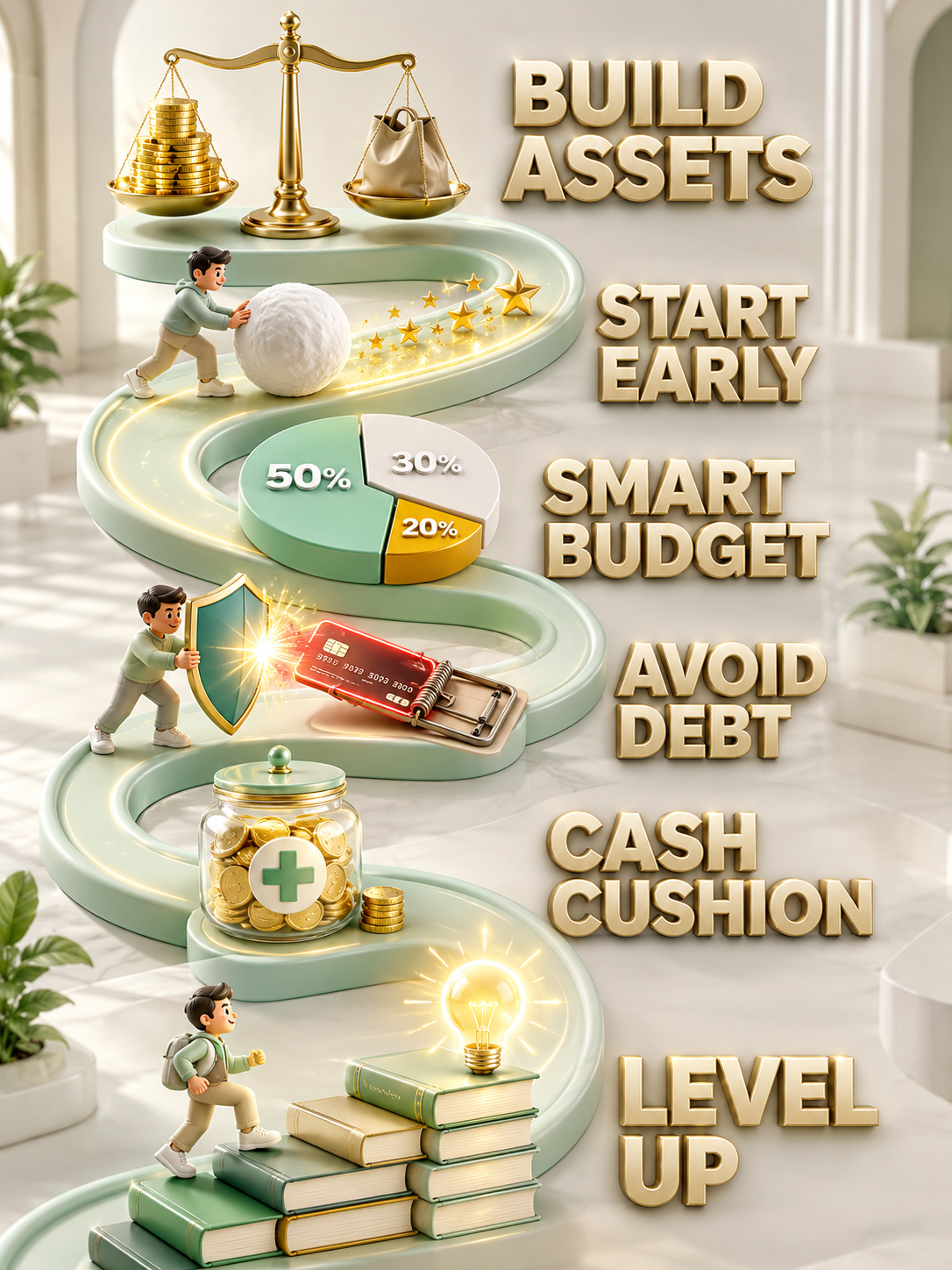
The path to genuine freedom is paved by the systematic acquisition of assets and the ruthless elimination of liabilities. If you focus your teenage energy on building assets, you will find that compounding returns handle the heavy lifting of wealth creation for you.
2. Time: Your Greatest Financial Lever
As a teenager, you possess a resource that no billionaire, regardless of their net worth, can purchase: time. This time is the catalyst for compound interest, often referred to as the eighth wonder of the world. Compound interest occurs when your initial investment grows, and then the interest earned on that investment earns its own interest, creating a compounding growth cycle.
If you start setting aside a modest amount each month at age sixteen, your funds will grow exponentially over three decades. Conversely, starting at age twenty-six requires a significantly higher monthly contribution to reach the same retirement milestone. In the world of finance, time is not just currency; it is a multiplier.
3. Simplifying Finance with the 50/30/20 Framework
Budgeting is frequently avoided because it is perceived as restrictive. However, a sustainable budget should act as a guide for your lifestyle rather than a cage. The 50/30/20 method is the gold standard for beginners looking to find balance:
- 50% for Needs: Direct half your income toward your absolute essentials, such as transportation, school supplies, and food.
- 30% for Wants: Dedicate 30% to leisure. This keeps your financial plan sustainable by allowing for social activities and hobbies without guilt.
- 20% for Savings: Before you allocate a single dollar to discretionary spending, move 20% into an automated savings or investment vehicle.
4. Avoiding the Debt Mirage
Modern marketing creates a culture of instant gratification. Apps and credit card providers target young consumers, framing debt as a tool for “adulting” or achieving early status. In reality, consumer debt is simply a mechanism for borrowing against your future self. Every dollar you spend on high-interest credit is a dollar you are taking away from your future financial freedom. Treat credit cards as tools for building credit history only—never use them to finance a lifestyle you cannot currently afford with cash.
5. Establishing an Emergency Reserve
Life is inherently unpredictable, and financial surprises are inevitable. A broken laptop or an urgent repair can derail your progress if you are unprepared. A foundational emergency fund—covering three to six months of typical expenses—serves as your financial shield. This fund should remain liquid in a high-yield account, distinct from your everyday spending money, and reserved strictly for genuine emergencies.
6. The Concept of Opportunity Cost
Every time you purchase a non-essential item, you aren’t just losing the money spent; you are losing the potential growth that money could have achieved elsewhere. This is the opportunity cost. Before clicking “buy” on a trendy item, ask yourself: “Could this money perform better as an investment?” By reframing spending as an exchange of current cash for future freedom, your decision-making will naturally improve.
7. Investing in Human Capital
While the stock market provides external returns, the highest yield on investment is always found in your own skillset. Spend your teenage years mastering marketable talents—be it coding, digital marketing, data analysis, or financial literacy. Unlike market-based assets, your knowledge is immune to economic crashes and serves as the primary engine for your future income potential.
Final Thoughts: The Compound Effect of Early Habits
Wealth building is not about hitting a sudden lottery win or working a high-stress career; it is the inevitable outcome of daily, disciplined habits formed during your youth. By understanding the mechanics of money, keeping your liabilities low, and prioritizing long-term investments, you place yourself on a trajectory of total financial sovereignty. Don’t wait for your thirties to learn these lessons; start today, and let the mathematics of wealth work in your favor.
Frequently Asked Questions
Why is financial literacy so vital for teenagers?
Learning money management early builds the discipline necessary to avoid common debt traps and allows teenagers to harness the power of compounding interest before they have heavy adult expenses.
What defines the difference between an asset and a liability?
An asset brings value into your account, such as investments or savings. A liability removes money from your account, such as impulsive shopping or high-interest debt.
How does compound interest benefit younger savers?
Because teenagers have more time, their money has longer to grow through the compounding cycle. Even small, consistent contributions made in your teens can equate to massive growth by the time you reach retirement age.
What is the 50/30/20 budgeting strategy?
It is a simple allocation model where 50% of income covers needs, 30% covers personal wants, and 20% is prioritized for savings and future investment.
Can teenagers build wealth without a full-time income?
Yes. Wealth building relies on the percentage saved rather than the total amount earned. Even small sums from side tasks or allowances can be invested effectively to build long-term habits.
What is the danger of consumer debt?
Consumer debt involves paying for current consumption with future labor at a high cost, essentially paying interest on items that provide no financial return.
Why is an emergency fund essential?
An emergency fund prevents you from having to lean on credit cards during unexpected life crises, keeping you out of the cycle of interest-bearing debt.
How do I define opportunity cost?
Opportunity cost refers to the value of the next best alternative you forfeit when making a decision. When you spend on a luxury, you give up the compounding growth of that money in an investment account.
What are the best ways for a teen to invest in themselves?
Read books on personal finance, take free online courses, and learn high-value technical skills that will increase your earning power in the future job market.
Is credit always bad?
Credit is not inherently bad. It is a tool. When used to build a credit score by paying off the full balance monthly, it is a positive financial lever. When used to buy things you cannot afford, it becomes a liability.
What are index funds?
Index funds are diversified portfolios that track a market index, offering a safer, hands-off way for beginners to start investing without the risk of picking single stocks.
What is the most important habit for wealth?
The habit of living below your means and consistently allocating a portion of your income toward future growth.