For most young people, the transition from high school to adulthood feels like jumping into the deep end of a pool without a swimming instructor. We spend years in classrooms mastering complex equations and historical dates, yet we are rarely given the tools to manage our most fundamental real-world necessity: money. The result is a generation of young adults navigating their first paychecks and credit applications in a state of confusion, often falling into traps that set their financial progress back by years.
However, your teenage years offer a unique advantage that no amount of money can buy: time. By internalizing specific financial principles now, you aren’t just saving pennies; you are building an engine for lifetime prosperity. Let’s explore the blueprint for mastering your finances before you even hit your twenties.
The Myth of Waiting Until You’re “Older”
A common misconception is that financial planning is reserved for professionals with full-time careers. This is a costly belief. Financial intelligence is a muscle; the sooner you begin exercising it, the stronger it becomes. If you wait until you are thirty to understand the mechanics of cash flow, you will likely spend your twenties cleaning up the messes created by bad debt, impulsive spending, and a lack of planning. Establishing a financial system as a teenager isn’t about restriction—it’s about empowerment.
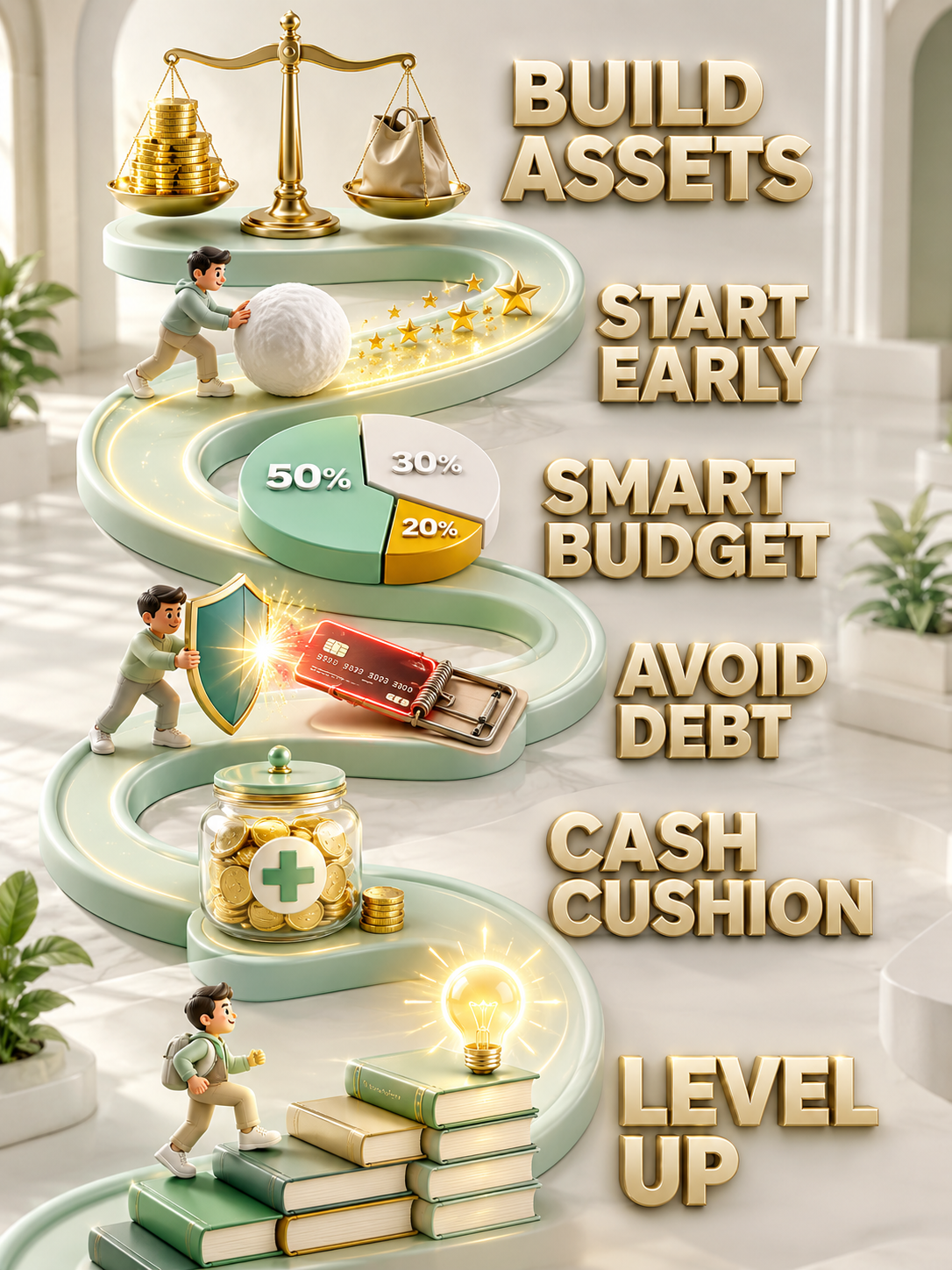
1. The Fundamental Distinction: Assets vs. Liabilities
At the heart of every great wealth-building strategy lies one simple, golden rule. You must learn to distinguish between what grows your net worth and what erodes it.
- Assets: These are tools that put money into your pocket. Whether it’s a high-yield savings account, dividend-paying stocks, or a side business that generates profit, assets work for you even when you aren’t around.
- Liabilities: These are items that take money out of your pocket. This includes non-essential monthly subscriptions, depreciating electronics purchased on credit, or expensive fashion trends.
To achieve financial freedom, your primary goal should be the consistent acquisition of assets while keeping your liabilities to an absolute minimum.
2. Harnessing the Mathematical Magic of Compound Interest
If there is a “cheat code” to building wealth, it is compound interest. Because you are young, your most powerful asset is the time available for your money to grow. Compound interest occurs when the interest earned on your initial principal begins to generate its own interest, creating a snowball effect. The difference between starting at age 15 and starting at age 25 is staggering. By delaying, you aren’t just losing ten years; you are losing the compounding growth that those ten years would have generated.
3. Structuring Wealth: The 50/30/20 Rule
Budgeting is often viewed as a chore, but it is actually the ultimate form of self-care. Without a system, your money will simply vanish. The 50/30/20 framework is an elegant, effective way to manage your income:
- 50% for Needs: Cover your basics—transportation, necessary school expenses, and essential daily living costs.
- 30% for Wants: This is your “fun money.” Use this for social activities, hobbies, or gaming. It keeps your budget sustainable because it allows you to enjoy life.
- 20% for Savings: This portion is non-negotiable. It should be moved immediately into a dedicated savings or investment account. Treat this as your most important “bill.”
4. Defending Your Future: Avoiding the Debt Trap
Society is built on the premise of “buy now, pay later.” Credit cards, buy-now-pay-later apps, and small personal loans are often marketed as tools for independence. In reality, they are often shackles. When you use credit for things you cannot afford today, you are essentially stealing from your future self. Every dollar you spend on interest is a dollar that cannot be invested in your future. Learn to view credit as a tool to build a credit score, not as a shortcut to owning things you haven’t earned yet.
5. Creating an Iron-Clad Emergency Fund
Life is unpredictable. A broken phone, an unexpected repair, or a sudden loss of income can derail your financial plans if you aren’t prepared. Having an emergency fund acts as a shock absorber. Aim to save three to six months of your typical expenses in a separate, high-yield account. This money is not for your “wants”; it is your peace of mind. Knowing you have a safety net allows you to navigate life’s challenges without resorting to high-interest debt.
6. The Concept of Opportunity Cost
Every transaction you make is a trade-off. When you spend $50 on a trendy hoodie, you aren’t just losing $50; you are losing the opportunity to have that $50 invested. This is known as opportunity cost. Before making any purchase, ask yourself: “Is this item worth more to me than the future value of this money if I invested it?” When you view spending through the lens of what you are sacrificing, your decision-making process will naturally become more disciplined.
7. Investing in Yourself: The Highest ROI
While the stock market is great, your own skill set is the most valuable asset you will ever own. Your earning capacity is determined by the skills you possess. Invest your time and money into learning, whether it’s through coding boot camps, financial literature, digital marketing courses, or mastering a trade. These skills are portable, inflation-proof, and they pay dividends for the rest of your life. No market crash can take away the expertise you have earned.
Building a Legacy Through Consistent Habits
You don’t need a massive trust fund or a six-figure salary to build a wealthy future. Wealth is the byproduct of discipline, patience, and intelligence. By mastering the concepts of compounding, budgeting, and asset allocation, you are setting yourself on a trajectory that will lead to total financial autonomy. Don’t wait for your career to start—start today. Transform your money habits now, and you will find that prosperity isn’t just possible—it’s inevitable.
Frequently Asked Questions
Why is financial literacy important for teenagers?
Financial literacy enables teenagers to build productive habits early, helping them avoid the cycle of debt and providing them with the knowledge to grow their net worth before they take on adult responsibilities.
What is the difference between an asset and a liability?
An asset is something that puts money into your pocket, like an investment or a high-yield savings account. A liability takes money out, such as unnecessary spending or high-interest credit debt.
How does compound interest work for young savers?
Compound interest allows your money to earn interest on top of previous interest. Because young people have more time, even small, consistent contributions can grow into significant sums over several decades.
What is the 50/30/20 budgeting rule?
It is a simple system: 50% of income goes to needs, 30% to personal wants, and 20% to savings or investments.
How can a teenager start a budget without a steady income?
Budgeting can be practiced with any money you receive, including allowances, gifts, or pay from part-time jobs. The key is to manage the percentage, not the absolute amount.
What is consumer debt and why should it be avoided?
Consumer debt is money borrowed for non-essential purchases. It is dangerous because high interest rates can make small purchases significantly more expensive over time.
What is an emergency fund and how much should a teen save?
It is a financial safety net for unexpected costs. A good target for teens is to save enough to cover three to six months of their average expenses.
What does ‘opportunity cost’ mean?
It is the potential gain you miss out on when you choose one alternative over another. In finance, it highlights how every dollar spent is a dollar that isn’t being invested.
How can teenagers safely invest in themselves?
By prioritizing education, reading personal finance books, and developing high-demand skills like coding or marketing, teens ensure their future earning potential remains high.
Can teenagers open their own investment accounts?
While minors usually cannot open accounts independently, they can utilize custodial accounts managed by a parent or guardian to begin learning how the stock market functions.
What is a high-yield savings account?
These are bank accounts offering higher interest rates than standard accounts, allowing cash savings to keep up with inflation better than a regular checking account.
How do impulsive buying habits affect future wealth?
Impulsive spending depletes the capital needed for investments. By consistently buying things instead of assets, individuals limit their long-term wealth growth.
Is using a credit card always a bad habit?
No. If used responsibly by paying off the full balance every month, credit cards can help build a positive credit score, which is beneficial for future loans.
What are index funds?
Index funds are collections of various stocks that track a market index. They are ideal for beginners because they provide instant diversification, reducing the risks associated with individual stocks.
What is the most critical money rule for a teenager?
Always spend less than you earn. Living below your means is the only way to generate a surplus that can be funneled into assets for your future.