We often fall into the trap of believing that financial freedom is reserved for those who hit the jackpot, land a massive inheritance, or sell a company for millions. While significant financial events can provide a temporary boost to your net worth, they are rarely the foundation of lasting prosperity. True financial success is not a sprint; it is the quiet, compounding result of thousands of micro-decisions made every single day.
At its core, your net worth is simply the sum of your daily habits. By mastering these invisible patterns—tracking your spending, automating your savings, and overcoming emotional triggers—you can transition from financial stress to absolute abundance. Let’s explore how you can rewrite your financial future through intentional daily action.
The Myth of the Financial Windfall
Society loves to celebrate the “overnight success” story. We fantasize about winning the lottery or getting a massive, unexpected bonus. However, behavioral finance tells us a different story: without the right habits, large influxes of cash often disappear as quickly as they arrived. This phenomenon, known as lifestyle inflation, occurs when people increase their spending to match their new income level, leaving them no better off than before.
Sustainable wealth is built during the mundane moments. It is found in the choice to brew coffee at home instead of buying it at a cafe, the decision to audit your subscriptions, and the consistency of setting aside a small portion of your paycheck. If your subconscious patterns are broken, no amount of money will ever be enough to secure your future.
Breaking the Cycle of Financial Avoidance
One of the most destructive habits people cultivate is financial avoidance. It is a defense mechanism; when we feel stressed about our budget, our instinct is to look away. We stop checking our banking apps, avoid opening credit card statements, and pretend that if we don’t look, the debt isn’t there.
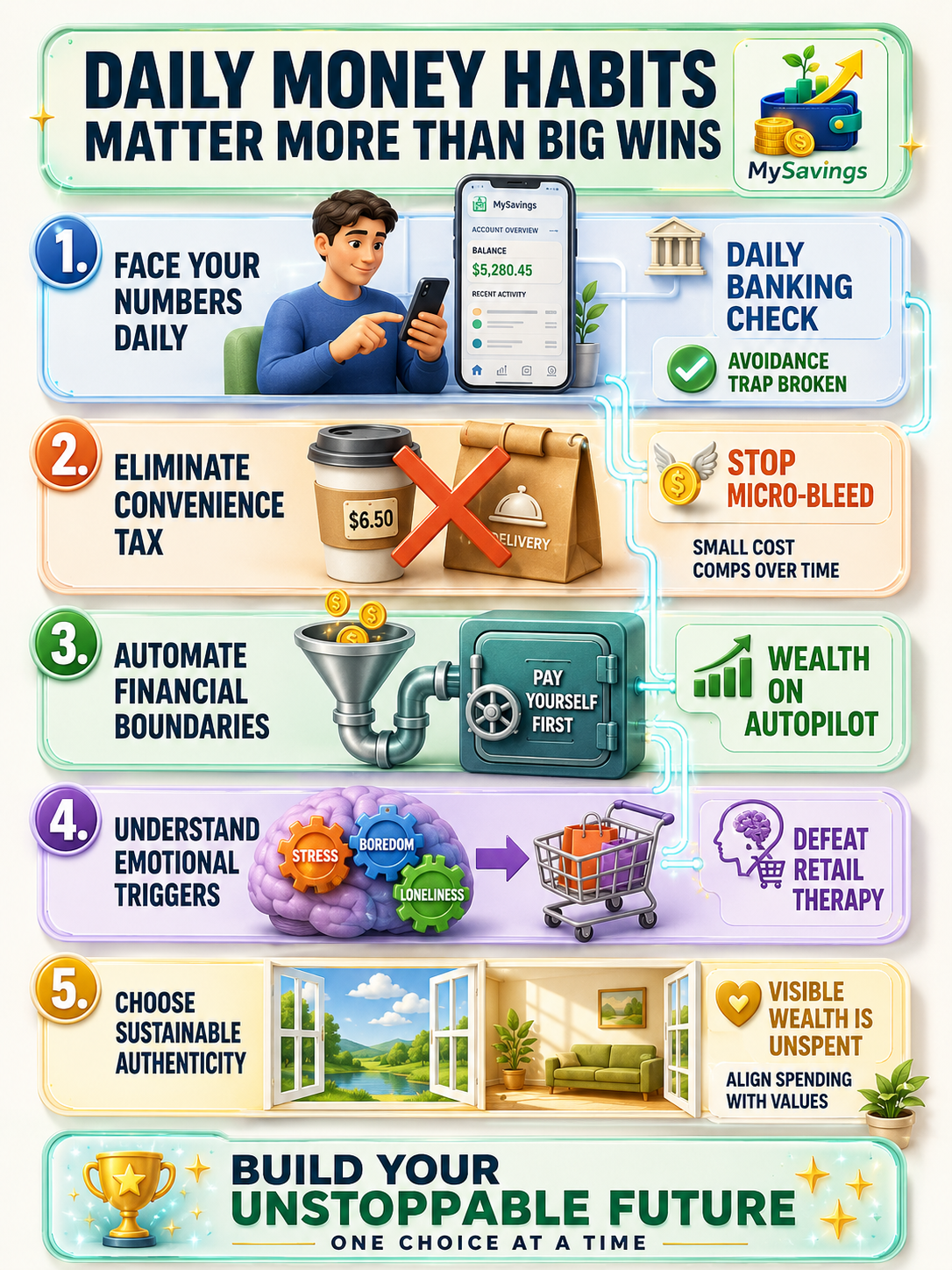
This “Ostrich Effect” creates a feedback loop of anxiety. When you don’t know your exact cash position, you lose the ability to make informed decisions. The cure? Radical awareness. Commit to checking your bank account every morning for just sixty seconds. By facing your numbers daily, you strip away the fear. You move from a state of reactive panic to a state of proactive control. Once you know exactly where your money is going, making the decision to cut non-essential spending becomes effortless.
Combatting the “Convenience Tax”
Modern life is designed to make spending money as frictionless as possible. With one-click ordering, food delivery apps, and digital subscriptions, we are constantly paying a “convenience tax.” While each individual transaction might seem negligible—a $5 here or a $15 delivery fee there—the aggregate impact is devastating.
To stop this leak, you must introduce intentional friction into your life:
- Delete Saved Cards: Remove your payment information from browsers and delivery apps. Forcing yourself to physically get your wallet and type in your card details provides a mandatory “pause” that allows the rational part of your brain to re-engage.
- The 24-Hour Rule: For any non-essential purchase over a certain threshold, force yourself to wait 24 hours. Most of the time, the emotional urge to buy will dissipate, and you will realize you didn’t need the item at all.
- Audit Your Subscriptions: We often lose hundreds of dollars annually to forgotten streaming services or unused apps. Conduct a quarterly “subscription purge” to ensure your money is working for you, not for corporations you no longer engage with.
The Power of Automation: Removing Willpower from the Equation
Willpower is a finite resource. By the end of a long workday, your mental battery is drained, making you more susceptible to impulse buys. The most successful investors in the world do not rely on willpower; they rely on automation.
The “Pay Yourself First” strategy is the gold standard for wealth building. Instead of waiting to see what is left over at the end of the month—which, let’s be honest, is usually nothing—automate your savings to move immediately upon payday. Set up an automatic transfer from your checking to a separate high-yield savings or investment account. When the money is moved before you even see it, you learn to live on what remains. This forces a budget constraint that is both effective and painless.
The Psychology Behind Emotional Spending
Retail therapy is a real psychological trap. Whether you are buying to soothe the stress of a corporate job, alleviate boredom, or satisfy a need for social validation, your spending is likely linked to your emotional state rather than your actual needs. Recognizing that shopping is an attempt to regulate your mood is the first step toward stopping the behavior.
Next time you find yourself browsing an online store during a stressful moment, ask yourself: “What is the feeling I am trying to fix?” By addressing the underlying emotion—whether it is loneliness, fatigue, or stress—you can find healthier ways to cope that don’t involve depleting your savings. Consider replacing the “shopping hit” with a walk, a quick meditation, or reaching out to a friend.
Redefining Status in a Digital World
We are bombarded with images of luxury lifestyles on social media, which pressures us to engage in constant comparison. We buy cars, clothes, and gadgets to project an image of success that we haven’t actually earned yet. This is the surest way to remain perpetually broke.
True wealth is often invisible. It is found in the freedom to choose your own path, the safety of an emergency fund, and the peace of mind that comes from being debt-free. Shift your focus from external status to inner security. When you stop trying to impress others, you find a massive amount of capital is suddenly freed up to be invested in assets that will actually provide you with long-term security.
Building Your Financial Blueprint
Your financial future is built brick by brick. Every morning, you have a choice. You can continue to act on autopilot, letting marketing and emotional impulses dictate your net worth, or you can take the wheel. The habits discussed here—daily tracking, automating, managing emotional triggers, and choosing intentionality—are the blueprints for a life of independence.
Stop waiting for the perfect moment to start. Start where you are, with the habits you can control today. As you refine your daily routine, you will see your savings grow, your stress levels decline, and your confidence soar. You are not just saving money; you are buying your future freedom.
Frequently Asked Questions
1. Why is consistency more important than big financial gains?
Consistency creates a reliable system. A large gain is a one-time event, but daily habits are a lifelong engine. Without the habits, even a large windfall will eventually be drained by poor financial choices.
2. How can I stop impulse buying effectively?
Increase the friction. Remove saved card data, delete shopping apps, and wait 24 hours before completing any purchase that isn’t a necessity.
3. What is the best way to handle ‘lifestyle creep’?
Every time you get a raise or a bonus, commit to saving or investing 50% of the increase immediately. This allows you to enjoy some of your success while simultaneously accelerating your long-term wealth building.
4. How do I start automating my finances if I have a low income?
Start small. Even if you can only automate $10 or $20 per paycheck, the habit of automation is more important than the amount. Once the habit is established, increase the amount as your income grows.
5. Is it ever okay to spend money on non-essentials?
Absolutely. The goal isn’t to live like a hermit; the goal is to be intentional. If you have automated your savings and covered your needs, you can afford luxuries as long as they align with your values and don’t compromise your long-term goals.
Ready to take control of your financial destiny? Our platform provides the resources and blueprints you need to turn your daily choices into an unstoppable fortune. Join our community today and start building the life you deserve.