In the traditional view of personal finance, cash is king. It represents safety, liquidity, and a psychological buffer against the unpredictability of life. However, in the modern economic landscape, holding excessive amounts of cash can be a silent wealth killer. While your physical currency sits stagnant in a low-interest checking account, the dual forces of inflation and rising costs of living are working to erode your purchasing power year after year. To truly thrive financially, you must shift your perspective from merely saving money to allocating it into assets that work for you around the clock.
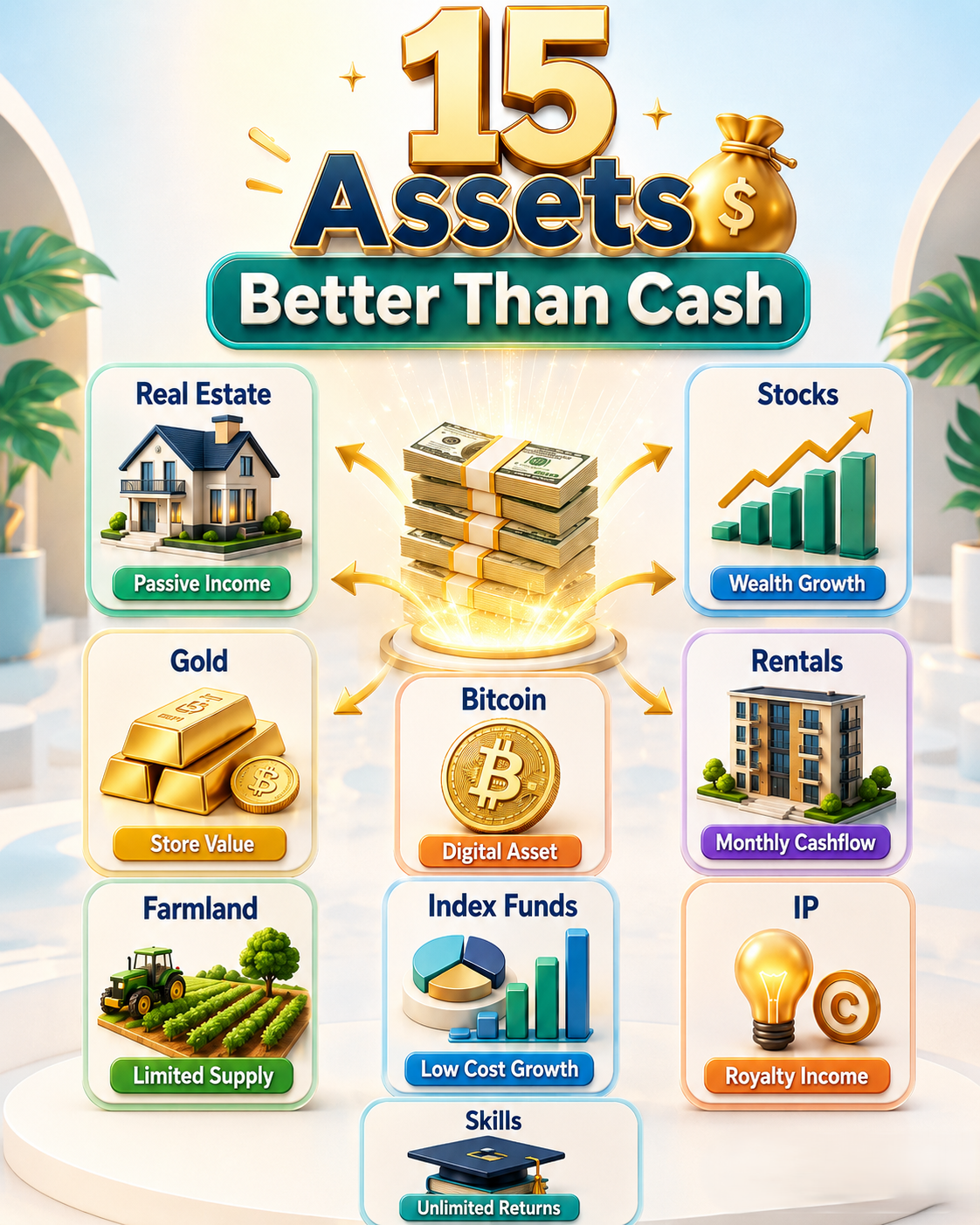
Strategic wealth creation is rarely about hoarding greenbacks; it is about owning a portfolio of assets that either appreciate in value or generate consistent cash flow. By moving your capital into high-performance vehicles, you transition from a passive saver to an active investor. This guide breaks down 15 distinct asset classes that have historically outperformed idle cash, helping you secure your financial future through smarter, more resilient choices.
1. The Power of Real Estate
Real estate remains the cornerstone of wealth for many of the world’s most successful individuals. Unlike currency, which is constantly debased by central bank policies, land and property represent tangible, limited resources. Owning real estate provides a unique trifecta of benefits: monthly rental income, long-term capital appreciation, and significant tax advantages. Whether you are looking at residential rentals, commercial office spaces, or even raw land, the ability to leverage a mortgage to control a larger asset often creates outsized returns compared to cash deposits.
2. Equity Through Stocks
Purchasing stocks is essentially buying a slice of ownership in a business. When you invest in a company that produces goods or services, you are betting on human productivity and innovation. Over decades, the stock market has consistently delivered returns that far outpace the rate of inflation. By choosing a mix of growth-oriented companies and dividend-paying “blue-chip” firms, investors can build a portfolio that offers both immediate income and massive long-term potential.
3. Gold: The Ultimate Safety Net
Gold has served as a global store of value for thousands of years. It acts as an “insurance policy” for your portfolio because it is inversely correlated with the trust placed in paper currencies. During periods of geopolitical uncertainty or runaway inflation, gold typically retains its value or increases, protecting investors from the volatility of more speculative markets. Integrating gold into a balanced portfolio provides a level of stability that liquid cash simply cannot match.
4. Silver: The Industrial Precious Metal
Silver is often the overlooked cousin of gold, but it carries its own distinct advantages. While it functions as a store of value, silver also has profound utility in modern technology. It is a critical component in solar panels, medical devices, and electronics. This dual nature—being both a monetary metal and a necessary industrial commodity—means that silver can perform well even when typical market forces are shifting.
5. Bitcoin and Digital Scarcity
In the digital age, Bitcoin has emerged as a disruptive asset class often referred to as “digital gold.” Its defining feature is its immutable, hard-capped supply, which protects it from the dilution caused by inflationary monetary policy. While it remains a volatile asset, its role in a modern diversified portfolio is becoming increasingly recognized by institutional players. For those with a higher risk tolerance, it represents an opportunity to participate in a globally decentralized financial network.
6. Rental Property Portfolios
While similar to general real estate, focusing specifically on a rental strategy shifts the goal from asset flipping to perpetual cash flow. A well-managed rental portfolio creates an “annuity” effect, where your monthly expenses are covered by tenants, while you continue to build equity. This is one of the most reliable ways to achieve financial independence, as the income stream is largely decoupled from your own labor hours.
7. Farmland: Investing in Survival
Food security is a perpetual human need. As the global population continues to grow and productive agricultural land becomes scarcer, farmland is becoming a premier institutional asset class. Farmland is historically one of the most stable investments, as it has a very low correlation with the stock market. Whether you lease it to operators or profit from the land’s inherent production value, it is a defensive, high-utility asset.
8. Commodities and Raw Materials
Commodities—including energy like oil and natural gas, or agricultural goods like coffee and grain—are the building blocks of the global economy. When the cost of living rises, it is usually because the cost of these raw materials has increased. By investing in commodities, you effectively hedge against the rising costs of the very things you consume, turning the rising price of oil or wheat into a profit rather than a financial burden.
9. Private Business Ownership
There is no greater engine for wealth creation than starting or buying a business. Unlike stocks, where you are a passive observer, business ownership allows you to control the operations, optimize for profit, and build a brand that carries intrinsic value. Whether it is an e-commerce operation, a local franchise, or a professional service firm, business equity allows you to scale your income far beyond what a traditional salary can provide.
10. Index Funds: The Passive Professional Strategy
For those who prefer a hands-off approach, index funds are the gold standard. By purchasing an index fund (such as one tracking the S&P 500), you are buying the entire market. This instantly eliminates the “single stock risk” while keeping management fees extremely low. History shows that for most investors, holding a broad-market index fund outperforms the majority of active traders over the long term.
11. Fixed-Income Bonds
Bonds represent a loan you provide to an entity, such as a government or a large corporation. In exchange, they pay you interest. Bonds are excellent for capital preservation and provide a predictable, steady stream of income. While they generally don’t offer the massive growth potential of stocks, they provide the “anchor” in your portfolio, ensuring that even when the market is turbulent, you have a steady return coming in.
12. Intellectual Property (IP)
In the information economy, knowledge is the most valuable asset. Intellectual property—such as copyrights for books, patents for inventions, software code, or musical rights—can generate royalties for years, or even decades, after the initial work is completed. Creating a digital course, writing a book, or developing an app is an investment in an asset that can scale to infinite users with minimal marginal costs.
13. Rare Collectibles
The market for rare, tangible items like vintage watches, classic cars, fine art, and rare trading cards has exploded. These assets are driven by scarcity and cultural sentiment. While they require significant research and expert knowledge, collectibles provide a unique aesthetic and financial store of value that is completely disconnected from the fluctuations of the banking or stock markets.
14. High-Yield Savings Accounts (The “Smart Cash” Option)
If you absolutely must hold cash, do not let it sit in a zero-interest checking account. High-yield savings accounts (HYSAs) or money market funds allow you to earn interest that at least partially offsets the effects of inflation. While not an “investment” in the traditional sense of explosive growth, it is a vital tool for your emergency fund, providing liquidity without completely wasting the potential of your money.
15. Self-Investment (Education and Skills)
Perhaps the most underrated asset on this list is yourself. Your ability to earn money is your primary wealth-building tool. Investing in high-income skills—such as artificial intelligence, digital marketing, data analysis, or executive leadership—can increase your earning capacity by multiples. Unlike an external asset that can fluctuate, your skills are portable, under your control, and represent an asset that no market crash can ever take away from you.
The Strategy: Diversification as Your Shield
Relying on a single asset class is a gamble. A sophisticated investor understands that diversification is not just about spreading your bets; it is about combining assets that behave differently under various economic conditions. If the stock market drops, perhaps your gold or real estate holdings remain stable. If inflation spikes, your commodities and business equity may surge. A balanced approach uses cash only for liquidity and safety, while deploying the remainder of capital into growth-heavy assets.
Conclusion: Move from Saving to Owning
The shift from saving to asset ownership is the most important transition you will ever make in your financial journey. While cash is useful for groceries and short-term emergencies, it is a poor long-term home for the wealth you spend your life accumulating. By diversifying into real estate, equities, digital assets, and skill development, you build a foundation that is resilient against inflation and capable of generating true prosperity.
The wealthy do not work for their money; they make their money work for them. Today is the best day to evaluate your own portfolio and ask yourself: “Is my money sitting idle, or is it building my future?” Choose the latter, and you will set yourself on a path of sustainable, long-term success.