
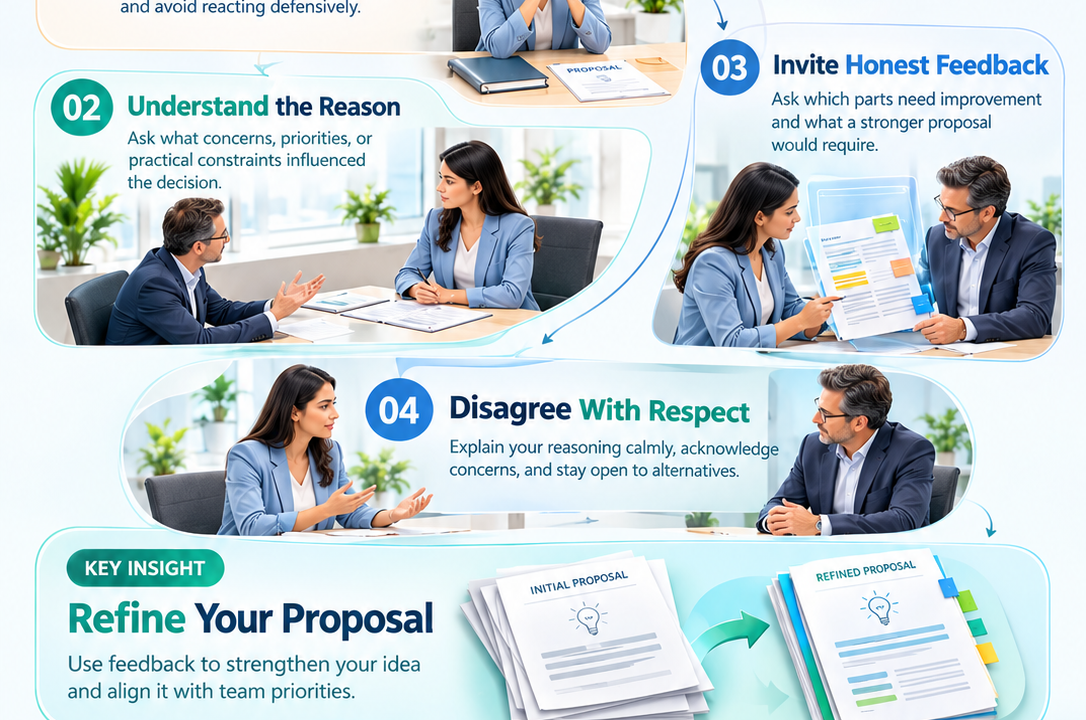
Stepping into the professional arena means sharing your thoughts, innovations, and potential solutions. You’ve poured your energy into crafting a brilliant idea, only to have it met with a managerial ‘no’. 😟 It’s a moment that can sting, especially when you believe in your proposal. However, the way you navigate this scenario can transform a disappointing encounter into a powerful opportunity for growth, deeper understanding, and a more robust connection with your supervisor. 🌱
It’s a common misconception that every brilliant spark of an idea needs to be instantly adopted. Managers often possess a broader view of organizational goals, financial constraints, or operational feasibility that might not be immediately apparent. A rejection doesn’t automatically signal your idea’s lack of merit; it might simply mean it requires more refinement, a different strategic alignment, or perhaps the timing isn’t quite right. ⏳ While disagreements are an inevitable part of collaborative environments, reacting defensively can erect barriers to understanding the underlying reasons. Instead of frustration or a feeling of being misunderstood, approaching the situation with genuine curiosity and a commitment to professionalism is key. Asking insightful questions unlocks the decision-making process, provides invaluable feedback, and opens doors to potentially enhancing your original concept. ✨
The ultimate objective here isn’t about unquestioningly accepting every decision. It’s about mastering the art of communication: expressing your perspective in a way that upholds respect, fosters dialogue, and keeps the focus squarely on achieving the best outcomes for the team and the organization. 🎯
The Core Principle: Shift from Defending to Understanding
Instead of feeling compelled to immediately defend your idea, cultivate a mindset of wanting to understand what would make it even better. This subtle shift can change the entire dynamic of the conversation. 🤔
1. Seek Deeper Understanding: The Power of Questioning ❓
When your proposal is met with a ‘no,’ the natural inclination might be to launch into a detailed defense, explaining precisely why your concept is superior. While explaining your rationale can be valuable, jumping straight into advocacy can inadvertently prevent you from truly grasping the concerns driving the decision. A more effective first step is to invite your manager to share their perspective. This subtle pivot shifts the focus from a ‘who is right’ debate to a mutual exploration of the project’s requirements and challenges. 🗺️
❌ Avoid Saying: “But my idea is much better and would solve everything.”
This statement can quickly escalate the exchange into an adversarial argument, hindering open communication. 🥊
✅ Try Saying: “Could you help me understand your concerns regarding this proposal?”
This phrasing is open-ended, inviting explanation and providing you with a clearer pathway to comprehending the decision-making process. It positions you as a learner, not a competitor. 🧠
After your manager responds, listen attentively without formulating your counter-argument. You might uncover valid points you hadn’t considered or realize that a specific aspect of your proposal needs more thorough explanation. This active listening is crucial for extracting maximum value from the feedback. 👂
2. Embrace Feedback: Fuel for Improvement 🔥
A rejected idea doesn’t have to signify the end of the learning curve. Feedback is a gift, even when it’s delivered in the context of a rejection. It’s an invaluable opportunity to identify potential weaknesses in your reasoning, hone your presentation skills for future ideas, and gain clarity on your manager’s expectations for proposals moving forward. 🌟
Rather than viewing the rejection as a personal indictment or a sign that your contributions are unvalued, actively solicit specific guidance on how you can refine your approach. This demonstrates a commitment to growth and a proactive attitude. 💪
❌ Less Helpful: “You never listen to my ideas, and this is proof.”
This statement is accusatory and focuses on blame, shutting down productive dialogue. 🙅♀️
✅ More Constructive: “I’d really appreciate your feedback on how I can improve this proposal or present it more effectively next time.”
This refined approach centers on actionable improvements you can make. It opens the door for a targeted discussion about the proposal itself, steering clear of broad judgments about your manager’s listening habits. 🚀
3. Demonstrate Adaptability: The Art of Refinement 🎨
When you’ve invested significant time and intellectual capital into developing an idea, a rejection can feel profoundly personal. It’s natural to desire recognition for your hard work. However, focusing solely on the effort invested doesn’t address the specific reasons why the proposal wasn’t accepted. A more constructive and professional response acknowledges that the idea might require adjustments and signals your willingness to collaborate on a stronger, more polished version. 🤝
✅ Try Saying: “I understand. I’d welcome the opportunity to refine this proposal based on your input.”
This statement elegantly conveys flexibility and a collaborative spirit without invalidating your original thinking. It keeps the conversation flowing, positioning improvement as the primary goal rather than dwelling on the disappointment of the rejection. This openness can often lead to synergistic problem-solving. 💡
A Practical Communication Guideline: Focus on the Idea, Not on Being Right ⚖️
You can maintain confidence in your innovative thinking while simultaneously demonstrating a willingness to be receptive to new perspectives and necessary revisions. Professional communication thrives on a balance between conviction and continuous learning. 📚
4. Respond with Professionalism: Disagree Respectfully 🧐
Professionalism doesn’t mandate the suppression of all disagreements. There might be valid reasons to believe your idea still holds significant merit and could warrant further exploration or reconsideration by your manager. The critical distinction lies in the *manner* in which you express that disagreement. Employing accusatory language tends to divert attention from the substance of your proposal, whereas posing respectful, open-ended questions keeps the dialogue focused on its potential value and impact. 🗣️
❌ Instead Of: “That’s not fair, and you’re not seeing the benefits.”
This statement can immediately put the other person on the defensive, shutting down rational discussion. 🛡️
✅ Try This: “I see your point regarding [mention manager’s concern]. Could we perhaps explore the potential benefits of my suggestion once more, considering that perspective?”
This approach respectfully acknowledges the manager’s viewpoint while gently requesting a further discussion about the benefits, without dismissing their decision outright. It’s a diplomatic way to keep the conversation alive. 🕊️
It’s also important to gauge the situation. If your manager has clearly articulated their decision and indicated that further discussion is not productive at this moment, it may be more beneficial to acknowledge the outcome gracefully and inquire about the priorities that should guide your next actions. This shows respect for their leadership and decision-making authority. 🙏
5. Maintain Open Dialogue: Avoid Dead Ends 🚪
When disappointment begins to surface, the temptation to abruptly end the conversation with a curt, dismissive remark can be strong. Phrases like “Fine, whatever” might express your frustration, but they offer little in the way of clarifying the decision or establishing a constructive path forward. 🚶
Instead, acknowledge the conversation that has taken place. Where appropriate, ask what key takeaways you should consider from the discussion. This shows you are engaged and processing the information. 📝
✅ A More Useful Response: “Thank you for explaining your perspective so clearly. Based on this discussion, what would you recommend I focus on next?”
This response acknowledges the value of the conversation and artfully redirects the focus toward practical, actionable next steps. It allows you to communicate your understanding without needing to feign complete enthusiasm if you’re still processing disappointment. It’s a sophisticated way to handle emotional responses professionally. 👍
Remaining engaged throughout the conversation also helps you discern whether an idea is fundamentally flawed and needs significant revision, or if it’s a matter of strategic alignment that might be revisited later. Understanding this distinction is crucial for charting your subsequent actions. 🧭
6. Chart a Course Forward: Aligning with Team Needs 🗺️
Often, a manager’s rejection stems from a concern about how a proposed idea aligns with the team’s current priorities or immediate objectives. Understanding this underlying concern is vital in determining whether to revise the idea, reframe its presentation, or pivot to an alternative approach. 🔄
Instead of persistently defending the same proposal, shift your focus to understanding the conditions under which it *could* be more effective or appropriate. This proactive stance demonstrates your commitment to solutions. 💡
✅ Ask: “What aspects of this proposal could be strengthened, or what adjustments would make it more impactful for our team’s current objectives?”
This question is designed to elicit specific, actionable feedback. It can help you pinpoint whether the idea requires clearer supporting data, a different strategic angle, or more thorough refinement. The ultimate goal is to understand how to make the proposal more viable, not simply to win an argument. 🏆
7. Recognize When to Conclude: Graceful Acceptance 🏁
It’s important to acknowledge that not every idea, even after thoughtful questioning and offers of revision, will be revisited or approved. Recognizing when a discussion has reached its natural conclusion is a hallmark of mature workplace communication. 🤝
You can respectfully acknowledge your manager’s decision while continuing to cultivate your skills and contribute fresh ideas in the future. If a decision is indeed final, leverage the feedback you’ve received to inform your subsequent proposals. Treat it as a learning experience that strengthens your approach, rather than letting a single setback diminish your confidence. 🚀
Where appropriate, you might also inquire if the idea could hold potential value under different circumstances or at a later time. This keeps the door open for future possibilities without presuming that reconsideration is guaranteed. It’s about planting seeds for future growth. 🌱
Putting it into Practice: A Simple Framework for Navigating Rejection 🛠️
When your manager rejects an idea, consider this straightforward sequence: pause before you respond, inquire about their concerns, actively listen to the feedback, and collaboratively determine a constructive next step. This structured approach can help you manage your immediate reactions and steer the conversation productively. 🧭
- Pause and Process: Take a brief moment to gather your thoughts and manage any initial emotional response before speaking. 🧘
- Ask a Neutral Question: Frame your inquiry neutrally to understand the underlying reasons for the rejection. ❓
- Listen Actively: Hear your manager out without interrupting or immediately launching into a defense. 👂
- Seek Improvement Guidance: If further development is appropriate, ask specific questions about how the idea could be enhanced. 🌟
- Acknowledge and Agree on Next Steps: Conclude by acknowledging the decision and, where possible, agreeing on a clear path forward. 🚶
Key Takeaways for Constructive Handling of Rejection 🔑
Navigating idea rejection effectively transcends mere politeness; it involves deep listening, emotional regulation, and maintaining a laser focus on improvement and collaboration. 🎯
- Seek Understanding First: Before assuming you know the ‘why’ behind the rejection, ask clarifying questions. 💡
- Welcome Feedback as a Tool: Treat constructive criticism as valuable data that can refine future proposals and strengthen your contributions. 💪
- Maintain Respectful Dialogue: Express any differing viewpoints without resorting to personal attacks or dismissive language. 🕊️
- Embrace Adaptability: Be open to refining your ideas when there’s a genuine opportunity to enhance their effectiveness or relevance. 🎨
- Focus on Future Actions: If a decision is final, use the insights gained to inform your subsequent efforts and contributions. 🚀
A Final Perspective: Even a Rejected Idea Can Be a Valuable Contribution 💎
While a manager’s decision to reject an idea can be disheartening, it doesn’t need to devolve into conflict. By consciously replacing defensive reactions with thoughtful inquiry, you significantly increase your chances of understanding valuable feedback, sharpening your own thinking, and preserving a positive and respectful working relationship with your manager. ✨
This approach doesn’t require you to abandon your core convictions or stop proposing innovative concepts. What truly matters is the *way* you communicate your ideas and respond to feedback. A demonstrated willingness to listen, learn, and move forward constructively transforms potential disagreements into a powerful engine for professional growth and a more dynamic work environment. 🚀
This guidance on workplace communication comes from Growth Coach, offering practical insights for professional development, fostering thoughtful conversations, and nurturing stronger working relationships. 🌟