The decision to pursue a traditional job or embark on the entrepreneurial journey is far more intricate than a simple fork in the road. It’s a profound choice that touches upon immediate financial security, personal autonomy, the allure of risk, the shadows of uncertainty, and the ambitious prospect of crafting a future with greater control. 🌟
Imagine a powerful visual: a person confined within a cage, their gaze fixed on a piece of bread just out of reach, while nearby lies a key. This isn’t merely about choosing between two objects; it’s a poignant metaphor for the human condition when faced with significant life decisions. The bread symbolizes sustenance, the steady hum of a regular income that supports our present needs – the essence of a conventional job. The key, however, represents something more profound: entrepreneurship, ownership, the potential for self-determination, and the tantalizing promise of future independence. 🔑🍞
Understanding the Metaphor: Job vs. Business
At its core, this powerful illustration contrasts the comforting predictability of a job with the exciting, albeit more challenging, path of building a business. The bread signifies the income vital for meeting today’s bills, covering rent or mortgage payments, feeding your family, and managing daily expenses. It’s the foundation of immediate financial security. The key, on the other hand, represents the potential to unlock a different future – one where you are the architect of your own financial destiny, where your efforts directly translate into ownership and potentially exponential growth. This metaphor highlights not just the choice, but also the inherent risks, sacrifices, and the understandable human inclination to prioritize immediate well-being over a less certain, though potentially more rewarding, future. 🤔
The Person in the Cage: A Symbol of Constraint
The figure enclosed within the cage embodies an individual who may feel restricted by their current employment situation. The cage itself is a potent symbol of limitations – perhaps a lack of creative freedom, limited autonomy, or the feeling of being tethered to a path over which they have little ultimate control. It’s crucial to understand that this imagery doesn’t inherently demonize every job; employment can offer invaluable stability, resources, and a vital springboard. Instead, the ‘cage’ represents a feeling of being bound, a sensation that intensifies when immediate financial obligations make exploring alternative paths seem daunting or impossible. ⛓️
- The Person: Limited Autonomy: This element symbolizes someone who might feel restricted by a standard employment role or by the sheer necessity of relying on a regular paycheck to survive.
- The Bread: Immediate Sustenance: This represents the tangible paycheck or salary – the income that ensures bills are paid, cupboards are stocked, and a sense of financial security is maintained day-to-day.
- The Key: Potential Freedom: This symbolizes the world of entrepreneurship, ownership, and the exciting possibility of cultivating greater independence over the long haul.
Why Reach for the Bread First? The Logic of Immediate Needs
Observe the stick in the illustration. Instead of reaching for the key to unlock a new future, the person uses it to pull the bread closer. This action powerfully illustrates a focus on securing an immediate, tangible need over pursuing a less certain, aspirational alternative. This decision often stems from a fundamental human trait: risk aversion. A regular job offers a predictable income stream, a comforting assurance. Conversely, launching a business is inherently uncertain. It can demand significant financial investment, carry substantial pressure, and involve a prolonged period where the outcome is far from guaranteed. 🎯
Here’s a breakdown of why this immediate focus is so understandable:
- Immediate Financial Needs Take Precedence: For many, regular income isn’t a luxury; it’s a necessity. Covering food, shelter, education, and transportation are paramount responsibilities that make immediate financial security a practical, often non-negotiable, priority. 🏠🍎🚌
- Business Involves Inherent Uncertainty: Entrepreneurship is a leap of faith. It often requires embracing ambiguity and navigating periods where income and results are unpredictable, demanding resilience and a strong stomach for risk. 🎢
- Security Feels Easier to Grasp: When the reward is immediate and clearly defined (the bread), and the alternative is nebulous and uncertain (the key), the human brain naturally gravitates towards the option that addresses today’s pressing requirements. ✅
- Long-Term Goals Require a Different Mindset: The key represents a transformative shift, a potential for profound change. However, simply recognizing this opportunity doesn’t magically dissolve the practical hurdles and sacrifices needed to achieve it. ⏳
The Deeper Message: Priorities and Possibilities
At its heart, the illustration is a powerful commentary on priorities. It suggests that our intense focus on meeting immediate needs can sometimes overshadow the pursuit of longer-term aspirations and potential. This metaphor isn’t designed to declare employment as inherently negative or entrepreneurship as a guaranteed ticket to freedom. Instead, it vividly portrays the inherent tension between enjoying certainty today and striving for greater autonomy tomorrow. ⚖️
Short-Term Security Versus Long-Term Autonomy: A Visual Tale
The central conflict depicted is between something that satisfies an immediate requirement and something that represents a potential, transformative shift in an individual’s future. This creates a clear and relatable visual representation of the timeless short-term versus long-term dilemma.
| Symbol | Represents | Main Idea |
|---|---|---|
| Cage | Conventional employment situation | Possible limitations or reduced autonomy |
| Bread | Job or salary | Immediate financial security |
| Key | Business or entrepreneurship | Potential ownership and independence |
| Stick | Immediate problem-solving | Focus on securing today’s needs |
EDITORIAL INSIGHT
The illustration poses a fundamental question: when immediate security is readily available, how much focus and energy can realistically be dedicated to the long-term pursuit of independence?
The Concept of the “Golden Cage” 💰
This imagery also resonates deeply with the concept of a “golden cage.” In this context, a stable and comfortable job can provide such a high degree of security and comfort that the prospect of leaving it for a more uncertain entrepreneurial path becomes incredibly daunting, even when a more promising alternative is clearly visible. The metaphor, therefore, zeroes in on the psychological and economic gravity of security. An individual might recognize the potential of another path but still consciously choose the predictable option because the potential fallout from uncertainty feels too overwhelming to bear. 🚧
Immediate Needs
A consistent income stream is crucial for meeting immediate financial obligations.
Visible Opportunity
The key symbolizes a potential route towards enhanced independence.
Embracing Uncertainty
Transitioning to entrepreneurship often involves navigating uncertainty and periods of intense effort.
Long-Term Vision
The metaphor encourages reflection on how current choices shape future aspirations.
What the Image Effectively Conveys (and Doesn’t)
It’s vital to recognize that this illustration serves as a commentary on a common human dilemma, not as an absolute decree on the nature of employment or entrepreneurship. A fulfilling job can provide invaluable stability, practical experience, essential skills, and a reliable income. Conversely, launching a business doesn’t automatically guarantee financial freedom; it comes with its own set of challenges and demands. The true power of the image lies in its ability to provoke thought about priorities: how does an individual judiciously balance the pressing demands of today with the ambitious aspirations for autonomy and ownership tomorrow?
⚠️ A Necessary Distinction
Financial security and the pursuit of entrepreneurship are not inherently mutually exclusive for everyone. The metaphor simplifies a complex decision into easily digestible symbols, thereby illuminating the inherent tension between the need for immediate income and the desire for long-term autonomy.
Key Takeaways from the Metaphor 🗝️
- 01. The Bread Symbolizes Immediate Security: It represents the consistent income stream that helps meet daily living expenses and provides a sense of financial stability. 🥖
- 02. The Key Represents a Potential Path to Autonomy: It signifies entrepreneurship, the opportunity for ownership, and the exciting prospect of achieving greater independence. 🚀
- 03. Risk Significantly Influences Decisions: The inherent uncertainty associated with starting a business often makes the predictable income from employment a more appealing choice. ⚖️
- 04. Short-Term and Long-Term Priorities Can Conflict: Immediate responsibilities and needs can understandably take precedence over longer-term ambitions and goals. ⏳
- 05. The Metaphor is Not a Universal Verdict: It functions as a visual exploration of the inherent tension between achieving financial security and pursuing entrepreneurial freedom, not as a definitive judgment. 🤔
FINAL PERSPECTIVE: Security Today, Possibility Tomorrow
The cage, the bread, the key, and the stick converge to form a simple yet profoundly impactful metaphor for a complex economic and personal decision. The bread underscores the practical importance of immediate income, while the key unlocks the vision of building something that offers greater ownership and autonomy. The central lesson is not to advocate for one path over the other; rather, it’s to illuminate that achieving financial security and realizing long-term freedom often involve distinct priorities, varying levels of risk, and different timelines. Grasping this inherent tension sharpens the clarity of the metaphor’s message. Sometimes, the most challenging choice isn’t seeing the key, but discerning how to harmoniously balance today’s necessities with the boundless possibilities of tomorrow. ✨
Explore More on Your Financial Journey! 💡
Continue to deepen your understanding of business and entrepreneurship. Explore practical business and entrepreneurship resources designed to guide you on your path toward financial independence, ownership, and fostering a robust long-term business perspective. Your journey to financial empowerment starts with knowledge and actionable steps!
Frequently Asked Questions (FAQ)
Q: What is the fundamental difference between a job and a business?
A: A job typically offers a predictable income through employment, whereas a business involves ownership, responsibility, inherent uncertainty, significant risk, and the potential to generate diversified income streams.
Q: Can a traditional job genuinely provide financial security?
A: Absolutely. A steady job can reliably cover daily expenses, facilitate savings, manage debt repayment, and support comprehensive financial planning due to its relatively predictable income flow.
Q: How can starting a business contribute to achieving financial freedom?
A: A business offers the potential for ownership and can unlock new income avenues. However, it’s crucial to acknowledge the accompanying uncertainty, operational costs, significant responsibilities, and inherent financial risks.
Q: Is financial freedom solely about choosing between a job and starting a business?
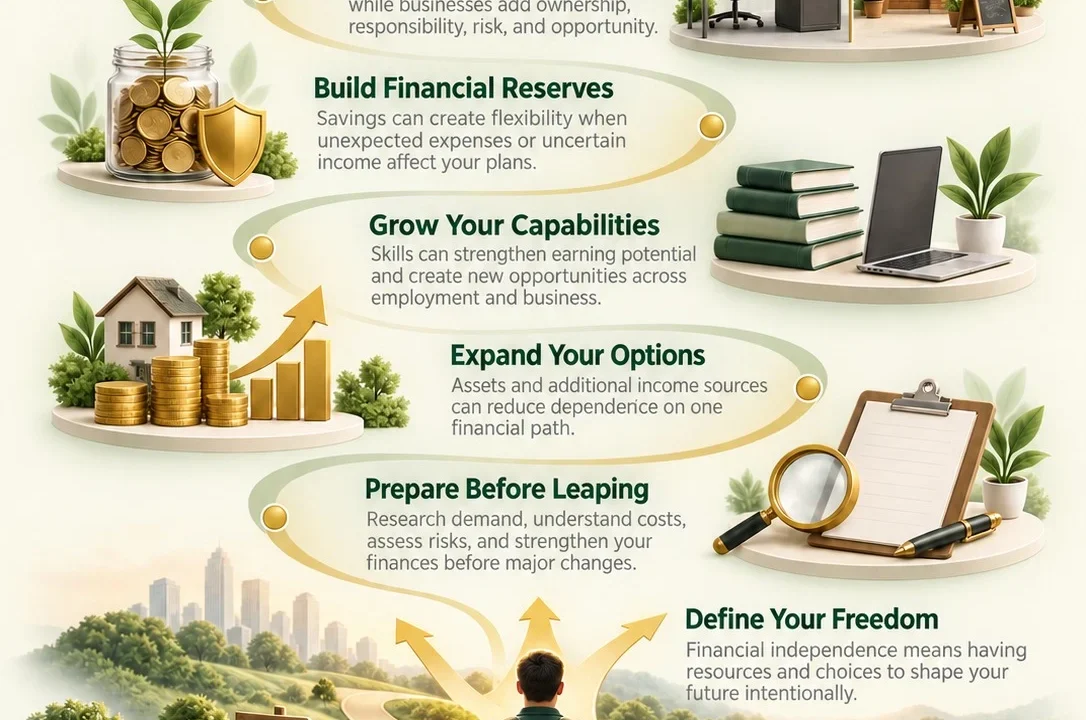
A: No, financial freedom is a broader concept. It encompasses building substantial savings, continuously developing valuable skills, strategically accumulating assets, diversifying income sources, and practicing responsible risk management.
Q: Why are building financial reserves so critical?
A: Financial reserves act as a crucial buffer, providing essential flexibility when unexpected expenses arise or during periods of income instability.
Q: How do savings contribute to overall financial freedom?
A: Savings strengthen your financial resilience, offering a solid foundation to navigate uncertainty and to seize emerging financial opportunities with greater confidence.
Q: What is the importance of developing skills before pursuing financial freedom?
A: Cultivating in-demand skills significantly enhances your earning potential and opens up a wider array of opportunities, applicable to both traditional employment and entrepreneurial ventures.
Q: How can owning assets expand one’s financial options?
A: Assets can generate additional income and provide valuable financial resources, potentially reducing reliance on a single source of income.
Q: What constitutes additional income sources?
A: Additional income sources are supplementary financial opportunities beyond your primary income stream, designed to enhance flexibility and provide greater personal choice.
Q: Should one immediately resign from a job to start a business?
A: Significant career transitions like this require careful consideration. Thorough market research, understanding costs, a realistic assessment of risks, and strengthening personal finances are paramount before making such a leap.
Q: What key factors should be evaluated before launching a business?
A: Essential considerations include market demand, operational expenses, potential financial risks, available resources, relevant expertise, and your personal capacity to manage uncertainty effectively.
Q: How does diligent risk management enhance financial planning?
A: Proactive and responsible risk management is vital for safeguarding financial stability, especially when exploring new ventures and making significant financial decisions.
Q: Can employment and business ownership coexist effectively?
A: Yes, they can potentially complement each other. Employment can offer income stability, while a business can be developed on the side to create additional opportunities and income streams.
Q: What is the true meaning of financial independence?
A: Financial independence signifies possessing sufficient resources and financial autonomy to consciously shape your future and pursue your life goals with greater intention.
Q: What are the essential steps to building financial freedom over time?
A: Building financial freedom involves strengthening income stability, consistently saving, acquiring valuable skills, growing assets, diversifying income streams, and managing risks prudently.