
For those who thrive on flexibility and independence, the freelance lifestyle offers unparalleled freedom. 🗽 You’re the captain of your own ship, setting your own hours, choosing your clients, and charting your own course without the constraints of a traditional 9-to-5. 💻 However, this autonomy comes with a unique set of financial responsibilities, particularly when it comes to securing your future. Unlike employees who benefit from employer-sponsored retirement plans and predictable payroll deductions, freelancers must proactively build their own safety net. 🚫 When income streams fluctuate and invoices are your primary paycheck, the thought of long-term retirement savings can easily get pushed aside. 📉
But building a comfortable retirement as a freelancer isn’t just possible; it’s achievable with the right approach and the right tools. The key lies in understanding how to manage variable income and leverage specialized savings vehicles designed for the self-employed. At SmartSave.top, we’re dedicated to empowering you to transform your independent earnings into lasting financial security. 🚀 Let’s explore five powerful, proven strategies to help you construct a robust retirement fund, no matter your income variability.
📊 1. Embrace Percentage-Based Automation: The Freelancer’s Savings Superpower ⚙️
One of the biggest hurdles for freelancers is the inherent unpredictability of income. Aiming to save a fixed dollar amount each month, say $500, can feel like a Herculean task during lean periods. 🎢 This rigid approach often leads to stress, budget shortfalls, and the temptation to dip into savings meant for your future self. It’s a recipe for financial anxiety when client payments are slow to land. 💸
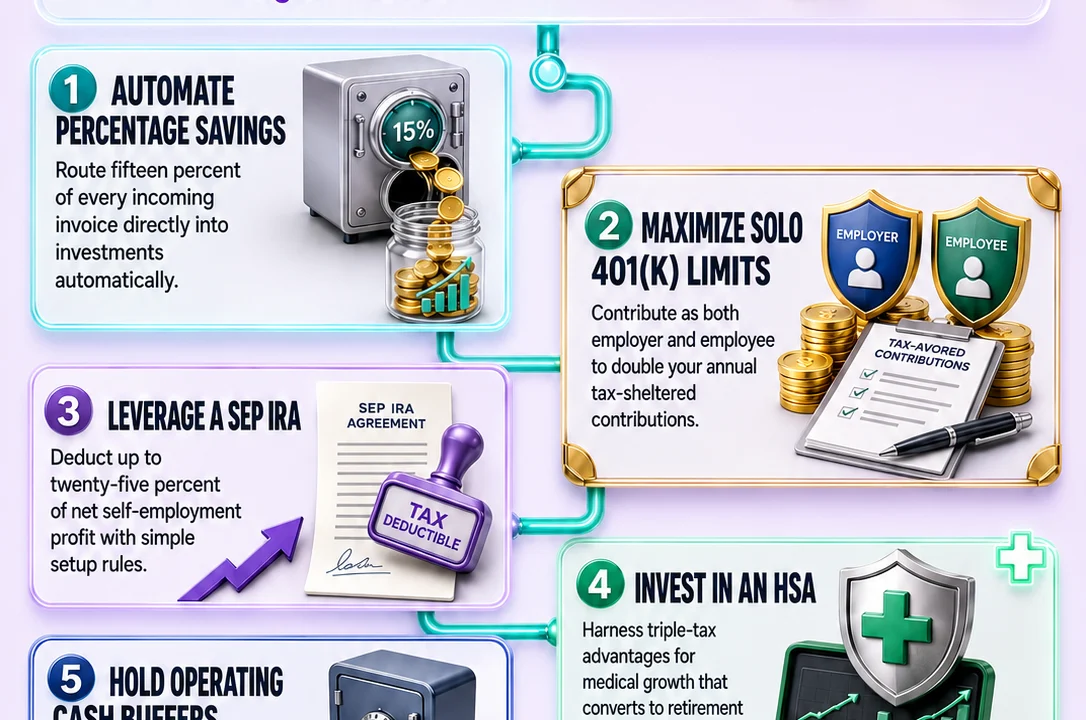
The solution? Switch from fixed cash goals to percentage-based automation. 🎯 Imagine this: every time a client payment clears, a predetermined percentage of that income is automatically swept into a dedicated retirement or investment account. If you set your automation to 15% of every incoming payment, your savings contributions naturally adjust with your earnings. 📈
🌟 High-Income Months: When you land a lucrative project or a client pays early, a larger sum flows seamlessly into your investment portfolio. This allows your wealth to grow even faster during your peak earning periods.
🌱 Quieter Periods: When business is slower, the percentage-based contribution automatically reduces the dollar amount allocated to savings. This crucial flexibility ensures you retain enough cash flow to cover your essential living expenses without panic.
By automating these percentage splits the moment funds hit your business account, you prevent the temptation to spend money that’s earmarked for your future. It’s a silent, powerful way to consistently build wealth without feeling the pinch. 🏦
📌 Key Takeaway: Set up your business bank accounts to automatically divert 15% to 20% of all gross client receipts into a separate savings or investment pool *before* you transfer funds for personal use or expenses! 🛠️ This simple habit is a game-changer.
🏛️ 2. Unlock Maximum Savings with a Solo 401(k) 💼
For self-employed individuals and small business owners with no full-time employees (besides a spouse), the Solo 401(k) is an absolute powerhouse. Also known as an Individual 401(k), this retirement plan offers some of the most generous tax-advantaged savings limits available. 📜
The magic of the Solo 401(k) lies in its dual contribution structure. Because you are both the employer and the employee of your freelance business, you can contribute to the plan in *both* capacities. 🤝 This means you can defer a significant portion of your income into a tax-advantaged account, shielding it from income taxes and allowing it to grow over time. 🛡️
Here’s a quick comparison to help you see the advantages:
| Account Type 🏛️ | Best Suited For 🎯 | Key Advantage 🏆 | Tax Flexibility ⚖️ |
| :————– | :——————- | :—————— | :—————– |
| Solo 401(k) | High earners with zero employees | Dual employer-employee limits 🚀 | Traditional & Roth options ☀️ |
| SEP IRA | Freelancers seeking simple setup | Up to 25% net profit 📊 | Tax-deductible pre-tax 📉 |
| Roth IRA | Beginners or lower tax brackets | Tax-free retirement growth 💎 | After-tax contributions 🏖️ |
💡 Smart Tip: Many reputable brokerage firms now offer Roth Solo 401(k) options. This is a fantastic way to contribute after-tax dollars now, which then grow tax-free and can be withdrawn completely tax-free in retirement. It’s a powerful strategy for long-term tax diversification. ☀️
📄 3. Streamline Contributions with a SEP IRA 📝
If the administrative nuances of a Solo 401(k) feel a bit daunting, a Simplified Employee Pension (SEP) IRA presents a wonderfully straightforward alternative. 📄 Opening a SEP IRA is typically a quick and easy process, often completed in minutes with most major online investment platforms. ⏱️
The primary benefit of a SEP IRA is its contribution limit: you can put away up to 25% of your net self-employment earnings each year. 📈 Crucially, every dollar you contribute to a SEP IRA is tax-deductible. This means it directly reduces your taxable income for the year, lowering your overall self-employment tax burden. 📉 It’s a direct way to cut down on your tax bill while simultaneously investing in your future.
📝 Flexible Funding: One of the most attractive features of a SEP IRA is its flexible deadline. You have the ability to open and fund a SEP IRA all the way up to your tax filing deadline, including any approved extensions. This provides significant flexibility in managing your tax liabilities.
⚙️ Minimal Overhead: Most modern brokerage accounts offer SEP IRAs with zero account maintenance or setup fees. This means more of your money goes directly into investments rather than administrative costs.
Funding a SEP IRA at tax time can be a strategic move to manage your final tax bill. 🧾 However, remember the earlier point about automation: while deadlines are flexible, making consistent, automated contributions throughout the year ensures your money is working for you in the market sooner. ⏳
⚠️ Common Pitfall: Waiting until the last minute to decide on your SEP IRA contributions! While the deadline is forgiving, establishing automatic monthly transfers allows your investments to benefit from compounding growth over a longer period.
🏥 4. Harness the Triple-Tax Advantage of a Health Savings Account (HSA) 💊
As a freelancer, you’re responsible for securing your own health insurance, which often leads to choosing High Deductible Health Plans (HDHPs). 🏥 This decision, while sometimes driven by cost, unlocks access to one of the most potent tax-advantaged accounts available: the Health Savings Account (HSA). 🛡️
HSAs are unique because they offer a triple-tax advantage that no other retirement savings vehicle can match. 🌟 Here’s how it works:
1. Tax-Free Contributions: Money you contribute to your HSA is deducted from your taxable income (or is not taxed if you contribute through payroll deductions with an employer).
2. Tax-Free Growth: Your HSA funds can be invested and grow completely tax-free, similar to a Roth IRA.
3. Tax-Free Withdrawals: When you use the funds for qualified medical expenses, the withdrawals are entirely tax-free. 💊
🧠 Expert Insight: Think of your HSA not just as a fund for immediate medical needs, but as a powerful long-term investment vehicle. If possible, pay for current medical expenses out-of-pocket. This allows your HSA balance to grow significantly over time. Let your HSA funds invest in a diversified portfolio of index funds or ETFs, and you can harvest tax-free growth for future healthcare costs in retirement. 🌲
An added benefit is that after age 65, any unspent funds in your HSA can be withdrawn for *any* reason (not just medical expenses) and are taxed at your ordinary income tax rate. This makes it function much like a Traditional IRA in your later years. 🏛️
🌊 5. Build a Financial Buffer: Your Operating Cash Runway 🧱
Even with the most diligent saving and investing, the freelance journey will inevitably include periods of slower client work or unexpected market fluctuations. 📉 If all your readily available cash is tied up in retirement accounts or spent on immediate needs, a quiet month could force you into a difficult position: liquidating investments at a loss just to cover your bills. 🕳️
To prevent this scenario, it’s crucial to maintain an operating cash runway. This means keeping 3 to 6 months’ worth of your essential living expenses readily accessible in a high-yield savings account. 🏦 This buffer acts as a financial shock absorber. It provides peace of mind, allowing you to weather slow periods or unexpected expenses without derailing your long-term investment strategy. 🧘♂️
📖 Mini Summary: Becoming a financially secure freelancer involves a multi-pronged approach: consistently automate savings using percentages of your income, choose high-contribution retirement accounts like the Solo 401(k) or SEP IRA, leverage the unique tax benefits of HSAs for medical and future needs, and always protect your core investments with a healthy emergency cash reserve.
📝 Key Takeaways for Independent Wealth Builders 📝
⚙️ Automate Smartly: Implement automatic transfers of 15% to 20% of each client payment into your designated savings and investment accounts.
💼 Explore Solo 401(k)s: Maximize your savings potential by leveraging both employer and employee contribution limits offered by this powerful plan.
📄 Simplify with SEP IRAs: Quickly reduce your taxable net profit with the straightforward setup and contribution rules of a SEP IRA.
🏥 Invest Your HSA: Transform your Health Savings Account into a growth engine by investing the funds for tax-free growth and future medical or non-medical needs.
🛡️ Maintain a Cash Buffer: Ensure 3 to 6 months of living expenses are held in liquid savings to safeguard your investments from forced liquidation.
🏁 Own Your Financial Future: The Freelancer’s Advantage 🏁
Freelancing grants you control over your career, and it absolutely should grant you control over your financial destiny too. 💎 You don’t need a corporate 401(k) match to achieve a substantial retirement nest egg; you can build it on your own terms, with your own strategic plan. 🏆
By combining the discipline of percentage-based automation with the strategic advantages of tax-advantaged accounts like Solo 401(k)s and SEP IRAs, your independent earnings can compound significantly year after year. 🌲 Start today, stay consistent, and let the power of time and compounding work wonders for your wealth.
Take the reins of your financial future. SmartSave.top offers a suite of practical tools, including wealth calculators, in-depth tax guides, and investment resources, designed to help you optimize your cash flow and accelerate your wealth-building journey right now! 🚀👇


