Most people approach personal finance as if it were a high-stakes math test. We are taught that if we just learn the right formulas, calculate the optimal interest rates, and follow the perfect budgeting spreadsheets, we will automatically become wealthy. However, the real world tells a different story. Financial success isn’t typically determined by high-level academic intelligence; it is determined by the behavior, temperament, and psychological patterns we exhibit in our daily lives.
In his seminal work, The Psychology of Money, Morgan Housel shifts the conversation from technical analysis to human conduct. He argues that our relationship with money is driven by our life experiences, our emotional baggage, and our unique perspectives. To truly grow your wealth, you must look inward. Here is an in-depth breakdown of the fundamental lessons that will change how you view your financial life forever.
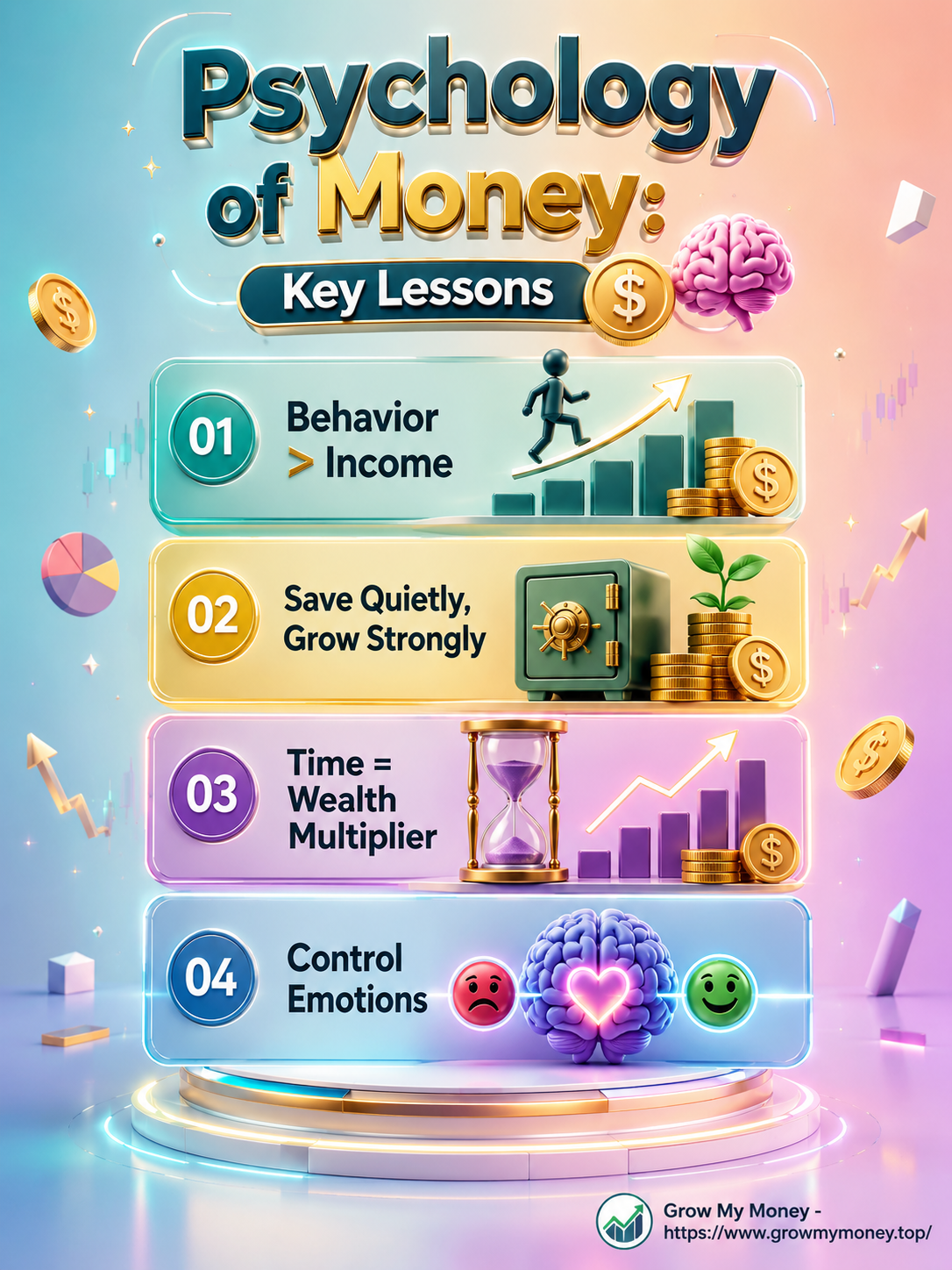
1. Behavior Trumps Brilliance
There is a dangerous misconception that to be successful with money, you must be a genius. In reality, finance is a soft skill. History is littered with brilliant people who failed financially because they could not control their impulses. Conversely, many average people have built significant fortunes simply through discipline and patience.
Wealth is not about what you earn; it is about how you act. It is the result of what you choose to do with your paycheck every single month. When you shift your focus from ‘how can I make more’ to ‘how can I behave better,’ you unlock the true engine of sustainable growth.
2. The Invisible Nature of True Wealth
We live in a culture that confuses ‘rich’ with ‘wealthy.’ Being rich is often displayed through high-end cars, designer clothes, and luxury vacations. These are indicators of current income, but they are not indicators of net worth. If someone spends every dollar they earn to show off their status, they are simply moving money from one hand to another—they have no staying power.
Wealth, by contrast, is the money you don’t spend. It is the financial asset that sits quietly in your account, providing you with options, flexibility, and a sense of security. Wealth is invisible because it is the potential to purchase things in the future rather than the purchase itself. When you prioritize the invisible (savings) over the visible (consumption), you build a foundation that can weather any economic storm.
3. The Unstoppable Power of Compounding
Human beings are notoriously bad at intuitively understanding the power of compounding. We tend to think linearly, but wealth grows exponentially. The most successful investors in the world aren’t necessarily the ones who hit home runs on individual stocks; they are the ones who allow their investments to compound over decades.
Warren Buffett is a prime example. While he is a brilliant investor, the vast majority of his wealth was accumulated after he turned 50. The secret wasn’t just his strategy; it was the fact that he has been investing consistently for over 75 years. Time is the most valuable asset you own. If you start early and keep your money invested, time will do the heavy lifting for you.
4. Keeping Wealth vs. Getting Wealthy
Getting wealthy often requires a set of skills rooted in risk-taking, optimism, and hustle. Keeping that wealth, however, requires a completely different set of skills: humility, fear, and paranoia. To maintain wealth, you must avoid the urge to bet everything on a single ‘sure thing’ and instead embrace a strategy of survival.
You cannot build wealth if you are constantly going bust. This is why diversification and avoiding ruinous risks are vital. You have to ensure that your financial plan is robust enough to survive market crashes, personal emergencies, and unexpected global events. Being ‘optimistic’ about long-term growth while remaining ‘paranoid’ about short-term risks is the winning combination.
5. The Goal is Independence, Not Luxury
Many people work jobs they dislike to buy things they don’t need to impress people they don’t like. This is the antithesis of financial freedom. The highest form of wealth is not owning a mansion or a fleet of cars; it is having control over your own time.
When you have enough savings to handle life’s surprises without panic, you gain the ability to wake up and decide what you want to do with your day. That freedom is the true currency of life. If you anchor your financial goals to freedom rather than status, you will find it much easier to save money and stay consistent.
6. The Danger of Emotional Investing
The stock market is a reflection of human emotion. When prices skyrocket, greed takes over, and people rush in, fearing they are missing out. When prices crater, fear takes hold, and people sell at the bottom, desperate to stop the bleeding. If your financial plan is based on your emotions, you are almost guaranteed to fail.
The best financial decisions are often the most boring ones. Automating your savings, sticking to a long-term plan, and ignoring the noise of the 24-hour financial news cycle are the habits that produce winners. Your goal should be to remain as detached as possible from the daily volatility of the markets.
7. Avoid the Trap of Social Comparison
The ‘goalposts’ in your life are moving targets. As soon as you achieve a certain level of wealth, you will inevitably look at someone who has more, which makes your own achievements feel insignificant. This is the ‘hedonic treadmill’ of finance.
Financial success is not a competitive sport. There is no prize for having more than your neighbor. By focusing on your own personal growth and your own unique financial goals, you escape the pressure to keep up with others. Define what ‘enough’ means for your life, and once you reach it, focus on preserving your happiness rather than chasing more numbers.
8. The Role of Flexibility
Life is unpredictable. Therefore, a rigid, inflexible financial plan is a fragile one. You need a margin of error—a ‘fudge factor’—in your budget. If you are living right at the edge of your means, even a small mistake or a minor emergency can derail your entire life.
By keeping your fixed costs low and maintaining a healthy emergency fund, you give yourself the flexibility to pivot when life throws you a curveball. Flexibility is the key to longevity. The longer you can stay in the game, the more likely you are to achieve your financial objectives.
9. Success is a Marathon, Not a Sprint
We live in an age of ‘get rich quick’ schemes and instant gratification. However, sustainable wealth is built slowly, day by day, through small, mundane habits. Whether it’s putting an extra hundred dollars into an index fund every month or simply avoiding high-interest consumer debt, these tiny actions compound into massive results over time.
Don’t be discouraged if you don’t see results in the first six months. Compounding is back-ended. You do the boring work for years with little to show for it, and then, suddenly, the growth becomes explosive. Stay the course and let the math work for you.
Conclusion: Adopting the Right Money Mindset
Ultimately, The Psychology of Money teaches us that financial success is a soft skill. It is about your temperament, your patience, and your ability to look past the superficial markers of wealth. If you can master your internal dialogue, control your reaction to market events, and prioritize long-term freedom over short-term pleasure, you will be well on your way to building a legacy.
Your money is a tool. Use it to build a life that you enjoy living, rather than a life that looks good on paper. When you align your financial behavior with your true values, you stop chasing money and start building a future of genuine abundance.
Frequently Asked Questions
Why is the psychology of money more important than technical finance?
Technical knowledge is useless if you lack the emotional control to execute it. Most financial failure stems from panic selling, greed-driven buying, and poor habits rather than a lack of mathematical knowledge.
How do I start building wealth if my income is low?
Wealth is defined as the gap between your income and your expenses. Even with a modest income, by minimizing your spending and investing the difference consistently, you can build significant wealth over time through compounding.
Is it ever okay to spend money on luxury?
Yes, but it should be done intentionally. The key is to avoid ‘lifestyle creep,’ where your spending increases every time your income does. If your core savings and investment goals are met, spending on things that bring you genuine joy is a valid use of money.
How can I avoid emotional investing?
The best antidote to emotional investing is automation. If your money is invested automatically every month regardless of market conditions, you remove the ‘human’ element from the decision-making process, allowing you to stay the course through volatile markets.