Many people dream of reaching a point where money is no longer a primary source of stress. Yet, for the vast majority, this goal remains elusive. The misconception is that wealth is the result of a massive salary, a lucky stock pick, or inheriting a fortune. While those paths exist, they are statistically rare. The reality for most high-net-worth individuals is far less glamorous. It is rooted in silent, disciplined, and often repetitive habits practiced over decades.
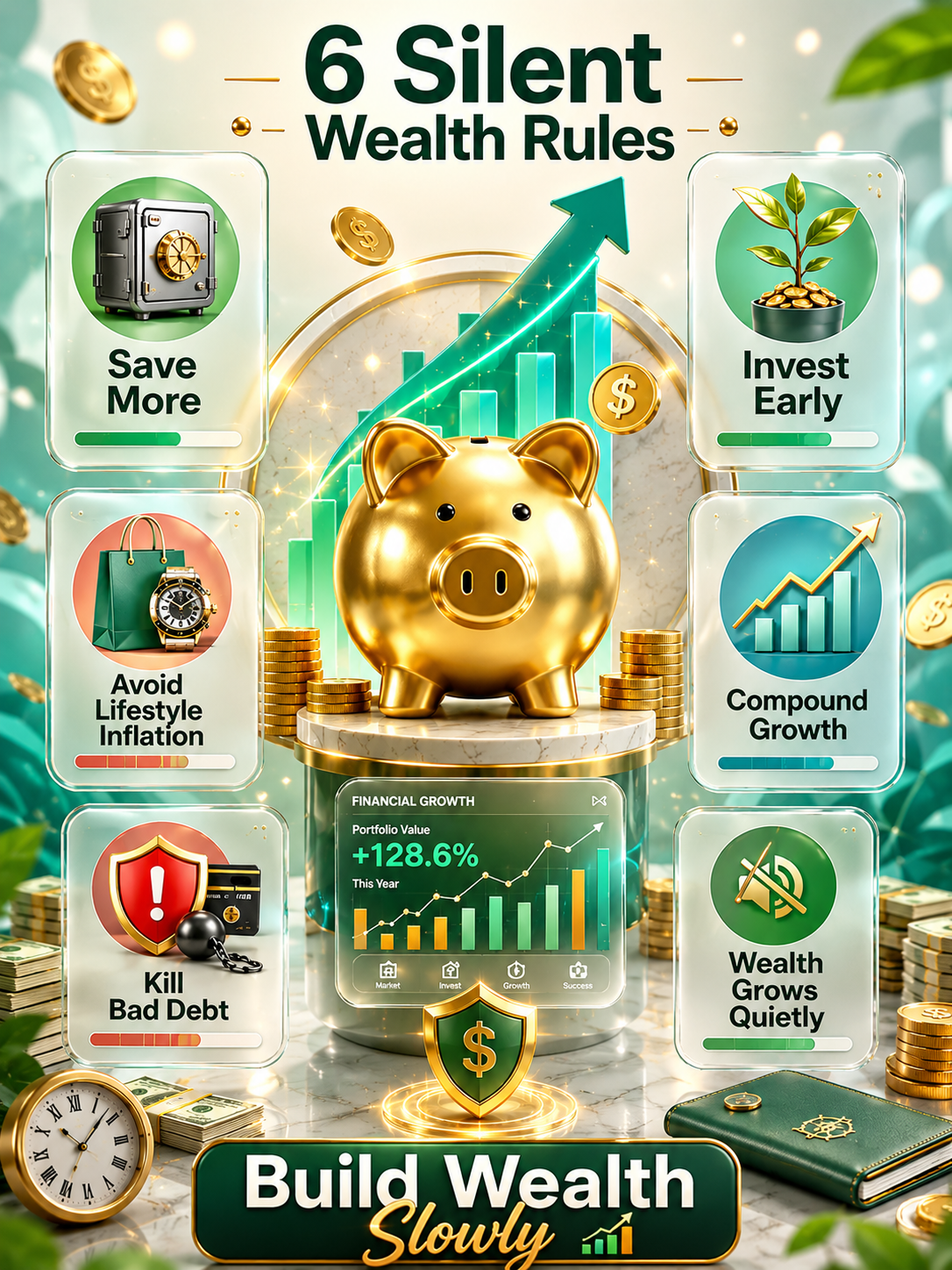
If you want to build genuine financial stability, you need to shift your focus from ‘getting rich’ to ‘building wealth.’ This article breaks down six essential silent rules that the wealthy follow daily—habits that create a compounding effect leading to true financial liberty.
1. The Savings Rate is More Important Than Your Salary
It is a common trap to believe that a higher income is the ultimate solution to financial problems. However, high-income earners are frequently just as financially precarious as those earning minimum wage. This happens because wealth is not determined by what you earn, but by what you keep.
The Mathematics of Wealth
Your savings rate—the percentage of your take-home pay that you save and invest—is the most critical variable in the wealth-building equation. If you earn $100,000 a year but spend $99,000, your net progress is negligible. If you earn $50,000 but live on $30,000, you have more capital to deploy into income-generating assets. Wealthy individuals understand that income is the fuel, but the savings rate is the engine.
Strategies to Boost Your Savings
- Automate Your Finances: Direct deposits into investment accounts before you see the money in your checking account remove the temptation to spend.
- Audit Your Subscriptions: Many ‘invisible’ costs drain your wealth. Regularly review recurring monthly charges for services you no longer utilize.
- Pay Yourself First: Treat your investment account like a non-negotiable bill. If you invest at the start of the month, you are forced to live on what remains.
2. Embracing the ‘Boring’ Nature of Wealth Creation
Social media and modern headlines thrive on stories of instant success. We are constantly inundated with tales of overnight crypto gains or viral business successes. This distorts our perception of reality. True wealth is rarely exciting; it is a marathon of consistency.
Why Boredom Leads to Success
Wealth building involves showing up every month, buying broad-market index funds, and staying the course regardless of market fluctuations. There is nothing thrilling about this, but that is exactly why it works. When you seek excitement in your financial life, you often introduce risk, speculation, and emotional decision-making—three enemies of long-term prosperity.
The Compound Interest Engine
Compound growth is the eighth wonder of the world. By reinvesting your dividends and allowing your initial capital to grow over years or decades, you create a snowball effect. In the early stages, progress seems painfully slow. However, if you maintain the discipline to let your investments sit untouched, the exponential growth phase eventually takes over, where your money begins to work significantly harder than your labor ever could.
3. Guarding Against Lifestyle Inflation
Lifestyle inflation is the silent predator of net worth. Every time a person receives a raise or a bonus, there is an immediate impulse to upgrade one’s standard of living—a better car, a larger house, or more expensive vacations. This behavior ensures that, regardless of how high your income climbs, your expenses will always rise to meet it, keeping you in a cycle of ‘earning-to-spend.’
The Art of Living Below Your Means
Wealthy individuals often practice what is known as ‘stealth wealth.’ They intentionally keep their cost of living flat even as their income grows. By keeping fixed expenses low, they unlock a massive surplus of cash that can be funneled into assets. The goal is not to live in poverty, but to live comfortably while maximizing the distance between your income and your expenses.
4. Recognizing the Difference Between Visible and True Wealth
There is a massive distinction between ‘looking rich’ and ‘being rich.’ Visible wealth involves the display of luxury goods—high-end watches, designer clothes, and luxury vehicles. Often, these items are purchased on credit, creating a veneer of success that hides a fragile financial foundation.
Prioritizing Assets Over Liabilities
True wealth is silent. It is reflected in a portfolio of income-generating assets, business equity, and high-interest savings. When you focus on building true wealth, you become less concerned with the opinions of others. You stop trying to impress people with depreciating liabilities (like cars) and start focusing on accumulating appreciating assets (like index funds, real estate, or business interests). The rich focus on owning things that pay them, not things that cost them.
5. Time is Your Greatest Asset: The Power of Starting Early
Many potential investors hesitate because they feel they don’t have enough capital to start, or they are waiting for the ‘right’ market timing. Both of these are dangerous traps. The most important factor in the growth of your investments is time.
The Cost of Waiting
If you start investing at 25, the compounding effect has 40 years to work its magic. If you wait until 45, you would need to invest exponentially more capital to catch up to that 25-year-old’s results. There is no such thing as a perfect time to enter the market. The volatility of the stock market is a constant, but history shows that over long periods, staying invested is the most effective way to build wealth.
Simplify Your Strategy
You don’t need to be a Wall Street professional to build wealth. Utilizing broad-based index funds or ETFs allows you to own a slice of the entire market. Pair this with Dollar-Cost Averaging—investing a fixed amount regularly regardless of price—and you remove the emotional burden of trying to time market peaks and valleys.
6. The Perils of High-Interest Debt
Debt is a double-edged sword. While low-interest, strategic debt (such as a mortgage or a business loan) can sometimes be used to build wealth, high-interest consumer debt is catastrophic. Credit card interest rates, which often exceed 20%, effectively negate any gains you might be making in the stock market.
Killing the ‘Interest’ Drain
When you carry a balance on high-interest credit cards, you are essentially working to make the bank wealthy instead of yourself. The interest compounds against you, creating a hole that becomes increasingly difficult to climb out of. If you have significant high-interest debt, your first ‘investment’ should be paying it off. The guaranteed ‘return’ on paying off a 20% interest credit card is effectively 20%—a rate that is nearly impossible to match in the investment markets.
The Debt-Free Mindset
Achieving total financial freedom requires a clean slate. Once you eliminate high-interest liabilities, you free up your monthly cash flow. That money should then be immediately redirected into your investment accounts, accelerating your path toward financial independence. By refusing to pay for things you cannot afford, you regain control over your future.
The Summary: Consistent Habits Lead to Freedom
Building wealth is not a secret kept by the elite; it is a set of principles that anyone can adopt. By prioritizing your savings rate, choosing consistency over excitement, avoiding the trap of lifestyle inflation, focusing on assets instead of appearances, starting as early as possible, and aggressively eliminating toxic debt, you set yourself on an unstoppable trajectory.
Financial freedom is rarely about the ‘big score.’ It is about the small, daily decisions that compound over time. Every dollar saved and invested is a soldier working for your future. Start today, stay disciplined, and understand that in the game of wealth, time and consistency will always outperform luck.
Frequently Asked Questions (FAQ)
Why is savings rate more important than income?
Your income is what you make, but your savings rate is what you keep. Without a high savings rate, you are simply facilitating a high-spending lifestyle rather than building an asset base.
What is lifestyle inflation?
It occurs when your expenses rise in tandem with your income. To build wealth, you must ensure your expenses remain stagnant even as your income grows.
How does compound interest work?
Compound interest is the process where the returns on your investments earn their own returns. Over time, this leads to exponential growth of your capital.
Should I pay off debt or invest?
Generally, if you have high-interest debt (like credit cards), pay that off first. Once that is gone, focus on investing to take advantage of compound growth.
Is it too late to start building wealth if I’m older?
It is never too late. While starting early is ideal, the second-best time is now. Even small, consistent contributions will yield better results than not starting at all.
What are the best investment vehicles for beginners?
For most people, low-cost, broad-market index funds are the most efficient way to build wealth over the long term without needing advanced financial knowledge.
Does wealth mean not spending any money?
No. Wealth is about prioritizing your spending on things that bring value and joy, while cutting out the waste that keeps you from your financial goals.
How much should I save each month?
A good rule of thumb is to aim for at least 15-20% of your gross income, but the more you can save, the faster you will reach financial independence.
Why is debt so destructive?
High-interest debt grows exponentially against you. It traps your future income, forcing you to pay for past consumption instead of funding future security.
What is the ultimate goal of these wealth rules?
The goal is to gain ‘financial freedom’—the point where your assets produce enough income to cover your living expenses, giving you the choice of how to spend your time.