
Most people view wealth building as a dramatic event—a massive promotion, a lucky stock market hit, or starting a unicorn startup. However, the reality of financial success is far more mundane and, fortunately, much more accessible. Building lasting wealth is rarely the result of a single “big break”; rather, it is the cumulative effect of small, consistent decisions made over many years. By integrating specific micro-habits into your daily routine, you can build a financial foundation that grows exponentially without requiring constant, high-stakes monitoring.
In this guide, we explore 15 actionable micro-habits that will shift your relationship with money, streamline your savings, and position you for long-term prosperity. These are not get-rich-quick schemes; they are the building blocks of financial independence.
1. Master Your Spending Through Micro-Tracking
You cannot manage what you do not measure. Most people operate on a ‘guesstimate’ budget, which is a recipe for financial leakage. Tracking every single dollar—from your morning coffee to your monthly utility bills—forces you to confront your spending patterns. When you write down your expenses daily, you move from passive consumption to active awareness. Over time, this habit highlights the ‘invisible’ costs of subscriptions you no longer use, recurring fees, and impulse purchases that quietly drain your bank account.
2. Adopt the ‘Save-First’ Mandate
The traditional advice is to save what is left over after expenses. The wealthy investor’s advice is to save before you touch a dime of your income. By treating your savings as a non-negotiable expense—a ‘bill’ you owe your future self—you ensure that growth is prioritized. Even if you start with just 5% or 10% of your paycheck, the act of diverting funds into a high-yield savings or investment account immediately upon payday is a psychological and financial win.
3. The Power of Micro-Investing
Thanks to modern fintech, you no longer need thousands of dollars to enter the stock market. You can start investing with as little as $5 or $10. By setting up a recurring monthly investment—even a tiny amount—you benefit from dollar-cost averaging. This removes the stress of trying to time the market and allows compound interest to work its magic over decades. Consistency in the market beats intensity every time.
4. Read Ten Pages of Financial Literature Daily
Financial literacy is the ultimate hedge against poverty. If you commit to reading just 10 pages a day of books related to personal finance, business psychology, or investing strategies, you will finish over a dozen books a year. This consistent influx of knowledge compounds your ability to make smarter decisions, spot investment opportunities, and avoid common financial pitfalls that catch the uneducated off guard.
5. Commit to One New Skill Each Month
Your earning potential is tied to the value you provide to the marketplace. The digital economy rewards specialized knowledge. Whether it’s learning a new programming language, mastering a data visualization tool, or refining your copywriting skills, adding one new ‘high-value skill’ per month keeps your career trajectory on an upward slope. In today’s world, a static skill set is a depreciating asset.
6. Implement the 24-Hour Cooling Off Rule
Impulse buying is the enemy of wealth. When you see something you want, force yourself to wait at least 24 hours before completing the purchase. This simple micro-habit allows the emotional urge to subside, giving your rational brain time to evaluate whether the purchase is truly necessary. Often, you will find that the desire fades, and your money remains safe in your account.
7. Prioritize Home-Cooked Nutrition
Dining out and relying on delivery apps is one of the most effective ways to sabotage a budget. Not only is eating out expensive, but it also carries hidden costs in health and time. By choosing to cook at home, you regain control over your budget and your health. Batch-cooking or meal-prepping for the week takes only a few hours on a Sunday but can save hundreds, if not thousands, of dollars annually.
8. The Weekly Financial Review
Designate 15 minutes every weekend for a ‘financial check-in.’ During this time, look at your spending for the week, check the progress of your savings goals, and adjust your budget for the week ahead. This habit ensures that you never drift too far off course and allows you to catch errors or overspending before they become a systemic problem.
9. Automate Everything Possible
Willpower is a finite resource. Do not rely on it to manage your finances. Automate your bill payments, your savings transfers, and your investment contributions. When these actions happen in the background without requiring your intervention, you eliminate the possibility of forgetting or succumbing to the temptation to spend those funds on something else.
10. View Debt as a Financial Emergency
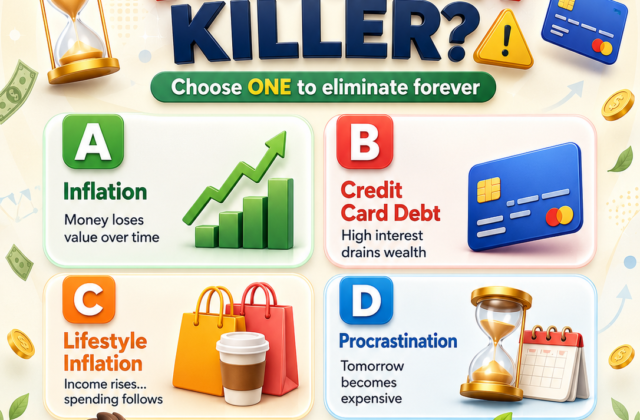
High-interest debt (like credit card balances) is a wealth destroyer. Adopt an aggressive mindset toward eliminating it. View every dollar spent on interest as money stolen from your future net worth. If you are in debt, make it your priority to pay it down systematically using the ‘debt snowball’ or ‘debt avalanche’ method. Every cent of interest saved is a direct contribution to your long-term wealth.
11. Learn the Art of Negotiation
Many of us accept the price tags on services like insurance, internet, and even our salaries as ‘fixed.’ They are rarely fixed. Developing the micro-habit of asking for a better rate, a loyalty discount, or a higher salary is a high-leverage activity. Even if you only negotiate one bill a month, the savings compound significantly over the course of a decade.
12. Diversify Your Income Streams
Relying on a single paycheck is a significant risk. Even if your ‘micro-hustle’ only brings in a small amount of extra cash, the act of diversifying your income builds resilience. Start by exploring low-barrier side projects like freelancing, creating digital products, or affiliate marketing. These streams can eventually grow into substantial assets that provide security when your primary career faces turbulence.
13. Win the Morning Hour
Waking up one hour earlier gives you a dedicated block of time that is yours alone. Instead of jumping straight into emails or social media, use this time for your personal growth. Read, exercise, plan your day, or work on a side project. High achievers often use this early quiet time to sharpen their tools, ensuring they are mentally and physically prepared to handle the demands of wealth building.
14. Curate Your Digital Consumption
Social media is often a breeding ground for comparison, which leads to ‘lifestyle creep.’ When you see others constantly displaying wealth, it’s easy to feel the urge to keep up. Limit your time on platforms that trigger impulsive spending or feelings of inadequacy. Replace that screen time with activities that contribute to your education or business goals, such as listening to podcasts on finance or networking with mentors.
15. Curate Your Peer Group
You are the average of the people you spend the most time with. If your inner circle talks only about entertainment and consumer trends, your habits will reflect that. If you surround yourself with people who prioritize investing, self-improvement, and business growth, you will naturally be pulled toward higher standards of financial discipline. Seek out communities or mentors who model the financial behaviors you wish to emulate.
The Compound Effect of Consistency
It is easy to look at these 15 habits and feel that they are too small to make a difference. However, that is the exact fallacy that keeps most people from achieving wealth. Wealth is not a destination you reach with a sprint; it is the result of thousands of small, correct choices. The ‘compound effect’ means that doing these things every day will not lead to linear growth; it will lead to exponential growth. Your future self will look back at these micro-habits as the pivotal moment your life changed for the better.
Final Thoughts
Don’t try to implement all 15 habits at once. Start by picking two or three that resonate with you most. Once they become part of your daily rhythm, layer in another. Financial success is a marathon, and the secret is simply staying in the race. By focusing on your daily inputs rather than worrying about the massive financial output you hope to see in twenty years, you create a sustainable, stress-free path to true financial independence. The journey of a thousand miles begins with a single dollar saved and a single page read.
Frequently Asked Questions
- Are these habits enough to build a million-dollar net worth? Yes, when paired with time and compounding interest, these habits create the necessary discipline to build significant wealth over the long term.
- How long until I see results? You will see immediate results in your monthly cash flow, but the true wealth-building effects typically become visible within 3 to 5 years of consistent practice.
- Is it okay to treat myself? Absolutely. The goal is not to live in poverty, but to ensure that your spending is intentional rather than accidental.