The modern creator economy is frequently misconstrued as a popularity contest driven by viral trends and vanity metrics like likes or followers. However, for those seeking a sustainable, high-growth career, the objective isn’t fleeting fame—it’s building a resilient business. If your income relies solely on the hours you clock, you haven’t built a company; you have essentially created a demanding job for yourself.
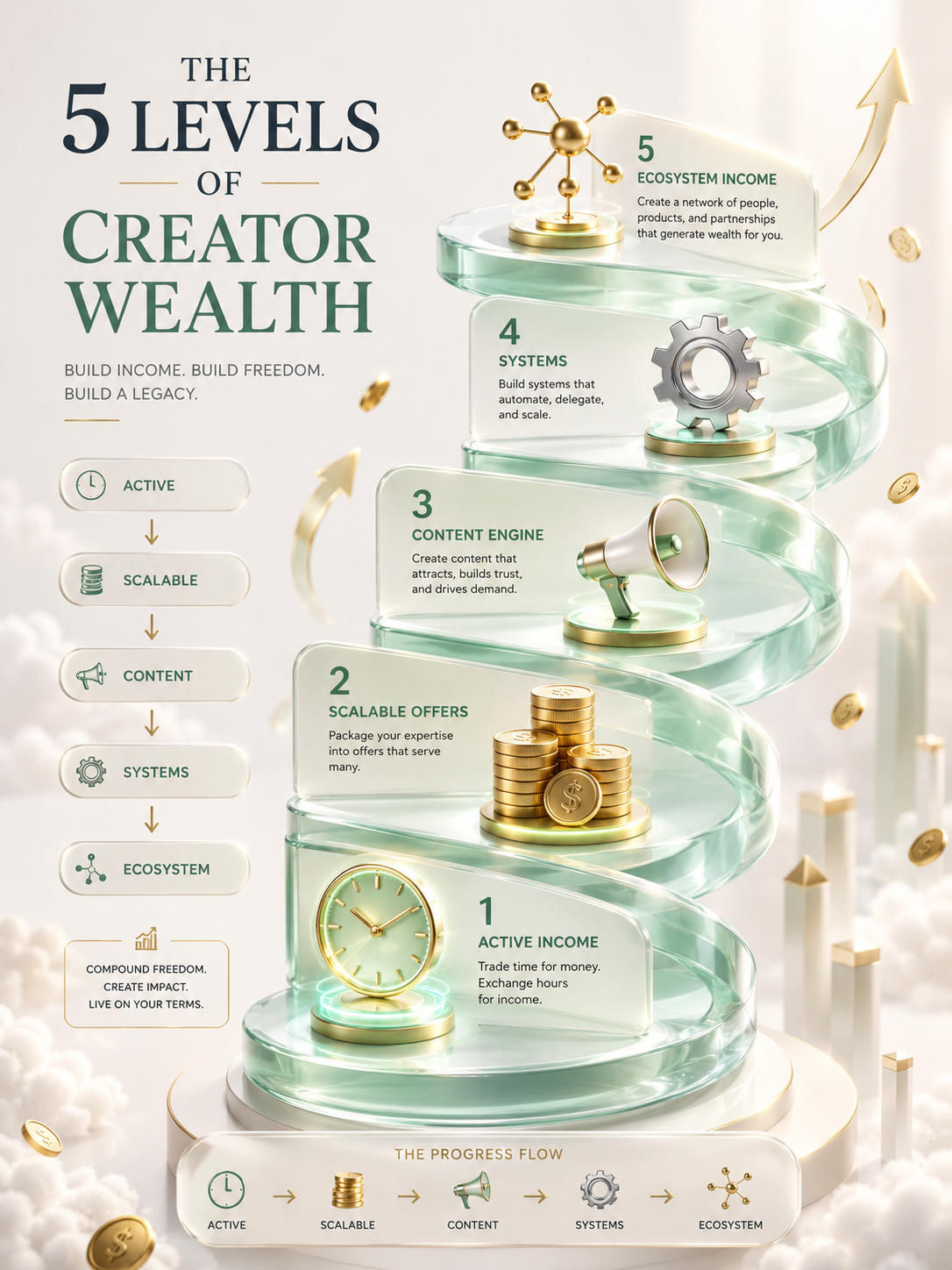
The path to genuine financial autonomy lies in shifting from linear labor to a compounding digital architecture. By integrating five strategic revenue layers, you can evolve from a solo service provider into an ecosystem owner. This transition moves your business away from fragile, single-source income toward a robust, automated engine that functions independently of your immediate presence.
1. The Foundation: Active Income
Every successful digital entrepreneur must start with active income. Whether through one-on-one consulting, freelance service delivery, or personalized coaching, this phase is non-negotiable. It is the crucible where your skills are tested and your business model is validated.
Why this matters: You cannot effectively automate what you do not understand. Engaging directly with clients provides the high-fidelity feedback loop required to identify specific pain points. This real-world interaction allows you to refine your methodology, clarify your value proposition, and establish the social proof necessary for future growth. It is the fastest route to generating initial cash flow while simultaneously stress-testing your professional capabilities.
2. The Leverage Point: Scalable Offers
Once you have mastered your craft through active service, you reach the first major inflection point: scalability. This involves packaging your expertise into products that can be sold repeatedly without a proportional increase in your time investment. Think of online courses, downloadable templates, digital workbooks, or recorded workshops.
Transforming knowledge into assets: By shifting your focus toward knowledge-based products, you disconnect your earning potential from the limits of the 24-hour day. Once a digital asset is created, it acts as a permanent, revenue-generating resource. This is where your business begins to move from “trading time for money” to “building equity,” allowing you to help hundreds of people simultaneously with the effort it previously took to assist one.
3. The Growth Engine: Strategic Content Distribution
A digital product is worthless if no one knows it exists. Your content engine serves as the acquisition arm of your business. By consistently producing high-value articles, short-form videos, or expert carousels across platforms like LinkedIn, Instagram, or YouTube, you create a beacon that attracts your ideal audience.
Building authority at scale: A robust content strategy acts as a pre-sales force. Instead of aggressive cold-pitching, high-quality content nurtures trust. When your educational material consistently solves minor problems for your audience, they naturally begin to view you as a subject matter expert. Consequently, by the time your followers are ready to invest in a premium solution, they have already been primed by your content, making the sales process organic and frictionless.
4. The Force Multiplier: Systems and Automation
If the content engine attracts the crowd, systems and automation handle the conversion. This layer involves setting up email marketing sequences, automated landing pages, and sophisticated sales funnels that guide prospects from initial discovery to purchase without requiring your constant, manual oversight.
Predictable results: Automation is the key to consistency. By deploying CRM tools and email sequencing, you ensure that every prospective lead receives the same high-touch experience regardless of when they join your ecosystem. This eliminates the ‘busy work’ that traps many creators, freeing you to focus on high-level strategy and new innovation rather than repetitive administrative tasks.
5. The Long-Term Play: Ecosystem Income
The final stage is the development of a true ecosystem. This involves creating secondary and tertiary revenue layers that extend the lifetime value of your audience. This could include paid memberships, private communities, recurring subscription models, licensing deals, or strategic affiliate partnerships that complement your core offerings.
Building a compounding asset: An ecosystem provides stability. When your income is diversified across multiple products and recurring memberships, your business becomes significantly more resilient to market fluctuations. You are no longer just a vendor; you become a centralized hub within your niche. By fostering a loyal community, you transition from searching for new customers every month to cultivating long-term relationships with a dedicated audience, resulting in predictable, compounded wealth.
Final Thoughts: Designing Your Compounding System
The mistake most creators make is trying to skip stages. They attempt to build an empire before they have validated their skills through active work, or they invest in complex automation before they have a consistent content engine. Building a sustainable business is a sequential process: use active income to learn, create scalable offers for leverage, fuel growth with a content engine, multiply your efforts with automation, and secure your future with an ecosystem.
Stop relying on the volatile nature of a single income stream. Start building a structured, compounding digital architecture today. By layering these five revenue sources, you can transform your creative passion into a scalable, high-performing asset that supports your professional goals for years to come.